

A leading critic of Thai Prime Minister Thaksin Shinawatra ended a marathon anti-government rally early yesterday, telling thousands of supporters they had achieved victory in their fight to oust the premier over allegations of corruption and shady business dealings.
"Politically, we have killed Thaksin," publisher and protest leader Sondhi Limthongkul told the crowd, which had dwindled to about 12,000 weary protesters by the time the rally was called off at 8am.
"We have successfully organized this protest that was held peacefully and without any incidents," Sondhi said, adding another rally will be held on Feb. 11.
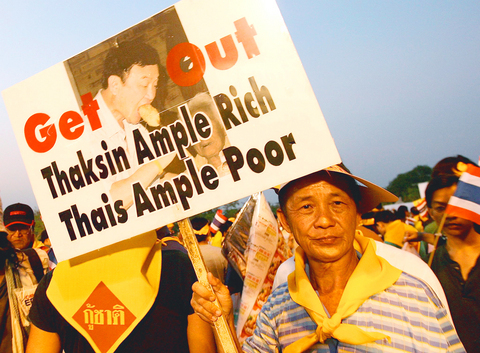
PHOTO: EPA
Police said the rally against Thaksin, which began on Saturday afternoon, had attracted about 60,000 people at its peak, though some local newspapers put the crowd at 100,000. It appeared to be Thailand's biggest political protest since 1992, when demonstrations toppled a military-backed government.
Some observers said the huge turnout should compel Thaksin to address allegations of widespread government corruption and his own ethical lapses.
"The fact that tens of thousands of people turned out to protest and shout slogans against Thaksin should unnerve him," said Vuthiphong Priebjrivat, a lecturer at several private universities. "Thaksin needs to be aware now that the stability of his government has been shaken."
During the rally, Information and Communication Technology Minister Sora-at Klinpratoom resigned without giving a reason. His resignation came a day after Culture Minister Uraiwan Thienthong stepped down, saying her decision was based on the need to uphold good governance.
But the government insisted the rally and the resignations would little affect the prime minister. The ministers were expected to be replaced anyway in an upcoming Cabinet reshuffle.
Some analysts have said rallies limited to the capital, Bangkok, wouldn't threaten Thaksin's government as long as they didn't spread to his rural base, where voters are concerned less with issues of corruption than with bread-and-butter issues like jobs and the price of daily goods.
"The protest has put serious pressure on the government," said Thitinan Pongsudhirak, a politics professor at Bangkok's Chulalongkorn University. "But it has not reached the point where the government will collapse."
Sondhi, a former supporter of the prime minister, has been holding rallies almost weekly in the capital, accusing the government of widespread corruption and abuse of power.
But this weekend's rally was Sondhi's biggest so far, with teachers, students and business people joined by throngs of curious onlookers. Sondhi led the crowd in chants of "Thaksin Get Out, Thaksin Get Out."
Protesters, who mostly filled the Royal Plaza near Parliament and the Royal Palace, said they had grown tired of Thaksin's arrogant attitude, his disdain for the press and perceived disrespect for the monarchy.
The rally got a boost after the prime minister's family sold its controlling interest in Shin Corp, a telecommunications conglomerate, to a Singaporean government company for 73.3 billion baht (US$1.9 billion).
The deal drew outrage, mainly because it was structured to allow the sellers -- Thaksin's children -- to avoid paying any taxes, and placed important national assets in the hands of foreigners.

US President Donald Trump on Wednesday threatened to take action against the EU if it moves forward with European Commission President Ursula von der Leyen’s proposal to make Canada the bloc’s first associate member. “If they do that, if I think it’s at all a hostile act; I will put very serious tariffs or stop trading with Europe on many things,” Trump told reporters en route to an event in North Carolina, calling the proposal “laughable.” “If it’s a good intention, that’s fine. If it’s a bad intention, we’ll put very heavy tariffs on Europe,” he said. Von der Leyen made the proposal

SECRET FOOTAGE: A 17-year-old girl told British broadcaster Channel 4 that she had been approached by a man who covertly recorded her and their interaction Calls are growing louder in Europe for action against “pervert” smart glasses after secretly filmed footage of girls and women appeared online — with a petition in Britain demanding a ban on their sale. Anyone wearing smart glasses can take photos, film videos, listen to music, make phone calls, translate text or interact with an artificial intelligence (AI) assistant, with sales now hitting millions. The devices grabbed attention this summer after a marketing tie-up between Kylie Jenner, beauty mogul and member of the Kardashian dynasty, and tech giant Meta. Since smartphones are now embedded in daily life, “big tech” is
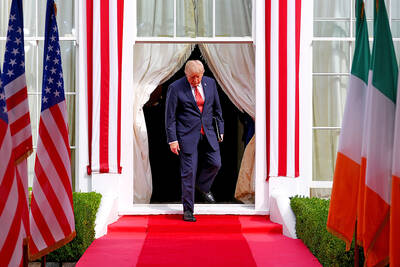
FROSTY RECEPTION: ‘I conveyed the strong view of the Irish people that the normalization of war and genocide can never be accepted,’ the Irish president said US President Donald Trump on Saturday said that he would “love to see” a united Ireland, wading into a politically sensitive subject as he embarked on a two-day Irish visit that blurs the lines between his presidency and personal business interests. After meeting Irish Prime Minister Micheal Martin in Dublin, Trump said reunification of the Republic of Ireland and Northern Ireland — split for more than a century — would be “a fantastic thing.” “It’s going to happen eventually. It may as well happen now,” he told reporters, adding that “the UK will have something to say about it, obviously.”
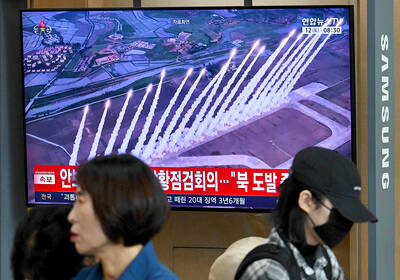
North Korea yesterday fired multiple ballistic missiles, Seoul said, a day after South Korea concluded five days of joint maritime drills with the US and Japan that were focused on the North. Pyongyang last month slammed plans for the so-called Freedom Edge joint exercises in international waters off South Korea as a “threat” to North Korea and other countries of the region. Yesterday, Seoul’s military detected “multiple short-range ballistic missiles launched from the Wonsan area toward the East Sea [the Sea of Japan],” the South Korean Joint Chiefs of Staff said in a statement. The missiles were detected at about


 RSS
RSS