


Bombs killed the country's oldest legislator and two US soldiers on the first anniversary of Iraq's sovereignty -- a day Iraqi President Jalal Talabani described as "blessed" despite the persistent violence.
More than a dozen Iraqis also were killed on Tuesday and US and Iraqi troops launched Operation Sword aimed at communities along the Euphrates River, their third major anti-insurgency campaign in Anbar province.
The campaigns have failed to stem a Sunni-dominated insurgency that has killed more than 1,360 people -- mostly civilians and Iraqi forces -- since Iraqi Prime Minister Ibrahim al-Jaafari announced his Shiite-dominated government on April 28.
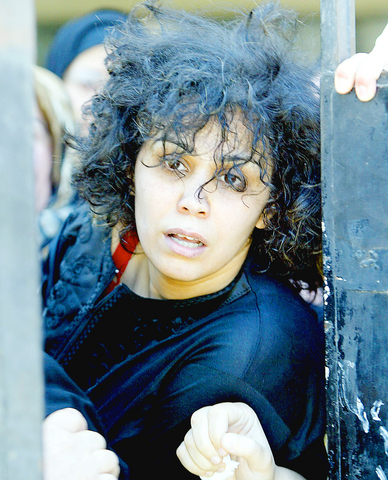
PHOTO: AFP
Talabani nevertheless praised the anniversary of the official transfer of sovereignty to the Iraqis because it led to the Jan. 30 election, the country's first free balloting in decades.
"This is a blessed day which saw the restoration of independence and national sovereignty," Talabani said after meeting US and British envoys. "But we think that the restoration of independence started after the epic, the legend, of the elections."
Those elections, however, were boycotted by the vast majority of Sunni Arabs -- either because of unwillingness or fear of the insurgency they now dominate.
Relentless attacks since al-Jaafari's government took office have sparked an escalation of sectarian tensions and fears of civil war.
National Assembly Legislator Sheik Dhari Ali al-Fayadh, his son and two bodyguards were killed when a suicide car bomber rammed his vehicle into theirs as they traveled to parliament from their farm in Rashidiya, 32km northeast of Baghdad.
Al-Fayadh, a Shiite in his late 80s, was the eldest member of the new parliament and had acted as temporary speaker. He belonged to the country's largest Shiite political party, the Supreme Council of the Islamic Revolution in Iraq, the senior partner in the governing coalition.
It marked the second political assassination in a week, coming after the June 22 killing of a prominent Sunni Arab who had been a candidate to join a committee drafting Iraq's constitution.
Al-Qaeda in Iraq, which has declared war on Shiites, claimed responsibility for al-Fayadh's assassination on an Islamic Web site. The statement's authenticity could not be verified.
Talabani said that the country would not be deterred by political assassinations and its security forces were working to eradicate the insurgency.
Efforts to include more Sunni Arabs in the political process suffered another setback on Tuesday when parliament again postponed setting up an expanded committee to draft the constitution -- which must be ready by Aug. 15 to be approved by referendum in October.
The postponement came after the committee said Sunni leaders, who nominated 15 representatives for the 71-member body, failed to endorse the list. Some objections also arose over candidates who allegedly were once senior members of former Iraqi president Saddam Hussein's outlawed Baath party.
Asked about the development, Talabani said although "we are strongly eager that the Sunni brothers be represented in the constitution committee," they should "not have one leg in the rebellion and another leg in the political process."
Also on Tuesday, a US soldier died in a suicide car bomb blast in Balad, 80km north of Baghdad, and another soldier was killed by a car bomb in Tikrit, the military said.
At least 1,743 members of the US military have died since the war began in 2003, according to an Associated Press count.
Five people were killed in a car bomb explosion in Baquba, north of Baghdad, police said.
In Musayyib, south of Baghdad, a policeman was killed when a suicide bomber wearing an explosive-laden belt blew himself up at a checkpoint, police said.
In Kirkuk, a suicide car bomber slammed into a convoy carrying traffic police chief Brigadier General Salar Ahmed, killing one of his bodyguards and a civilian, police said.
US soldiers allegedly killed an Iraqi news executive when he did not pull over as a US convoy passed in Baghdad, said Dr. Muhanad Jawad of Yarmouk Hospital. Ahmed Wael Bakri worked as a director at al-Sharqiya TV.
The US military said they were investigating. Bakri was the third Iraqi journalist allegedly killed in similar incidents in the past week.

‘CROSSING THE LINE’: China’s embassy in Seoul criticized US Forces Korea Commander General Xavier Brunson, asking if his ‘hostile’ remarks were authorized by Washington South Korea and the US are in talks over recent public remarks by the commander of US Forces Korea, Seoul’s presidential office said yesterday, after the comments drew sharp criticism from China. In a recent podcast interview, US Forces Korea Commander General Xavier Brunson described South Korea as “the dagger in the heart of Asia” from China’s east coast, prompting the Chinese embassy in Seoul to say that he had “truly crossed the line.” The interview came amid growing speculation that Washington might seek to expand the role of US Forces Korea in countering the growing regional influence of China, a key

SEEKING ORDER: Rodrigo Paz said that ‘anyone who wants to destroy the nation will have to deal with this president and the full force of the constitution’ Bolivian President Rodrigo Paz on Wednesday said that the nation was at a “breaking point” after nearly a month of protests that have caused shortages of food, fuel and medicine. Paz, who took office six months ago amid the worst economic crisis there in four decades, is battling a groundswell of fury over his policies. The political capital, La Paz, has been besieged by low-income workers and members of the indigenous majority calling for his resignation. “The country needs order and is reaching breaking point,” the 58-year-old said at a public event in La Paz, renewing his appeal for dialogue. On Tuesday, the Bolivian

Australian researchers have trained lab-grown brain cells on a silicon computer chip to play the 1990s shooter game Doom and said they are just scratching the surface of what the neurons could be capable of doing. It is the science-fiction work of biotech boffins at Cortical Labs, who researched and developed the technology that harnesses the workings of the brain’s networking system. Each so-called “biological computer” contains about 200,000 living human brain cells, grown from stem cells that were harvested from blood donations. Having mastered the simple computer game Pong, where a paddle is moved up and down to send a ball

Through the noise of rushing papers and whirring belts at a print factory in Kyoto, two creators watch their photo essay come to life in broadsheet form — part of an effort to win new audiences in the age of artificial intelligence (AI). Despite the decline of the publishing industry, self-publication and handmade “zine” magazines are growing in popularity in Japan, reflecting the nation’s enduring love of paper in the digital era. While speaking to Agence France-Presse at the plant, his hands black with ink, one of the creators, Kazuma Obara, said: “I think [paper] is a medium that engages all five


 RSS
RSS