


Black-clad, masked assailants torched a German cultural center in crisis-hit Togo, while the man officially named winner of violently contested presidential elections vowed not to let the country slip into civil war.
Opposition coordinator Yawovi Agboyibo claimed Friday that 100 people were killed and more than 300 wounded by government loyalists and security forces in violence that erupted after Sunday's poll. The claim could not be independently verified and government officials could not be reached for comment.
The International Committee of the Red Cross has said at least 11 people were killed nationwide this week and at least 100 wounded. The government has confirmed another 11 dead.
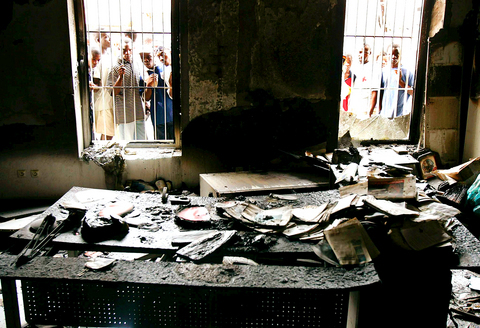
PHOTO: EPA
Agboyibo said the toll was collected from opposition officials across the country. He said the government bused about 3,000 armed loyalists from the interior to Lome to help crack down on opposition supporters.
Faure Gnassingbe, official winner of Sunday's vote, denounced the attacks of recent days and assured the world that Togo was not on the fast track to civil war -- long the destructive route of its West African neighbors.
"I have confidence in the forces of order and security and, most of all, in the political maturity and good sense of the Togolese," Gnassingbe said in remarks published Friday.
"I do not think Togo will tip into civil war," he told French daily Le Monde. "Not, at least, as long as I am at the head of this country."
Opposition leaders in Togo insisted Gnassingbe's ruling party rigged the elections and preordained a victory for Gnassingbe, the son of Togo's late dictator who died Feb. 5.
Tuesday's announcement of Gnassingbe's win sparked two days of clashes.
Daytime violence subsided Thursday in the capital, Lome, but overnight assailants had attacked a German institute promoting cross-cultural exchange -- the latest post-election violence that targeted foreigners.
The attack on the Goethe Institute in the Togolese capital was well-executed, the center's Director Herwig Kempf said.
The gunmen, dressed all in black and wearing masks, forced their way inside the center's steel gates and beat two guards before sending them running away, Kempf said, citing the guards' accounts. The gunmen then opened fire on the white, art-deco building and set fire to the first-floor library. The fire engulfed most of the building.
Gunmen also torched a van parked in the courtyard, as well as a large toolshed. No one was injured in the attack, though damage was estimated at several hundred US dollars.
Through films, book-lending and language lessons, the Goethe Institute promotes cultural exchange between Togo and Germany, Togo's one-time colonial master.
Talk had been swirling of an attack on a German institution since Togo's former Interior Minister Francois Boko fled to the German Embassy on April 22, Kempf said. Boko had been dismissed after calling for the weekend elections to be canceled for fear of bloodshed.
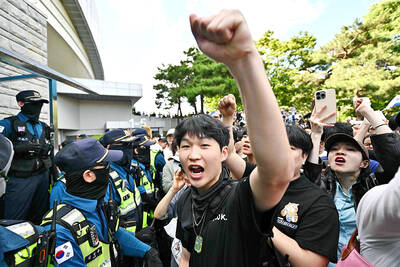
‘ABSURD MISTAKE’: The election commission said that there had been a failure to anticipate turnout after 14 polling stations ran short of ballot papers South Korean riot police yesterday cleared protesters from a Seoul polling station after a 35-hour blockade sparked by a shortage of ballot papers during local elections earlier this week. Wednesday’s election was the first nationwide vote since South Korean President Lee Jae-myung took office following the ouster of Yoon Suk-yeol over his short-lived martial law declaration. Lee’s ruling Democratic Party swept most races, but failed to flip the crucial Seoul mayoral seat. The South Korean National Election Commission apologized, blaming a failure to anticipate turnout after 14 polling stations in Seoul ran short of ballot papers. Some polling stations stayed open until 10pm to

France experienced its hottest spring on record, the French weather service said on Tuesday, after an exceptional early heat wave that also broke highs for the season in England and Wales. Meteo-France said the average nationwide temperature over March to May was 13.8°C — about 1.7°C above the norm, and surpassing records set in 2011 and 2020. “The warmest spring since records began in 1900,” it said in a bulletin. All three months were warmer than average, but the onset of an “unprecedented heatwave” late last month pushed the mercury to highs typically seen at the height of the summer. “Our country had never
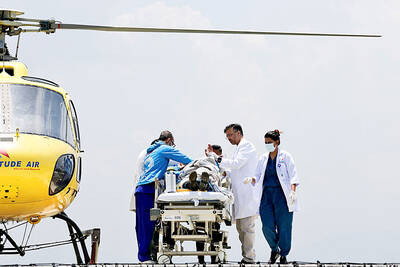
A Sherpa guide was found crawling to base camp on Mount Everest a week after he went missing and was reunited with his family, who had given up hope he would return. Dawa Sherpa was last seen on Friday last week descending the mountain, but he did not reach base camp even though his client did. The pair were among the last climbers on the mountain as the climbing season came to an end and the route was dismantled. Dawa was located by a cleaning crew on Thursday morning as he was crawling down the snowy slopes around the Khumbu Icefall, just above
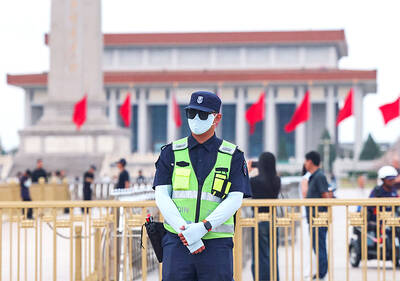
Chinese authorities are snuffing out any remembrance of the deadly 1989 military crackdown on student-led pro-democracy protests in Tiananmen Square, which happened 37 years ago yesterday, in a further tightening of a years-long campaign to erase what happened from public memory. Police told relatives of the victims they would not be allowed to visit a cemetery in Beijing on the anniversary of the crackdown, a person with knowledge of the matter said. Relatives of the victims visited the cemetery on the anniversary for more than 30 years to read memorial statements with police keeping watch, Amnesty International said. Hundreds of people,


 RSS
RSS