

US envoy Christopher Hill held consultations with China yesterday amid concerns North Korea is planning a nuclear test, as Washington works to entice the Stalinist regime back to six-party talks.
The assistant secretary of state for East Asia and the Pacific was expected to discuss ways to restart stalled multilateral talks on North Korea's nuclear weapons ambitions, a US embassy spokeswoman said.
Hill came straight from talks in Seoul and heads to Japan today before returning to South Korea for more discussions, US officials said.
"We are trying to get the six-party process going," Hill told reporters at Beijing airport. "We have got five countries that are there and one that continues to stay away, so as soon as we get the North Koreans to the talks, we look forward to vigorous negotiations."
Hill refused to put a timeframe on the resumption of talks, saying it would be easier to assess the current situation after his meetings with the Chinese side.
Chinese officials said that Hill would meet with three vice foreign ministers.
"China welcomes the visit by Mr. Hill and we are willing to exchange ideas on Sino-US relations, on the North Korean peninsula and other subjects of common interests," foreign ministry spokesman Qin Gang (
"Our wish is that all relevant parties can resume the talks soon and do more to contribute to peace and stability on the North Korean peninsula," he said in response to a question on North Korea's reported nuclear weapons test.
Three rounds of the talks that include North Korea, the US, China, Russia, Japan and South Korea have been held but the process stalled last June.
Pyongyang has cited alleged US intentions to topple its government as its primary reason for pulling out of the talks, and on Feb. 10 announced that it possessed nuclear weapons.
Earlier this month, North Korea said it had shut down its nuclear power plant at Yongbyon and was preparing to reprocess the plant's spent fuel, a move that could result in the production of enough plutonium to build up to six more nuclear bombs.
En route to Brazil on Monday, US Secretary of State Condoleezza Rice said Washington was committed to the six-party talks process, but repeated that the US reserved the right to take its case to the UN Security Council.
"At this point we are committed to a course that we have described, and that is through the six-party talks to convince the North Koreans that there is really only one route to the kind of international respect that they seem to want, and that is the course that we are on," Rice said.
The New York Times reported that Washington might seek a UN resolution empowering all nations to intercept shipments in or out of North Korea that may contain nuclear materials.
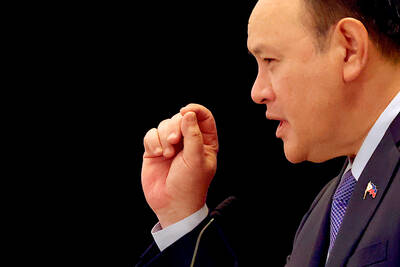
Philippine Secretary of National Defense Gilberto Teodoro Jr on Tuesday hit out at China at an international forum after a memo asserting Beijing’s position over their longstanding maritime dispute was delivered to him while he was speaking on stage. The unusual incident was captured on video at the Seoul Defense Dialogue as the secretary was responding to a question about “gray zone” coercion in the South China Sea. The video shows what appears to be a conference staffer placing it on the table next to him while speaking. “I have a note here, I think this is from China,” he said, describing
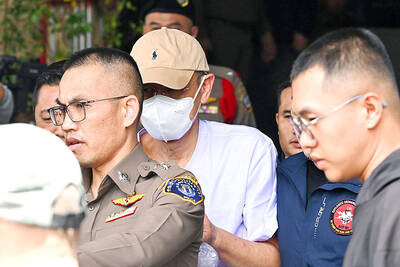
Thai police yesterday said that they arrested a senior Buddhist monk on suspicion of embezzling US$2.8 million intended for his monastery, alongside a suspected female accomplice he was having sex with. The case is the latest scandal to hit the clergy in Buddhist-majority Thailand after a sex and extortion case involving senior monks last year prompted public outrage and calls for greater scrutiny of temple finances. Phra Wachirayan Wi, the 66-year-old abbot of the 14th-century Wat Phutthaisawan in the ancient capital of Ayutthaya, was arrested on Thursday on charges including embezzlement and money laundering, lead police investigator Pattanasak Bupphasuwan said. A 47-year-old woman

SECRET FOOTAGE: A 17-year-old girl told British broadcaster Channel 4 that she had been approached by a man who covertly recorded her and their interaction Calls are growing louder in Europe for action against “pervert” smart glasses after secretly filmed footage of girls and women appeared online — with a petition in Britain demanding a ban on their sale. Anyone wearing smart glasses can take photos, film videos, listen to music, make phone calls, translate text or interact with an artificial intelligence (AI) assistant, with sales now hitting millions. The devices grabbed attention this summer after a marketing tie-up between Kylie Jenner, beauty mogul and member of the Kardashian dynasty, and tech giant Meta. Since smartphones are now embedded in daily life, “big tech” is
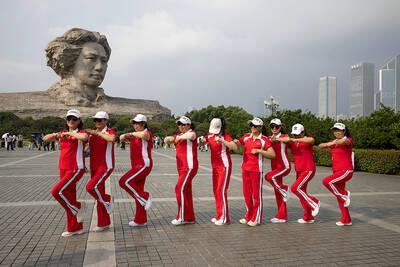
China yesterday marked half a century since the death of Mao Zedong (毛澤東), founder of the People’s Republic, who brought roughly one-quarter of the world’s population under communist rule and whose specter still haunts China’s future. Mao’s death on Sept. 9, 1976, at age 82, mourned by many and welcomed by some who suffered under his nearly three-decade rule, also hastened the end of the Cultural Revolution, a frenzied mass movement he launched in 1966. The party later condemned the Cultural Revolution as a grave error for which Mao bore primary responsibility, but still reveres him, saying his achievements outweigh his mistakes. Mao’s


 RSS
RSS