


Tokyo Governor Shintaro Ishihara is a gracious host, settling comfortably into a white leather chair and patiently listening to a question from a visitor. Then he opens his mouth, launching into a tirade.
China is "very dangerous," he thunders. Japan's critics are "just jeal-ous." Tokyo's bloody 1930s and 1940s campaigns saved Asia from colonization by "white people."
At 72, Japan's best-known nationalist politician says he's too old to pursue the prime ministership that pundits have predicted he would capture.
But in a recent interview, the co-author of 1989's The Japan That Can Say No still growls the convictions that have made him perhaps Japan's most divisive and popular political figure.
"I'd say I'm a realist," Ishihara said at Tokyo's towering City Hall. "Everyone misunderstands, though."
Even without gaining the premiership, Ishihara is far more influential than his position suggests. He leads one of the world's largest cities, with a population of 12.5 million people and an economy bigger than Canada's.
Ishihara, who gained fame as a bad-boy novelist in the 1950s, has grown more popular with time. First elected Tokyo governor in 1999, he stomped his way to re-election last year with more than 70 percent of the vote.
At the same time, Ishihara is widely vilified here and abroad for his blunt nationalist talk, criticism of immigrants and unapologetic praise of Japan's militarist past.
Outspoken in his pro-military views, he accuses China of threatening Japanese security with its territorial claims against tiny islands held by Japan.
"We should properly rebuild the military," Ishihara said. ``We don't need nuclear weapons, and even saying we should discuss that possibility would create misunderstanding. But we should protect our airspace and territorial wa-ters. We can't allow China take what they are trying to take."
Ishihara, who called for greater Japanese independence from the US in his 1989 book, has campaigned strenuously for returning to Japan's control the Yokota Air Base, now run by the US Air Force. He railed against Japan's willingness to go along with Washington, alleging Japan's Foreign Ministry was a "branch office" of the US State Department.
"Japan is a vassal of the United States," Ishihara said. "Pretty soon it will be a slave."
Riling others across Asia, Ishihara insists that Tokyo need not apologize for its bloody wartime invasions of neighbors, and argues that Japan did Asia a favor by delivering it from Western imperialism.
"If Japanese hadn't fought the white people, we would still be slaves of the white people. It would be colonization," he said.
While such blunt talk embarrasses some Japanese, supporters say Ishihara is saying out loud what many believe, but hesitate to say.
"Among Japanese leaders, Shintaro Ishihara is a rare politician who has a clear will, talks about it and is convincing," Kazuya Fukuda, a Keio University professor, wrote in a recent book about Ishihara.
Still, Ishihara's popularity in Tokyo is also based on parochial concerns. At his initiative, for example, Tokyo and three neighboring areas won high grades from voters last year by banning older diesel-powered vehicles to reduce pervasive air pollution.
Tokyoites angered by a massive public bailout to help banks overcome bad debt also cheered his attempt to slap a new tax on the banks. His move was struck down in the courts, but was later put into the national tax code.
He fans fears that illegal immigrants are behind a surge in crime and promising to deal swiftly with threats to public security.
Ishihara's government is cracking down on public school teachers who refuse to stand for the rising sun flag and national anthem because these symbols are associated with wartime militarism.
Such views on immigration and patriotism show the dark side of his popularity, said Jin Igarashi, a Hosei University professor.
"He's used the fears and frustrations of the masses to carry out antidemocratic nationalist policies and make nationalistic remarks," Igarashi said. "He's a modern fascist."
Ishihara brushes off such criticism, declaring: "I'm no fascist."
Whatever his appeal, it's unlikely Ishihara will ever be prime minister. He failed in an attempt to take control of the long-ruling Liberal Democratic Party in 1989, and his decision to run for re-election last year was taken as a sign he had scaled back his ambitions.
"I'm not young. Yesterday or the day before I pushed myself a little hard when I went diving and I almost died! That never used to happen," he said. "Younger people have to come to the fore now."

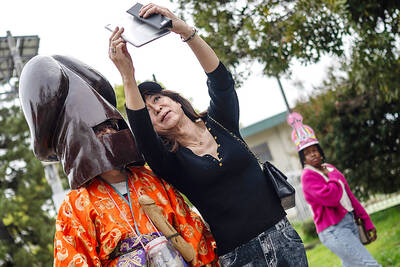
Showcasing phallus-shaped portable shrines and pink penis candies, Japan’s annual fertility festival yesterday teemed with tourists, couples and families elated by its open display of sex. The spring Kanamara Matsuri near Tokyo features colorfully dressed worshipers carrying a trio of giant phallic-shaped objects as they parade through the street with glee. The festival, as legend has it, honors a local blacksmith in the Edo Period (1603-1868) who forged an iron dildo to break the teeth of a sharp-toothed demon inhabiting a woman’s vagina that had been castrating young men on their wedding nights. A 1m black steel phallus sits in the courtyard of

JAN. 1 CLAUSE: As military service is voluntary, applications for permission to stay abroad for over three months for men up to age 45 must, in principle, be granted A little-noticed clause in sweeping changes to Germany’s military service policy has triggered an uproar after it emerged that the law requires men aged up to 45 to get permission from the armed forces before any significant stay abroad, even in peacetime. The legislation, which went into effect on Jan. 1 aims to bolster the military and demands all 18-year-old men fill out a questionnaire to gauge their suitability to serve in the armed forces, but stops short of conscription. If the “modernized” model fails to pull in enough recruits, parliament will be compelled to discuss the reintroduction of compulsory service, German
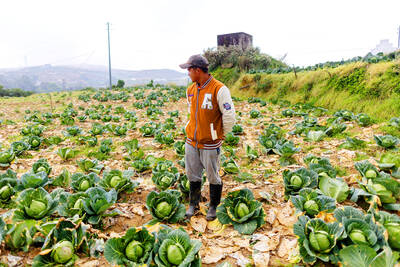
Filipino farmers like Romeo Wagayan have been left with little choice but to let their vegetables rot in the field rather than sell them at a loss, as rising oil prices linked to the Iran war drive up the cost of harvesting, labor and transport. “There’s nothing we can do,” said Wagayan, a 57-year old vegetable farmer in the northern Philippine province of Benguet. “If we harvest it, our losses only increase because of labor, transportation and packing costs. We don’t earn anything from it. That’s why we decided not to harvest at all,” he said. Soaring costs caused by the Middle East

Hungarian Prime Minister Viktor Orban’s officially declared wealth is fairly modest: some savings and a jointly owned villa in Budapest. However, voters in what Transparency International deems the EU’s most corrupt country believe otherwise — and they might make Orban pay in a general election this Sunday that could spell an end to his 16-year rule. The wealth amassed by Orban’s inner circle is fueling the increasingly palpable frustration of a population grappling with sluggish growth, high inflation and worsening public services. “The government’s communication machine worked well as long as our economic situation remained relatively good,” said Zoltan Ranschburg, a political analyst


 RSS
RSS