


The detailed surveillance photos and documents that prompted higher terror warnings came largely from a Pakistani computer engineer whose capture set Pakistani and US officials searching for those planning to harm America, and what they intend to do.
In the 72 hours leading up to Sunday's warning about new risks of terror attacks, senior officials pored over a wealth of detailed new information indicating al-Qaeda operatives were collecting chillingly precise information about five financial-services buildings in the US.
The trove of hundreds of photos, sketches and written documents came to light as a result of Pakistan's mid-July capture of Muslim extremist Mohammad Naeem Noor Khan, also known as Abu Talha.
Officials are now following investigative leads, as they try to learn more about possible plots against the apparent targets: The Citigroup Center building and the New York Stock Exchange in New York, the IMF and World Bank buildings in Washington and Prudential Financial Inc's headquarters in Newark, New Jersey.
The information amassed by the plotters "was gathered in 2000 and 2001," and "it appears that some of it may have been updated as recently as January of this year," Frances Townsend, the White House homeland security adviser, said on PBS' NewsHour With Jim Lehrer.
But, she added, "you can't tell from the intelligence itself whether or not those individuals [who amassed it] are still here."
On Monday, a Pakistani intelligence official said Khan, a computer and communications expert, had sent messages to suspected al-Qaeda members using code words -- a practice typical of the international jihadist organization that bedeviled US efforts to unravel the Sept. 11, 2001, plot. But the Pakistani official refused to say if Khan was part of al-Qaeda.
Khan's information has been merged with other pieces of intelligence, including information gleaned after Pakistan's arrest last month of a senior al-Qaeda operative named Ahmed Khalfan Ghailani.
E-mails that included plans for new attacks in Great Britain and the US were found on the computer of the captured Ghailani, Pakistan's information minister, Sheikh Rashid Ahmed, said Monday. But it was Khan and the information found after his arrest that was mostly behind the decision to raise the terror alert for the financial-services buildings in New York, Washington and northern New Jersey.
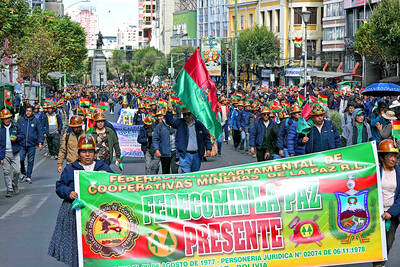
The Bolivian government on Friday struck a deal with protesting miners, but was still grappling with blockades and demonstrations by other workers across La Paz. Other groups are still blocking access roads into the city, which is also the seat of the government. Police on Thursday prevented the miners from entering the main square by using tear gas, while the demonstrators hurled stones and explosives with slingshots. Protests against the policies of Bolivian President Rodrigo Paz have convulsed the Andean nation since early this month, and roadblocks were choking routes into La Paz throughout Friday, the national road authority said. Miners demanded that Paz
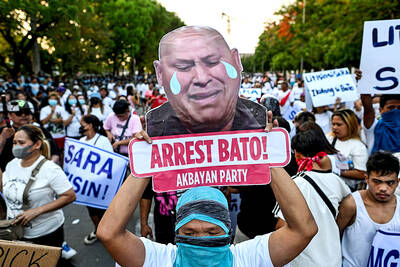
The Philippines said it has asked the country’s Supreme Court to allow it to arrest former Philippine president Rodrigo Duterte’s chief drug war enforcer to stand trial in an international tribunal. The International Criminal Court (ICC) last week unsealed an arrest warrant against Philippine Senator Ronald dela Rosa, accusing him along with Duterte and other “coperpetrators” of the “crime against humanity of murder.” Dela Rosa briefly sought refuge in the Philippine Senate last week while asking the Philippine Supreme Court to stop an ongoing attempt by government agents to arrest him. “By his own conduct, he has placed himself outside the protection of
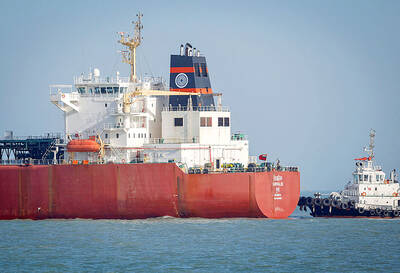
A ship anchored off the United Arab Emirates (UAE) was seized and taken toward Iran and another — a cargo ship near Oman — sank after being attacked, authorities said on Thursday, as tensions escalated near the Strait of Hormuz. It was not immediately clear who was behind these incidents, but they happened as a senior Iranian official reiterated his country’s claim of control over the waterway and another said it had a right to seize oil tankers connected to the US. The turmoil in the strait has been a sticking point for weeks in talks between the US and Iran to
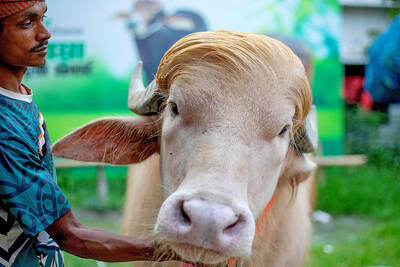
Crowds in Bangladesh are flocking to snap photographs with an unlikely social media star — an albino buffalo with flowing blond hair nicknamed “Donald Trump” that is due to be sacrificed within days. Owner Zia Uddin Mridha, 38, said his brother named the 700kg bull over its flowing helmet of hair resembling the signature look of the US president. “My younger brother picked this name because of the buffalo’s extraordinary hair,” he said at his farm in Narayanganj, just outside the capital, Dhaka. Mridha said that a constant stream of curious visitors — social media fans, onlookers and children — have come throughout


 RSS
RSS