


Landslides triggered by heavy rains buried at least 12 people in their homes while six people drowned in surging river waters as floods rav-aged parts of South Asia yesterday.
More than seven million people have been marooned or left homeless in villages and towns across eastern India, Nepal and Bangladesh after annual monsoon floods inundated large tracts of land.
Government helicopters brought packages of food and relief material such as tarpaulin sheets to thousands of villagers in Nepal and India where thousands were stranded on rooftops.
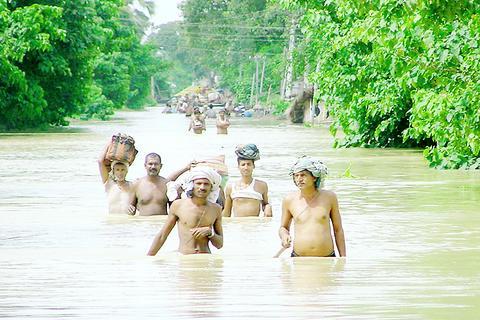
PHOTO: AFP
Close to 170 people have died in densely-populated South Asia since the start of July as heavy monsoon rains set off landslides and caused dozens of rivers to overflow.
Officials in India's Assam state, where two million people have lost their homes because of flooding, said they found it hard to cope with the sheer scale of flooding.
"The state is not adequately equipped to handle the rescue and relief operations," said Tarun Gogoi, the chief minister who appealed for international assistance on Monday.
People negotiated flooded areas of Assam in boats made from the trunks of banana trees and bamboos, and loaded with clothes and cooking utensils.
In some flooded areas of Bangla-desh, overflowing rivers submerged crops and cut rail and road links, pushing up food prices.
Twenty-five of the country's 64 districts have been hit by flooding and millions marooned. Officials fear outbreaks of water-borne diseases as thousands of drinking wells have been submerged.
Most of the deaths were in Nepal, where 12 people were killed in landslides in the east, pushing to 48 the impoverished nation's death toll from landslides, drowning and snake bites this season. Floodwaters have washed away bridges and felled electrical lines, although in other areas waters were receding.
"Though water levels have fallen, people are scared to return home as they fear their mud and brick houses will collapse," resident Brij Kumar Yadhav said in Janakpur, 450km east of Kathmandu.
The region's monsoon, which has yet to provide good rains to south and central India, is vital for the farm-dependent economies.
About 3.7 million people have been displaced with an estimated 3,200 villages under water, a flood control official said.
The Brahmaputra River, which criss-crosses the state of Assam, was flowing at least 1.5m to 2.6m above the danger level.
"We are trying our best to provide food and medicines to the victims. But then as we all know, it is next to impossible to meet the needs of millions of flood-hit people," Assam Health Minister Bhumidhar Barman said.
Floods and landslides have also hit the neighboring Himalayan kingdom of Bhutan, where a dozen bridges have been washed away.
Meanwhile, floodwaters Tuesday entered the Kaziranga Wildlife Sanctuary in Assam, forcing scores of endangered animals to flee.
The 430-square-kilometer park east of Guwahati is home to the world's largest concentration of one-horned rhinoceros. There are an estimated 1,600 rhinos at Kaziranga out of a total world population of some 2,300.
"Herds of elephants, deer, wild buffaloes and rhinos from the park are migrating to an adjoining hill for safety," another park official said.
Park officials said they were also worried about poachers killing animals, especially rhinos and elephants, as the animals move out of the sanctuary.

‘ABSURD MISTAKE’: The election commission said that there had been a failure to anticipate turnout after 14 polling stations ran short of ballot papers South Korean riot police yesterday cleared protesters from a Seoul polling station after a 35-hour blockade sparked by a shortage of ballot papers during local elections earlier this week. Wednesday’s election was the first nationwide vote since South Korean President Lee Jae-myung took office following the ouster of Yoon Suk-yeol over his short-lived martial law declaration. Lee’s ruling Democratic Party swept most races, but failed to flip the crucial Seoul mayoral seat. The South Korean National Election Commission apologized, blaming a failure to anticipate turnout after 14 polling stations in Seoul ran short of ballot papers. Some polling stations stayed open until 10pm to

France experienced its hottest spring on record, the French weather service said on Tuesday, after an exceptional early heat wave that also broke highs for the season in England and Wales. Meteo-France said the average nationwide temperature over March to May was 13.8°C — about 1.7°C above the norm, and surpassing records set in 2011 and 2020. “The warmest spring since records began in 1900,” it said in a bulletin. All three months were warmer than average, but the onset of an “unprecedented heatwave” late last month pushed the mercury to highs typically seen at the height of the summer. “Our country had never

A Sherpa guide was found crawling to base camp on Mount Everest a week after he went missing and was reunited with his family, who had given up hope he would return. Dawa Sherpa was last seen on Friday last week descending the mountain, but he did not reach base camp even though his client did. The pair were among the last climbers on the mountain as the climbing season came to an end and the route was dismantled. Dawa was located by a cleaning crew on Thursday morning as he was crawling down the snowy slopes around the Khumbu Icefall, just above
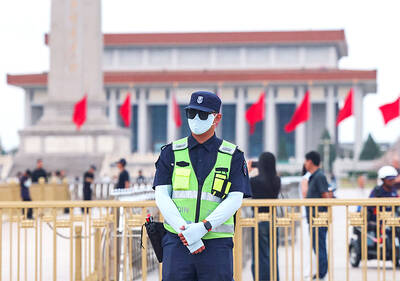
Chinese authorities are snuffing out any remembrance of the deadly 1989 military crackdown on student-led pro-democracy protests in Tiananmen Square, which happened 37 years ago yesterday, in a further tightening of a years-long campaign to erase what happened from public memory. Police told relatives of the victims they would not be allowed to visit a cemetery in Beijing on the anniversary of the crackdown, a person with knowledge of the matter said. Relatives of the victims visited the cemetery on the anniversary for more than 30 years to read memorial statements with police keeping watch, Amnesty International said. Hundreds of people,


 RSS
RSS