


A Syrian Muslim cleric called for national unity on Friday following a week of clashes between Arabs and Kurds that left 25 people dead and more than 100 wounded in northern Syrian towns.
Salah Kuftaro, the son of Syria's Grand Mufti Ahmad Kuftaro, said in a Friday sermon that the riots were a "strange phenomenon" that should not be generalized.
"The Kurds must not be viewed as troublemakers," said Kuftaro, imam of the Abu al-Nour Mosque in Damascus. "The Kurds are honest citizens and we will not allow [anybody] to say Arabs and Kurds. We are all Syrians."
The violence began March 12 with a brawl between supporters of rival soccer teams before a match in Qamishli, 775km northeast of Damascus. One team had many Kurdish players, the other had Arab players.
The fighting continued the next day when Kurds went on the rampage during a funeral for the riot victims, and it spread to Hasakah, a city 80km southwest of Qamishli.
On Tuesday, Kurds battled Arab policemen in Syria's second biggest city, Aleppo, 320km north of Damascus, and the nearby town of Afreen.
In the government's first report on casualties, Syrian Interior Minister Ali Hammoud said Thursday that a total of 25 people were killed in the violence, 19 of them in Hasakah and nearby cities and six in Aleppo.
The government has blamed the violence on what it calls "mobs and opportunists" who have been influenced from abroad, and Kuftaro repeated those claims.
"We are subjected to a major conspiracy that aims to harm us from inside after the failure of external plots," Kuftaro said. "Syria has long been an example of national coherence."
Also Friday, hundreds of Kurds demonstrated in a suburb near Damascus denouncing what they called "some demagogues who infiltrated Syrian areas" during last week's clashes.
Participants in the apparently pro-government march in the predominantly Kurdish suburb of Dumar, 8km west of Damascus, affirmed their adherence to national unity and condemned "threats and pressures" against their country.
The Al-Thawra government newspaper called on the government to act firmly against "any move or behavior that may harm national unity."
Kurds comprise about 1.5 million of Syria's 18.5 million people and live mostly in the underdeveloped provinces of Qamishli and Hasakah.
In a statement faxed to reporters, the New York-based Human Rights Watch criticized the Syrian government's handling of the riots and said it should take immediate steps to curb excessive use of force and halt mass arrests following the unrest.
"Syria's Kurds have endured decades of severe discrimination under Baath Party rule," said Joe Stork, acting executive director of the Middle East and North Africa division of Human Rights Watch.
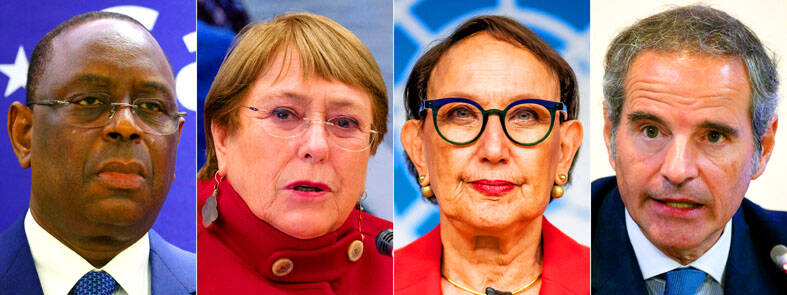
Four contenders are squaring up to succeed Antonio Guterres as secretary-general of the UN, which faces unprecedented global instability, wars and its own crushing budget crisis. Chile’s Michelle Bachelet, Argentina’s Rafael Grossi, Costa Rica’s Rebeca Grynspan and Senegal’s Macky Sall are each to face grillings by 193 member states and non-governmental organizations for three hours today and tomorrow. It is only the second time the UN has held a public question-and-answer, a format created in 2016 to boost transparency. Ultimately the five permanent members of the UN’s top body, the Security Council, hold the power, wielding vetoes over who leads the

A humanoid robot that won a half-marathon race for robots in Beijing on Sunday ran faster than the human world record in a show of China’s technological leaps. The winner from Honor, a Chinese smartphone maker, completed the 21km race in 50 minutes and 26 seconds, said a WeChat post by the Beijing Economic-Technological Development Area, also known as Beijing E-Town, where the race began. That was faster than the human world record holder, Ugandan Jacob Kiplimo, who finished the same distance in about 57 minutes in March at the Lisbon road race. The performance by the robot marked a significant step forward

An earthquake registering a preliminary magnitude of 7.7 off northern Japan on Monday prompted a short-lived tsunami alert and the advisory of a higher risk of a possible mega-quake for coastal areas there. The Cabinet Office and the Japan Meteorological Agency said there was a 1% chance for a mega-quake, compared to a 0.1% chance during normal times, in the next week or so following the powerful quake near the Chishima and Japan trenches. Officials said the advisory was not a quake prediction but urged residents in 182 towns along the northeastern coasts to raise their preparedness while continuing their daily lives. Prime
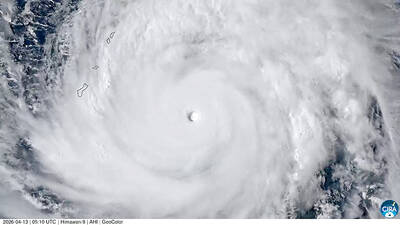
HAZARDOUS CONDITION: The typhoon’s sheer size, with winds extending 443km from its center, slowed down the ability of responders to help communities, an official said The US Coast Guard was searching for six people after losing contact with their disabled boat off the coast of Guam following Typhoon Sinlaku. The crew of the 44m dry cargo vessel, the US-registered Mariana, on Wednesday notified the coast guard that the boat had lost its starboard engine and needed assistance, Petty Officer 3rd Class Avery Tibbets said yesterday. The coast guard set up a one-hour communication schedule with the vessel, but lost contact on Thursday. A Coast Guard HC-130 Hercules aircraft was launched to search for the six people on board, but it had to return to Guam because of


 RSS
RSS