

Just as bizarrely as he disappeared last week, a Russian presidential candidate reappeared on Tuesday, alive and well, if obviously wan and confused about the fuss he had caused.
"I decided last week to take a break from all the bustle around me," the politician, Ivan Rybkin, told the Interfax news agency from Kiev, the capital of Ukraine, by way of explaining his disappearance, which terrified his family and his campaign aides and prompted a police manhunt.
"I left fruit and money for my wife, who is now occupied with the grandchildren," he said, "but didn't say anything to her, changed my jacket, got on the train and left for Kiev."
Rybkin, a former speaker of parliament who is one of six candidates standing against President Vladimir Putin in an election now barely a month away, returned on Tuesday night to Sheremetyevo Airport, outside Moscow. There he faced a group of waiting journalists and only deepened the mystery of his abrupt hiatus.
"Such tyranny as now, I have not seen or experienced in my 15 years in politics," he said, echoing an anti-Putin theme he raised with increasing vigor in the days before he disappeared. Then he went on: "Tyranny is tyranny. Tyranny in Africa is tyranny, only there they eat people."
Rybkin's whereabouts managed to roil, if briefly and in the end farcically, a political race whose outcome is universally considered a foregone conclusion.
But the issues he hoped to raise against Putin -- such as the state of democracy and liberal reforms in today's Russia -- have been drowned out in the furor following his disappearance.
His disappearance raised fears that something untoward had happened to him, prompting speculation that he had been a victim of politically motivated violence. In the days before he left, he openly criticized Putin for cultivating close ties with business tycoons and eroding democratic freedoms in Russia.
In brief remarks before driving from the airport in a van, Rybkin expressed contrition over the anxiety he had caused his family and campaign workers, and suggested that he might soon end his presidential campaign, which was a longer-than-long shot from the start.
Rybkin was never going to defeat Putin, but Kseniya Ponomaryova, Rybkin's campaign chairwoman, said his actions had done "a lot of harm" to his campaign and his credibility. She said she was pleased he was safe, but did not expect to continue to work for his campaign.
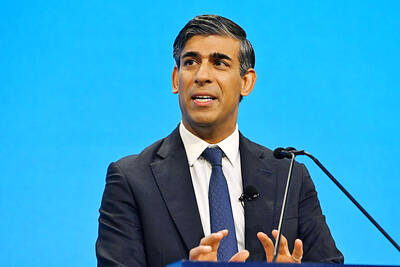
Former British prime minister Rishi Sunak on Wednesday urged so-called middle powers to become a “poisonous shrimp” to carve out strategic economic leverage in a more turbulent global environment. Sunak drew from a metaphor by former Singaporean prime minister Lee Kuan Yew (李光耀): A big fish will eat a smaller fish, and the smaller fish will eat the shrimp. Lee made the point a year after the Asian nation’s independence in 1966 that the city-state needed to build up its defense mechanisms — like a shrimp that stings — so it would be left alone by predators. “He was thinking about what Singapore’s

POLL POSITION: Democrats criticized the timing of the raid, saying that the US justice department historically avoids public investigations within 60 days of an election Federal agents on Monday searched the home of Democratic US Representative Ilhan Omar, a startling escalation in a criminal investigation that brings renewed focus to the frequent target of White House derision in the final weeks of her re-election bid. The search of the Minnesota congresswoman’s home so close to next month’s midterm contests that would determine control of the US House and the Senate was swiftly condemned by top Democrats in Congress, who raised questions about the timing given longstanding US Department of Justice (DOJ) protocol to avoid overt investigative steps involving political candidates in the direct run-up to an

A Rhode Island pumpkin grower appears to have broken the world record for the heaviest pumpkin, with his giant squash topping the record by nearly 136kg. Ron Wallace of Greene, Rhode Island, weighed his pumpkin on Saturday at a contest in New England and is waiting for the Guinness World Records to confirm he smashed the record, set about a week earlier by a grower in England. Wallace said he has been in contact with Guinness officials who say his record is on track to be verified. “It’s truly massive, it was a pleasure to grow,” Wallace said on Monday. Guinness World Records lists

BUILDUP: The report comes as Japanese Prime Minister Sanae Takaichi boosts defense spending in the face of China’s military expansion and the North Korean threat French defence contractor Thales will establish a maintenance and operational support base in Japan in what is seen as the first such move by a foreign firm in the country, a report said yesterday. Thales chairman and CEO Patrice Caine told the Nikkei business daily that the base “will mark a milestone toward Thales’ long-term engagement in Japan.” It is believed to be the first time a foreign defense company has established a dedicated base in Japan for the maintenance and operation of Japanese defense equipment, the Nikkei said. It added that Thales might also expand its Japan-based business to


 RSS
RSS