


Filipinos love to drink Eduardo Cojuangco's beer and eat his food, but his other role as a political godfather is having a much more divisive effect as the country gears up for a volatile election campaign.
The 68-year-old chairman of San Miguel Corp, seller of nine of 10 beers in the Philippines, kept a stony silence throughout a recent battle over the impeachment of the top judge that brought the country to the edge of a constitutional crisis.
But the fact that his own political machine launched the attempt to impeach Chief Justice Hilario Davide has left few Filipinos in doubt that he was pulling the strings.
The impeachment was stopped in its tracks last week when a majority of lawmakers agreed with a Supreme Court decision that it was unlawful.
The question now is -- how will Cojuangco react?
The answer could have a major bearing on next May's election when Filipinos go to the polls to choose a president for the first time in six years.
Analysts say that Cojuangco, a close enough friend of late dictator Ferdinand Marcos to have flown into exile with him in 1986, seems to be backing away from making a personal bid for the presidency. The only time he tried in 1992, he was thrashed by Fidel Ramos.
But he undoubtedly has the financial muscle and political connections to be a kingmaker, and the bitter impeachment row may have driven him further away from President Gloria Macapagal Arroyo.
"Many who know him would agree that he is like Don Corleone himself in Mario Puzo's The Godfather in that Cojuangco runs a tight ship, works quietly, moves with very little visibility but packs a lot of power," said William Esposo, a leader of a political action group critical of Arroyo.
His supporters say Cojuangco's no-nonsense business skills are just what the Philippines needs after years of economic mismanagement that have seen the country overtaken by its more dynamic neighbors and left millions mired in poverty.
They see him as a strong businessman coming to the rescue of a troubled nation -- a Philippine version of Thai Prime Minister Thaksin Shinawatra or Italy's Silvio Berlusconi.
Cojuangco's Nationalist People's Coalition (NPC) has been in a very loose alliance with Arroyo's ruling party for three years, often acting in opposition. The failure to have Davide impeached could prompt "The Boss," as friends and employees call him, to back another political horse.
Analysts believe Cojuangco is determined to oust Davide, during whose tenure the Supreme Court has issued several unfavorable rulings on a multi-billion-peso coconut levy fund that was used to buy a bank and shares in San Miguel.
Soon after Marcos was overthrown, the new government sequestered a 47 percent block of shares in San Miguel on suspicion it had been amassed using funds illegally collected from coconut farmers during his dictatorial rule.
Of this stake, Cojuangco has claimed about 20 percent as his own investment. The other 27 percent is claimed by coconut farmers and a private coconut producers' group.
Since the legal battle for control of the coconut levy fund began in 1987, Cojuangco has won victories at the anti-graft court only to suffer bitter reversals at the Supreme Court.
On December 2001, the Supreme Court issued a landmark ruling that the coconut levy fund was public, or, in other words, belonged to the Philippine people. It ordered the anti-graft court to finally settle the case.
Cojuangco backed the successful 1998 presidential campaign of Joseph Estrada. In 2001 the former movie star -- nicknamed Erap -- was ousted in a Catholic Church-backed uprising after allegations that he had plundered state funds and Arroyo, his vice-president, took over.
"What Cojuangco cares about is himself and his financial empire, which bankrolled Erap to victory in 1998 and could bankroll another winner in 2004," wrote Ana Marie Pamintuan in the Philippine Star newspaper.
"But Cojuangco's finances -- and his hold on San Miguel -- will depend a great deal on decisions that will be made by the Supreme Court," Pamintuan said.
Cojuangco has deftly mixed business with politics since his younger years in Tarlac province, north of Manila, where he grew up on his father's sugarcane farm.
Many believe it is Cojuangco's business interests that will force him again to wade into the country's murky political waters, most likely on the side of the opposition.

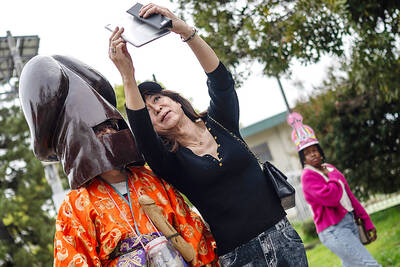
Showcasing phallus-shaped portable shrines and pink penis candies, Japan’s annual fertility festival yesterday teemed with tourists, couples and families elated by its open display of sex. The spring Kanamara Matsuri near Tokyo features colorfully dressed worshipers carrying a trio of giant phallic-shaped objects as they parade through the street with glee. The festival, as legend has it, honors a local blacksmith in the Edo Period (1603-1868) who forged an iron dildo to break the teeth of a sharp-toothed demon inhabiting a woman’s vagina that had been castrating young men on their wedding nights. A 1m black steel phallus sits in the courtyard of

JAN. 1 CLAUSE: As military service is voluntary, applications for permission to stay abroad for over three months for men up to age 45 must, in principle, be granted A little-noticed clause in sweeping changes to Germany’s military service policy has triggered an uproar after it emerged that the law requires men aged up to 45 to get permission from the armed forces before any significant stay abroad, even in peacetime. The legislation, which went into effect on Jan. 1 aims to bolster the military and demands all 18-year-old men fill out a questionnaire to gauge their suitability to serve in the armed forces, but stops short of conscription. If the “modernized” model fails to pull in enough recruits, parliament will be compelled to discuss the reintroduction of compulsory service, German
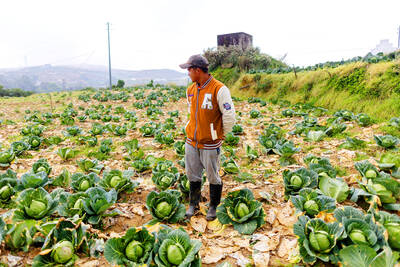
Filipino farmers like Romeo Wagayan have been left with little choice but to let their vegetables rot in the field rather than sell them at a loss, as rising oil prices linked to the Iran war drive up the cost of harvesting, labor and transport. “There’s nothing we can do,” said Wagayan, a 57-year old vegetable farmer in the northern Philippine province of Benguet. “If we harvest it, our losses only increase because of labor, transportation and packing costs. We don’t earn anything from it. That’s why we decided not to harvest at all,” he said. Soaring costs caused by the Middle East
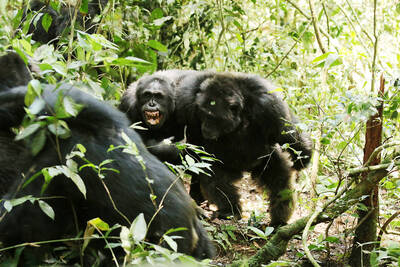
For two decades, researchers observed members of the Ngogo chimpanzee group of Kibale National Park in Uganda spend their days eating fruits and leaves, resting, traveling and grooming in their tropical rainforest abode, but this stable community then fractured and descended into years of deadly violence. The researchers are now describing the first clearly documented example of a group of wild chimpanzees splitting into two separate factions, with one launching a series of coordinated attacks against the other. Adult males and infants were targeted, with 28 deaths. “Biting, pounding the victim with their hands, dragging them, kicking them — mostly adult males,


 RSS
RSS