


The German-Czech border region has become a haven for child prostitution, where youngsters and infants from across eastern Europe are often sold into sex slavery by their families to be abused by German sex tourists and paedophiles, UNICEF said on Tuesday.
Prostitution rings are bringing minors from throughout the Czech Republic and other central and eastern European countries to the German border, according to a study presented in Berlin by the UN children's organization and ECPAT, an anti-child exploitation group.
"It is shocking that children right in our backyard are being mistreated unscrupulously," UNICEF patron Christina Rau, wife of German President Johannes Rau, told reporters.
"We must do everything to help the victims and protect other children from these crimes."
But Czech Prime Minister Vladimir Spidla said the report was "unrealistic" and did "not correspond to reality".
German police psychologist Adolf Gallwitz said the border region had become "the biggest brothel in Europe," adding that paedophilia there was "increasing at an incredible rate."
"The Czech Republic is becoming a discount market for sex with children," he said.
Gallwitz estimated there were about 100,000 German sex tourists who travel to the Czech Republic, about half of whom were interested in children.
The head of UNICEF in Germany, Reinhard Schlagintweit, said both the German and Czech governments had failed to do enough to combat child exploitation in the region and that authorities there had long turned a blind eye to the problem.
The author of the report, Cathrin Schauer, from the regional aid project KARO, has studied the problem in the region since 1996, observing 500 children and youths who either offered themselves as prostitutes or were being pimped by their parents.
KARO also spoke to some 200 children who had escaped the sex trade, older prostitutes, social workers and police officers working on the border.
Schauer and her team of researchers found that bus stops, petrol stations and rest stops on the German-Czech border area had been converted into "bazaars" for eastern European child prostitutes and mainly German men.
"In some districts, they wait in cars or apartment windows. Women with small children in their arms look out for sex tourists and hand the children over into cars," the study said.
Schauer said the victims were often from large families and driven to prostitution by desperate poverty. Many had already been subjected to sexual abuse by their families and some were themselves the children of sex workers.
"I used to beg the Germans for money in their cars," the study quoted a 12-year-old girl as saying. "We have no money at home. Then I started going off with the drivers."
Schauer said that children from the age of eight had been seen negotiating over sex practices and prices.
The children were generally paid between five and 25 euros (between US$6 and US$30). Sometimes they were only given sweets. Violence and even torture were common.
The pimps generally came from the Czech Republic or Slovakia but occasionally included Vietnamese immigrants, according to the study.
Schauer said most of the paedophiles came from the German states of Bavaria and Saxony, directly on the Czech frontier, but demand seemed to be spreading to the rest of the country as well as Austria and Italy.


Showcasing phallus-shaped portable shrines and pink penis candies, Japan’s annual fertility festival yesterday teemed with tourists, couples and families elated by its open display of sex. The spring Kanamara Matsuri near Tokyo features colorfully dressed worshipers carrying a trio of giant phallic-shaped objects as they parade through the street with glee. The festival, as legend has it, honors a local blacksmith in the Edo Period (1603-1868) who forged an iron dildo to break the teeth of a sharp-toothed demon inhabiting a woman’s vagina that had been castrating young men on their wedding nights. A 1m black steel phallus sits in the courtyard of

JAN. 1 CLAUSE: As military service is voluntary, applications for permission to stay abroad for over three months for men up to age 45 must, in principle, be granted A little-noticed clause in sweeping changes to Germany’s military service policy has triggered an uproar after it emerged that the law requires men aged up to 45 to get permission from the armed forces before any significant stay abroad, even in peacetime. The legislation, which went into effect on Jan. 1 aims to bolster the military and demands all 18-year-old men fill out a questionnaire to gauge their suitability to serve in the armed forces, but stops short of conscription. If the “modernized” model fails to pull in enough recruits, parliament will be compelled to discuss the reintroduction of compulsory service, German
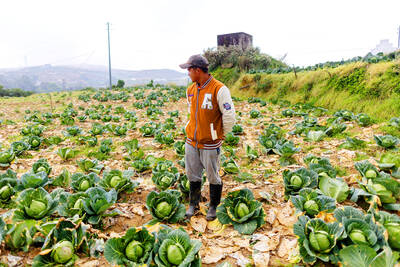
Filipino farmers like Romeo Wagayan have been left with little choice but to let their vegetables rot in the field rather than sell them at a loss, as rising oil prices linked to the Iran war drive up the cost of harvesting, labor and transport. “There’s nothing we can do,” said Wagayan, a 57-year old vegetable farmer in the northern Philippine province of Benguet. “If we harvest it, our losses only increase because of labor, transportation and packing costs. We don’t earn anything from it. That’s why we decided not to harvest at all,” he said. Soaring costs caused by the Middle East

Hungarian Prime Minister Viktor Orban’s officially declared wealth is fairly modest: some savings and a jointly owned villa in Budapest. However, voters in what Transparency International deems the EU’s most corrupt country believe otherwise — and they might make Orban pay in a general election this Sunday that could spell an end to his 16-year rule. The wealth amassed by Orban’s inner circle is fueling the increasingly palpable frustration of a population grappling with sluggish growth, high inflation and worsening public services. “The government’s communication machine worked well as long as our economic situation remained relatively good,” said Zoltan Ranschburg, a political analyst


 RSS
RSS