


Police fired rubber bullets and tear gas at Palestinian demonstrators protesting an Israeli security barrier in the West Bank on Monday, and police found the body of a soldier they suspect was kidnapped and killed by Arabs.
The protest came ahead of a summit between Israeli Prime Minister Ariel Sharon and US President George W. Bush yesterday. The two will discuss how to move ahead with the US-backed "road map" peace plan that calls for a Palestinian state by 2005.
About 200 people -- 140 Palestinians and 60 foreign supporters -- protested at the security fence 15km west of the West Bank town of Jenin on Monday.
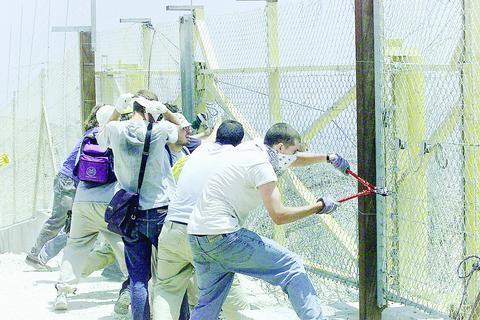
PHOTO: AFP
Several tried to cut or push through the fence, and Israeli soldiers fired rubber bullets and tear gas at them, dispersing the crowd. One of the foreigners was wounded in the leg and was taken to a hospital. There were no arrests.
The security fence is a major sticking point between Israelis and Palestinians. Israelis say the barrier, which is still being constructed, is needed to stop militants from entering into Israel to carry out attacks.
The Israeli newspaper Maariv reported on Monday that Israel would offer to freeze construction of a section of the fence that drives deep into the West Bank, but a government spokesman called the report "speculations."
"The prime minister will explain to President Bush the need for the fence, which is only security-related and is not supposed to create a political border," Sharon aide Avi Pazner said.
The barrier sweeps into Palestinian areas of the West Bank to encircle Jewish settlements, and Palestinians say the project amounts to a land-grab that cuts them off from agricultural fields, towns and jobs. Bush has suggested that the project hinders Mideast confidence-building.
In violence early yesterday, Palestinians opened fire on an Israeli car near the Jewish settlement of Itzhar in the West Bank, slightly wounding an 11-year-old girl, the rescue service said. She was treated at a local clinic and then taken to a hospital.
Israeli police on Monday found the body of a soldier who had been missing for a week, and the investigation focused on suspicions he was kidnapped and killed by Arabs.
The body of Oleg Shaichat, 20, who disappeared July 21, was found buried in northern Israel, said police spokesman Gil Kleiman. Hundreds of police, soldiers and volunteers had been searching for him.
Police suspected that Shaichat had been abducted by Arabs. Security officials have warned they have intelligence warnings of militants' intentions to kidnap Israeli soldiers.
"We are talking about a murder with nationalist motives," said Yaakov Borovski, northern region police commander, using a Hebrew euphemism for terrorism.
"We cannot say at the moment who the killers are or if we are talking about Israeli Arabs or people from the territories," he said, referring to the West Bank and Gaza Strip.
Defense Minister Shaul Mofaz said late Monday that Shaichat was "murdered in cold blood ... immediately after being kidnapped."
Shaichat's disappearance followed the kidnapping of an Israeli taxi-driver by Palestinians on July 11. The cabbie was later freed by Israeli commandos, and officials said main Palestinian militant groups were not involved.
Shaichat was last seen by a fellow hitchhiker traveling in a car near the biblical village of Cana in the Galilee, on his way to his home in a nearby Jewish suburb of Nazareth, Israel's largest Arab city.
His gun was missing when he was found, Israel Radio reported. No public ransom demands or claims of responsibility have been made in the case.
In Gaza City, about 400 people protested peacefully, calling for the release of all 7,700 Palestinians in Israeli jails, many for alleged roles in terror attacks.
The prisoners have become a top rallying point for Palestinians. Israel has released about 250 prisoners and is preparing to release a reported 600 more in coming days; Palestinian officials call for a wider mass release.
The main Palestinian militant groups declared a ceasefire on June 29 after nearly three years of violence, but progress on the road map has been slowed by disagreement between Israel and the Palestinians over what should be the next step.
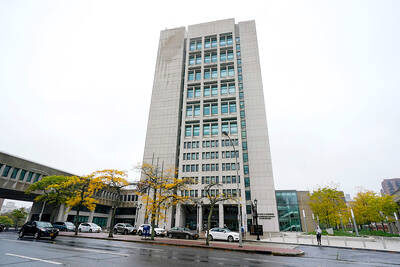
A coalition of civil rights groups on Tuesday asked a New York State judge to order one of its largest suburban counties to stop its deployment of nearly 600 license plate readers, calling it a warrantless and “indiscriminate surveillance system” that violates the state constitution. The class action lawsuit also alleged that Westchester County never got proper authorization to launch the program, which has amassed a database of 1.6 billion plate scans that has been shared with more than 50 outside law enforcement agencies. The complaint said the network “records the long-term travel patterns, daily habits, and intimate information of millions of

Pope Leo XIV on Wednesday blessed a giant new tower at Barcelona’s famed Sagrada Familia Basilica after celebrating mass inside what is now the world’s tallest church. A fireworks and light show illuminated the exterior of the temple at the end of the ceremony, bathing the unfinished basilica in shifting colours that highlighted its towering spires. A choir of 600 singers performed at the service which lasted around 90 minutes and was attended by Spanish Prime Minister Pedro Sanchez as well as King Felipe VI and Queen Letizia. The stained-glass windows in various colours shone brightly in between the tree-like

Voters in Switzerland yesterday cast their ballots on an initiative championed by the top right-wing party to cap the Alpine country’s population at 10 million. As of press time last night, early results showed that Swiss voters were leaning against it. The populist Swiss People’s Party, which has the most seats in parliament, has stirred up and fostered anti-migration sentiment over the years, notably about an influx of workers from the neighboring EU. Critics called the bid a self-inflicted wound, saying the boom in migration over the past generation has brought foreign labor and skills to sectors such as healthcare, finance, pharmaceuticals
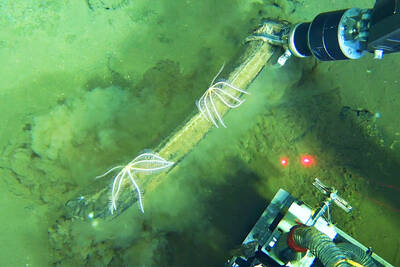
Scientists have discovered communities of marine life — including jellyfish, tubeworms and brittle stars — thriving on a whale graveyard. The graveyards form when whale carcasses fall to the sea floor, becoming a sustaining snack for nearby critters. This one, which is up to 7km below the surface of the southeastern Indian Ocean, spans the largest area, and is so far the deepest found. A whale’s sheer size and the unique chemistry of its bones are the keys to forming these unique underwater neighborhoods, said Song Xikun (宋希坤), a biologist with the Chinese Academy of Sciences’ Institute of Deep-sea Science and Engineering


 RSS
RSS