


Dust-covered but alive, a two-year-old girl was pulled from the rubble of Algeria's earthquake, a moment of joy for rescuers as the stench of decaying bodies drowned out hopes of finding many others alive.
With the death toll topping 1,600 and expected to climb, grief turned to anger with widespread complaints that rescue efforts were inadequate and that shoddy construction compounded the devastation of Wednesday evening's quake, when buildings collapsed like card-houses.
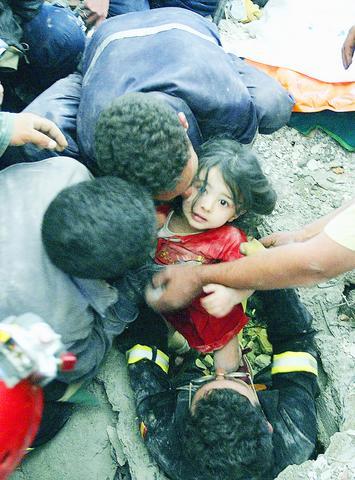
PHOTO: AP
After two days of counting bodies and fewer and fewer survivors, the remarkable rescue Friday of wide-eyed toddler Emilie Kaidi from the rubble of her family's home in Corso, in the quake zone east of the capital Algiers, offered momentary hope.
Guided by her plaintive cries and an ultrasound locating device inserted into the wreckage, rescuers found her beneath the shattered concrete of her collapsed ground-floor bedroom, protected by a door that had fallen across a television set.
Rescuers asked for total silence as they sought to precisely locate her, witnesses said. A half-hour later, a Spanish volunteer, wedged in a tiny hole in the rubble, handed the black-haired little girl dressed in a red shirt up to other rescuers. She appeared unharmed.
"It warmed our hearts and gave us hope," said Amirouche Istanbule, a 38-year-old decorator. "When they brought her out, she was covered in dust and a Spanish rescue worker immediately put his hand over her eyes to block out the light."
Emilie's parents also survived. But her sister, 4-year-old Lisa, died in the ruins of the four-story building, said another witness, Amar Boutihe, a 46-year-old construction manager who lives across the street.
"The mood really changed an hour later when they brought out her sister," he said.
By Friday, the death toll from the 6.8-magnitude quake east of Algiers had risen to more than 1,600 and was expected climb, the North African country's Interior Ministry said. Another 7,207 were injured.
Even as nations around the world rushed in medical teams, sniffer dogs and other aid, villagers in destroyed towns like Corso struggled with shortages of food, water, electricity, medicine and blankets.
"Nobody has visited us, not even to establish a death count," said Yoscef Manel, 34, who does odd jobs. "Helicopters flew overhead and the interior minister drove through, but it's noise for nothing."
Many directed their anger against builders and the government, saying it had turned a blind eye to substandard construction. Others faulted corruption.
"Our building is still standing because it was built by an honest man," said Lies Boumeridja, an egg and poultry vendor in Bourmerdes, a nearby town where the official news agency APS said 955 people died.
"That house over there used to be filled with lovely people, but it was built by villains," Boumeridja said, pointing to a ruined neighboring building.

‘CROSSING THE LINE’: China’s embassy in Seoul criticized US Forces Korea Commander General Xavier Brunson, asking if his ‘hostile’ remarks were authorized by Washington South Korea and the US are in talks over recent public remarks by the commander of US Forces Korea, Seoul’s presidential office said yesterday, after the comments drew sharp criticism from China. In a recent podcast interview, US Forces Korea Commander General Xavier Brunson described South Korea as “the dagger in the heart of Asia” from China’s east coast, prompting the Chinese embassy in Seoul to say that he had “truly crossed the line.” The interview came amid growing speculation that Washington might seek to expand the role of US Forces Korea in countering the growing regional influence of China, a key

SEEKING ORDER: Rodrigo Paz said that ‘anyone who wants to destroy the nation will have to deal with this president and the full force of the constitution’ Bolivian President Rodrigo Paz on Wednesday said that the nation was at a “breaking point” after nearly a month of protests that have caused shortages of food, fuel and medicine. Paz, who took office six months ago amid the worst economic crisis there in four decades, is battling a groundswell of fury over his policies. The political capital, La Paz, has been besieged by low-income workers and members of the indigenous majority calling for his resignation. “The country needs order and is reaching breaking point,” the 58-year-old said at a public event in La Paz, renewing his appeal for dialogue. On Tuesday, the Bolivian

Through the noise of rushing papers and whirring belts at a print factory in Kyoto, two creators watch their photo essay come to life in broadsheet form — part of an effort to win new audiences in the age of artificial intelligence (AI). Despite the decline of the publishing industry, self-publication and handmade “zine” magazines are growing in popularity in Japan, reflecting the nation’s enduring love of paper in the digital era. While speaking to Agence France-Presse at the plant, his hands black with ink, one of the creators, Kazuma Obara, said: “I think [paper] is a medium that engages all five

Australian researchers have trained lab-grown brain cells on a silicon computer chip to play the 1990s shooter game Doom and said they are just scratching the surface of what the neurons could be capable of doing. It is the science-fiction work of biotech boffins at Cortical Labs, who researched and developed the technology that harnesses the workings of the brain’s networking system. Each so-called “biological computer” contains about 200,000 living human brain cells, grown from stem cells that were harvested from blood donations. Having mastered the simple computer game Pong, where a paddle is moved up and down to send a ball


 RSS
RSS