


Kaohsiung Mayor Han Kuo-yu (韓國瑜) and his wife, Lee Chia-fen (李佳芬), should demonstrate class and decorum when speaking in public, Democratic Progressive Party (DPP) officials said yesterday, while a Kaohsiung city councilor accused Lee of making baseless claims.
At an event in Pingtung County on Monday, Lee expressed concern about gender equality education, citing a friend as saying that course materials for third and sixth-graders contained references to anal sex and orgasms respectively.
President Tsai Ing-wen (蔡英文), who is seeking re-election, yesterday said that Han, the Chinese Nationalist Party’s (KMT) candidate in next year’s presidential election, and his wife should not be vulgar and base their statements on facts.
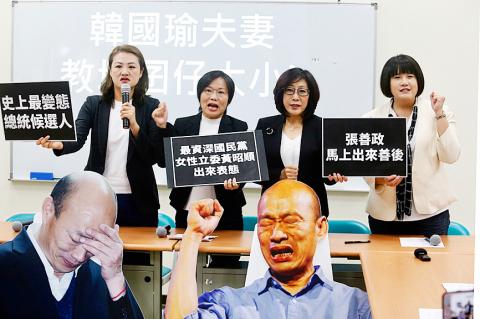
Photo: CNA
Vulgarity is a theme with Han and Lee, who should discontinue its use, Tsai said.
The Ministry of Education also issued a statement disputing Lee’s comments.
Meanwhile, New Power Party Kaohsiung City Councilor Huang Chieh (黃捷) called Han and Lee the source of “public chaos,” saying that they have become accustomed to making comments without fact-checking.
Huang said that she went through the course materials and could not find the information that Lee claimed they contained.
Premier Su Tseng-chang (蘇貞昌) said that Lee was “irresponsible” and spreading false information.
Su also said that Han’s description of Tsai running with former premier William Lai (賴清德) as her vice presidential candidate was inappropriate.
Han on Monday compared a possible Tsai-Lai ticket to characters from Chinese-language literary classic Water Margin (水滸傳): the dwarf Wu Dalang (武大郎) and his wife, Pan Jinlian (潘金蓮).
Han’s description — “Pan and Wu under the blanket; their heads lie on the same pillow, but their feet match not” — refered to the appearance of harmony, but possible internal strife.
The DPP knows well the “essence of democracy” and that its members would always stand united, despite fierce internal competition, Su said, referring to a bruising presidential primary between Tsai and Lai in June.
Han should be more concerned about infighting in his own party, rather than insinuate disunity in the DPP with improper metaphors, Su said.
Separately yesterday, a source said on condition of anonymity that Han was making improper statements to obfuscate a property deal.
Han’s image as an “everyman” has been challenged after media reports that he purchased a presale luxury apartment in Taipei’s Nangang District (南港) in 2011 for NT$70 million (US$2.3 million at the current exchange rate).
Han reportedly sold the apartment in 2015 at a loss of about 3.5 percent.
Han, Lee and KMT Tainan City Councilor Hsieh Lung-chieh (謝龍介) equating vulgarity with being regular folk is a sign that they look down on everyday people, the source said.
Additional reporting by Chen Wen-chan and Su Yung-yao
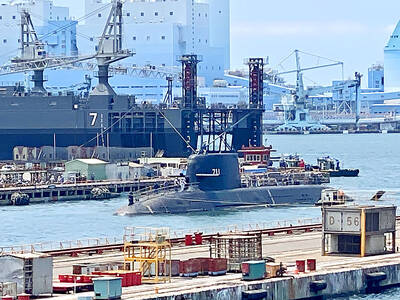
AGING: While Japan has 22 submarines, Taiwan only operates four, two of which were commissioned by the US in 1945 and 1946, and transferred to Taiwan in 1973 Taiwan would need at least 12 submarines to reach modern fleet capabilities, CSBC Corp, Taiwan chairman Chen Cheng-hung (陳政宏) said in an interview broadcast on Friday, citing a US assessment. CSBC is testing the nation’s first indigenous defense submarine, the Hai Kun (海鯤, Narwhal), which is scheduled to be delivered to the navy next month or in July. The Hai Kun has completed torpedo-firing tests and is scheduled to undergo overnight sea trials, Chen said on an SET TV military affairs program. Taiwan would require at least 12 submarines to establish a modern submarine force after assessing the nation’s operational environment and defense

Yangmingshan National Park authorities yesterday urged visitors to respect public spaces and obey the law after a couple was caught on a camera livestream having sex at the park’s Qingtiangang (擎天崗) earlier in the day. The Shilin Police Precinct in Taipei said it has identified a suspect and his vehicle registration number, and would summon him for questioning. The case would be handled in accordance with public indecency charges, it added. The couple entered the park at about 11pm on Thursday and began fooling around by 1am yesterday, the police said, adding that the two were unaware of the park’s all-day live
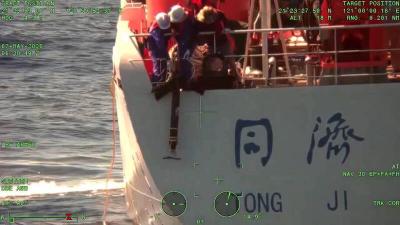
The coast guard today said that it had disrupted "illegal" operations by a Chinese research ship in waters close to the nation and driven it away, part of what Taipei sees a provocative pattern of China's stepped up maritime activities. The coast guard said that it on Thursday last week detected the Chinese ship Tongji (同濟號), which was commissioned only last year, 29 nautical miles (54km) southeast of the southern tip of Taiwan, although just outside restricted waters. The ship was observed lowering ropes into the water, suspected to be the deployment of scientific instruments for "illegal" survey operations, and the coast

A former soldier and an active-duty army officer were yesterday indicted for allegedly selling classified military training materials to a Chinese intelligence operative for a total of NT$79,440. The Taipei District Prosecutors’ Office indicted Chen Tai-yin (陳泰尹) and Lee Chun-ta (李俊達) for contravening the National Security Act (國家安全法) and the Anti-Corruption Act (貪污治罪條例). Chen left the military in September 2013 after serving alongside then-staff sergeant Lee, now an army lieutenant, at the 21st Artillery Command of the army’s Sixth Corps from 2011 to 2013, according to the indictment. Chen met a Chinese intelligence operative identified as “Wang” (王) through a friend in November


 RSS
RSS