


The New Power Party (NPP) legislative caucus yesterday issued a survey for the nominees of the Executive Yuan’s transitional justice promotion committee, saying that their answers would be used as a reference for evaluating whether the candidates are suitable for the position.
After the Act on Promoting Transitional Justice (促進轉型正義條例) passed its third reading on Dec. 5 last year, the Executive Yuan on March 27 nominated former Control Yuan member Huang Huang-hsiung (黃煌雄) as the chairman of the nine-member committee, while a few other nominees were announced last week.
NPP caucus convener Hsu Yung-ming (徐永明) said the party issued surveys to help lawmakers understand nominees for grand justice and minister and deputy minister of justice, so no exception is being made for the nominees to the new committee.
He urged the nominees to be specific when answering the 15 questions, which pertain to subjects the caucus thinks the public is curious about, saying that their answers would become the reference for their evaluations and their approval.
The independent committee must be well-supported by the public, NPP Legislator Kawlo Iyun Pacidal said, adding that as it is “responsible for taking the lead in enacting transitional justice measures on others,” it should conduct them on its own members first.
The committee’s members must have appropriate ideas and the proper attitudes on transitional justice to meet the public’s expectations, she added.
The 15 questions in the survey are categorized into six main themes: knowledge on transitional justice, the duties of the committee, the elimination of authoritarian symbols, transitional justice for Aborigines, knowledge on redressing unfair judicial cases and the ethics of committee members.
Regarding knowledge on transitional justice, the survey asks the nominees to define and characterize transitional justice, estimate the level of achievement of transitional justice in the nation and identify the model of investigation most suitable for Taiwan from the different types conducted in other nations, Kawlo Iyun Pacidal said.
On transitional justice for Aborigines, she said the questions pertain to redressing injustices related to Aboriginal territory that has been appropriated for Taiwan Sugar Corp and privatized, and whether Wu Feng Temple (吳鳳廟) in Chiayi County, which stigmatizes Aborigines, should be removed.
Regarding the ethics of committee members, Kawlo Iyun Pacidal said that Huang has been asked to explain his stance when he was a Control Yuan member on the handling of an impeachment motion against former prosecutor-general Huang Shih-ming (黃世銘), who was involved in a wiretapping case, and the reasoning for his stance, as well as his thoughts on the failed motion.
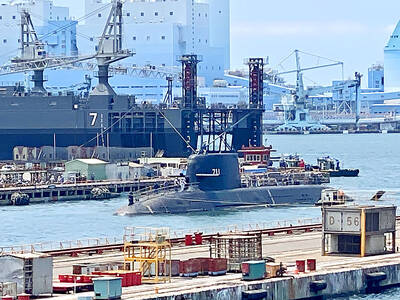
AGING: While Japan has 22 submarines, Taiwan only operates four, two of which were commissioned by the US in 1945 and 1946, and transferred to Taiwan in 1973 Taiwan would need at least 12 submarines to reach modern fleet capabilities, CSBC Corp, Taiwan chairman Chen Cheng-hung (陳政宏) said in an interview broadcast on Friday, citing a US assessment. CSBC is testing the nation’s first indigenous defense submarine, the Hai Kun (海鯤, Narwhal), which is scheduled to be delivered to the navy next month or in July. The Hai Kun has completed torpedo-firing tests and is scheduled to undergo overnight sea trials, Chen said on an SET TV military affairs program. Taiwan would require at least 12 submarines to establish a modern submarine force after assessing the nation’s operational environment and defense
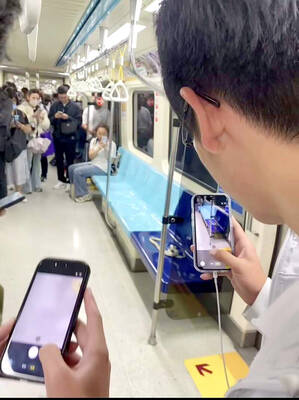
A white king snake that frightened passengers and caused a stir on a Taipei MRT train on Friday evening has been claimed by its owner, who would be fined, Taipei Rapid Transit Corp (TRTC) said yesterday. A person on Threads posted that he thought he was lucky to find an empty row of seats on Friday after boarding a train on the Bannan (Blue) Line, only to spot a white snake with black stripes after sitting down. Startled, he jumped up, he wrote, describing the encounter as “terrifying.” “Taipei’s rat control plan: Release snakes on the metro,” one person wrote in reply, referring
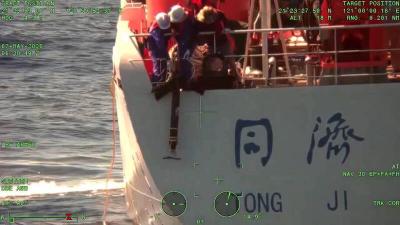
The coast guard today said that it had disrupted "illegal" operations by a Chinese research ship in waters close to the nation and driven it away, part of what Taipei sees a provocative pattern of China's stepped up maritime activities. The coast guard said that it on Thursday last week detected the Chinese ship Tongji (同濟號), which was commissioned only last year, 29 nautical miles (54km) southeast of the southern tip of Taiwan, although just outside restricted waters. The ship was observed lowering ropes into the water, suspected to be the deployment of scientific instruments for "illegal" survey operations, and the coast
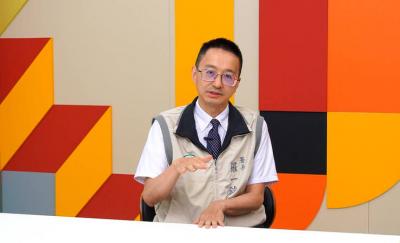
Taiwan’s two cases of hantavirus so far this year are on par with previous years’ case numbers, and the government is coordinating rat extermination work, so there should not be any outbreaks, Centers for Disease Control (CDC) Director-General Philip Lo (羅一鈞) said today in an interview with the Liberty Times (the Taipei Times’ sister newspaper). An increase in rat sightings in Taipei and New Taipei City has raised concerns about the spread of hantavirus, as rats can carry the disease. In January, a man in his 70s who lived in Taipei’s Daan District (大安) tested positive posthumously for hantavirus, Taiwan’s


 RSS
RSS