


CPC Corp, Taiwan’s (CPC) plan to build a third liquefied natural gas terminal in Taoyuan was yesterday rejected by an environmental impact assessment committee, which asked it to submit more documentation by April.
The proposed terminal project at Guantang Industrial Park in the city’s Guanyin District (觀音) was turned down by the Environmental Protection Administration (EPA) committee after a review meeting.
At a news conference before the meeting, environmental groups urged the committee to base its review on professionalism, not politics.
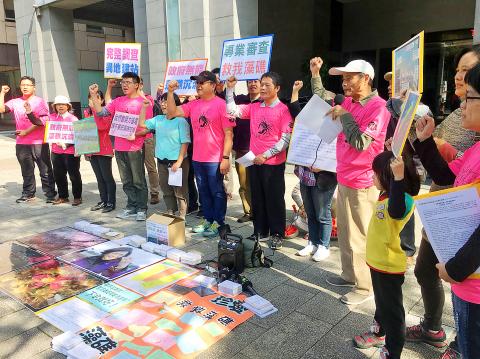
Photo: CNA
The project would jeopardize Polycyathus chaishanensis, an endangered species of coral, and algal reefs in the intertidal zones off Datan Borough (大潭), the groups said, calling on the company to build the terminal elsewhere.
The Council of Agriculture in a legislative session on Monday promised that it would spend about NT$10.73 million (US$364,941) to conduct a one-year study with Academia Sinica about local ecosystems starting in March, Chinese Nationalist Party (KMT) Legislator Apollo Chen (陳學聖) said, urging the committee to postpone its review until the council’s report is released.
The groups stalled the meeting for more than two hours by challenging the legitimacy of its procedures and the council’s inaction in legally protecting the species.
Committee member Liu Ching-yu (劉靜榆), associate researcher at the council’s Endemic Species Research Institute, said the utility’s report contains many errors, such as the kind of species on Datan’s coast, and called on the committee to reject the project.
The project is urgent because it is expected to supply between 8 percent and 10 percent of the nation’s natural gas from July 2022, Bureau of Energy Deputy Director-General Lee Chun-li (李君禮) said.
If the terminal is to be built at another venue such as the ports of Taipei, Linkou or Taichung, it could only start supplying gas to the Datan Power Plant by 2027 or 2028, which would impede the government’s goal to generate half of the nation’s electricity from natural gas by 2025, the company said.
To reduce the project’s effect on the local ecology, the CPC said it has curtailed its development areas from 232 hectares to 37 hectares and canceled the construction plans for less relevant facilities, such as petrochemical products.
Schedule delay is the main reason the company did not opt for the other venues, CPC vice president J.Z. Fang (方振仁) said.
The company would avoid affecting or dislocating the protected coral in the intertidal zones, Fang said, adding that it would monitor the construction process around the clock through a closed-circuit television system.
The committee asked the developer to submit more documentation on ecology and another impact assessment by April 30, and advised the EPA to convene an expert meeting to discuss the project’s potential effect on local ecosystems.

The military has spotted two Chinese warships operating in waters near Penghu County in the Taiwan Strait and sent its own naval and air forces to monitor the vessels, the Ministry of National Defense (MND) said. Beijing sends warships and warplanes into the waters and skies around Taiwan on an almost daily basis, drawing condemnation from Taipei. While the ministry offers daily updates on the locations of Chinese military aircraft, it only rarely gives details of where Chinese warships are operating, generally only when it detects aircraft carriers, as happened last week. A Chinese destroyer and a frigate entered waters to the southwest
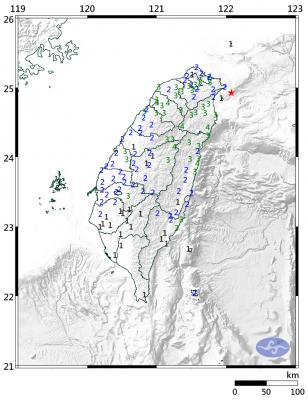
A magnitude 6.1 earthquake struck off the coast of Yilan County at 8:39pm tonight, the Central Weather Administration (CWA) said, with no immediate reports of damage or injuries. The epicenter was 38.7km east-northeast of Yilan County Hall at a focal depth of 98.3km, the CWA’s Seismological Center said. The quake’s maximum intensity, which gauges the actual physical effect of a seismic event, was a level 4 on Taiwan’s 7-tier intensity scale, the center said. That intensity level was recorded in Yilan County’s Nanao Township (南澳), Hsinchu County’s Guansi Township (關西), Nantou County’s Hehuanshan (合歡山) and Hualien County’s Yanliao (鹽寮). An intensity of 3 was

Japanese Prime Minister Sanae Takaichi’s comment last year on Tokyo’s potential reaction to a Taiwan-China conflict has forced Beijing to rewrite its invasion plans, a retired Japanese general said. Takaichi told the Diet on Nov. 7 last year that a Chinese naval blockade or military attack on Taiwan could constitute a “survival-threatening situation” for Japan, potentially allowing Tokyo to exercise its right to collective self-defense. Former Japan Ground Self-Defense Force general Kiyofumi Ogawa said in a recent speech that the remark has been interpreted as meaning Japan could intervene in the early stages of a Taiwan Strait conflict, undermining China’s previous assumptions
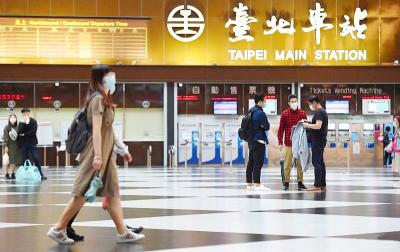
Taiwan Railways Corp (TRC) today announced that Shin Kong Mitsukoshi has been selected as the preferred bidder to operate the Taipei Railway Station shopping mall, replacing the current operator, Breeze Development Co Ltd. Among eight qualified firms that delivered presentations and were evaluated by a review committee, Shin Kong Mitsukoshi was ranked first, while Breeze was named the runner-up, the rail company said in a statement. Contract negotiations are to proceed in accordance with regulations, it said, adding that if negotiations with the top bidder fail, it could invite the second-ranked applicant to enter talks. Breeze in a statement today expressed doubts over


 RSS
RSS