

The Chinese Nationalist Party (KMT) yesterday criticized claims that President Tsai Ing-wen’s (蔡英文) APEC envoy and Chinese President Xi Jinping (習近平) had “met” at the APEC leaders’ summit in Lima, Peru, although it took credit for what it called a “chance encounter.”
KMT Culture and Communications Committee deputy director Hu Wen-chi (胡文琦) told a morning news conference in Taipei that People First Party (PFP) Chairman James Soong’s (宋楚瑜) 10-minute conversation with Xi on Saturday was only a chance encounter, nothing like the “formal meetings” that former vice presidents Lien Chan (連戰) and Vincent Siew (蕭萬長) held with Chinese leaders when they attended previous APEC summits as special envoys of the president.
The government should refrain from boasting about the encounter, Hu said.
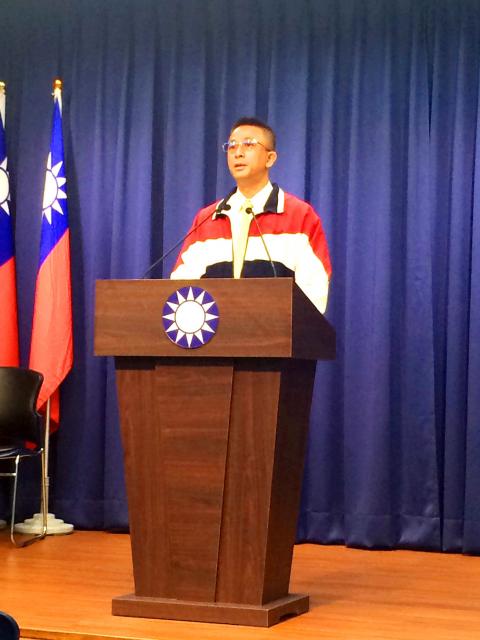
Photo: Lu Yi-hsuan, Taipei Times
The lack of a formal meeting between Soong and Xi was due to Tsai’s refusal to acknowledge the so-called “1992 consensus,” a tacit understanding between Beijing and the KMT that both sides of the Taiwan Strait acknowledge there is “one China,” with each side having its own interpretation of what “China” means.
Given that Beijing denied Soong an opportunity to be photographed with Xi and has categorized the pair’s talk as “simple, natural greeting exchanges” rather than a “Soong-Xi meeting,” the PFP founder should not try to “pass off fish eyes for pearls” (魚目混珠), Hu said, using a Chinese idiom meaning to present a fake as something real.
The KMT recognizes the good intentions of Soong and the Tsai administration in wanting to help Taiwan’s small and medium-sized businesses, but the government “cannot fool” the public into believing a formal Soong-Xi meeting took place, he said.
That there was even a brief chat was due to KMT Chairwoman Hung Hsiu-chu’s (洪秀柱) meeting with Xi in Beijing earlier this month, Hu said.
Hung’s meeting with Xi was aimed at Taiwan’s participation in APEC and other international organizations, adding that Hung invited China to participate in next year’s Summer Universiade in Taipei and to increase exchanges with KMT-led municipalities, he said.
“We can see China’s benevolent response… the Hung-Xi meeting was a success,” Hu added.
Hu said the Soong-Xi meeting at APEC could not be anything more than a chance encounter since Tsai has not recognized the “1992 consensus,” adding that the KMT believes the encounter would nevertheless improve Taiwan’s visibility on the international stage.
“I expect it will prove directly beneficial to the development of cross-strait relations,” Hu said.
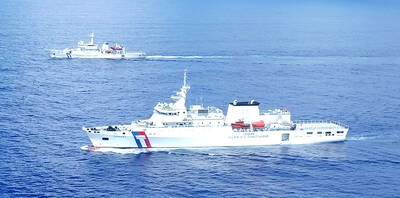
‘FRIENDSHIP FLEET’: A CGA official is scheduled to meet with the president of the Pacific nation, while one of the ships is to host a banquet and National Day event Two Coast Guard Administration (CGA) patrol vessels have docked at Malakal Harbor in Palau as part of an expedition exercise and diplomatic visit, during which a senior official is expected to meet with Palauan President Surangel Whipps Jr, the agency said yesterday. The two vessels, the 4,000-tonne-class Chiayi and the 1,000-tonne-class Penghu, set sail for Palau from Taiwan last week and arrived on Tuesday at Malakal Harbor, the CGA’s Fleet Branch said in a statement. The journey marks the second time the CGA has dispatched a “friendship fleet” to another country, after it sent its first-ever goodwill fleet, comprising the Hualien and
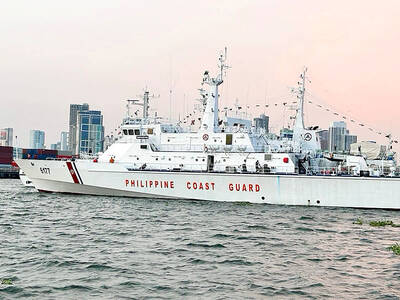
A patrol vessel donated by the Coast Guard Administration (CGA) to the Philippines was commissioned into the Philippine Coast Guard (PCG) on Friday, a Philippine non-governmental organization said. The CGA on Sept. 16 confirmed media reports that Taiwan had donated a retired 500-tonne patrol vessel to the Philippines. The Manila-based We Protect Our Seas (WPS) foundation, which served as an intermediary in the transfer, said that the vessel was formerly the CGA’s 500-tonne petrol vessel Kinmen (CG123). The WPS, in a statement issued on Friday, said the vessel, renamed as the BRP Sarangani, had been commissioned into the PCG the
The Coast Guard Administration (CGA) today said that two of its patrol vessels have docked at Palau's Malakal Harbor as part of an expedition exercise and diplomatic visit, during which a senior official is expected to meet with the Palauan president. The two vessels, the 4,000-tonne-class Chiayi (嘉義) and the 1,000-tonne-class Penghu (澎湖), set sail for Palau from Taiwan last week and arrived at Malakal Harbor yesterday, the CGA's Fleet Branch said in a statement. The journey marked the second time the CGA has dispatched a "Friendship Fleet" to another country, after it sent its first-ever goodwill fleet, comprising the Hualien (花蓮)

Had I Not Seen the Sun (如果我不曾見過太陽), a coming-of-age mystery romance, yesterday won best series at the Seoul International Drama Awards in South Korea. The show's producer, Phoebe Ma (麻怡婷), accepted the award on behalf of the production team. "Telling this story was difficult," Ma said. "There were moments when I doubted my strength to keep going, but I never doubted the story itself." Ma went on to thank the cast and crew of the show for making the win possible. Released in two parts on Netflix at the end of last year, the 20-episode drama starred Tseng Jing-hua (曾敬驊) and Alice Ko (柯佳嬿). The


 RSS
RSS