


Minister of Defense Kao Kuang-chi (高廣圻) yesterday said that tension has been rising in the South China Sea amid an arms race among nations in the region, and that Taiwan’s armed forces are ready to defend its remote island outposts.
Due to a potential military threat against Taiwan’s islands in the South China Sea, Kao said programs have been underway to enhance radar installations and electronic surveillance in the region and to improve the combat capability of the nation’s coast guard units stationed on the Pratas Islands (Dongsha Islands, 東沙群島) and Spratly Islands (Nansha Islands, 南沙群島).
According to a Ministry of National Defense report to the legislature’s Foreign Affairs and National Defense Committee, the ministry has mandated the Navy’s Marine Corps to train coast guard units on weapon handling, operating artillery guns and field combat drills, for those units deployed on Itu Aba Island (Taiping Island, 太平島) and other outposts in the South China Sea.
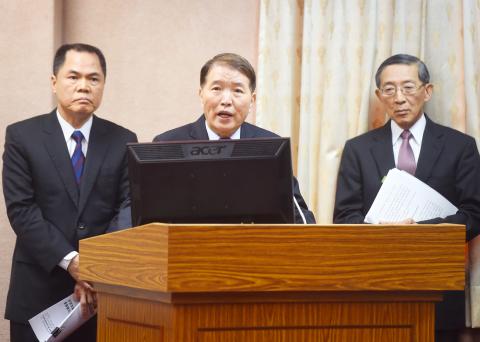
Photo: Chien Jung-fong, Taipei Times
It said that in recent years, defensive firepower on these outposts has been enhanced with the installation of Bofors 40mm guns and Taiwan’s own T-63 120mm mortar systems, which receive regular repair and maintenance checks by artillery technicians.
When asked by Democratic Progressive Legislator Wang Ting-yu (王定宇) if the ministry has deployed anti-air missile defense systems on these islands, Kao said he was not at liberty to answer.
China’s military and radar installations on Woody Island (Yongxing Island, 永興島), along with the lengthening of a runway to 3,000m might indicate that Beijing intends to declare an air defense identification zone (ADIZ) in the South China Sea, US Deputy Secretary of Defense Robert Work said on Wednesday.
National Security Bureau Deputy Director Chou Wu-mei (周伍美) said the bureau is aware of the situation and is monitoring developments in the South China Sea closely, as any unilateral declaration by China would increase tension in the region.
Chou said surveillance and intelligence gathering by the bureau and Taiwan’s armed forces indicate China has been undertaking preparations to enhance Woody Island’s basic infrastructure, and to deploy missile systems, jet fighters and other aircraft.
“However, we know that China does not yet have the military capability in the region to declare an ADIZ, therefore we believe it is unlikely China would do so in the near future,” he said.
The ministry report said China has already deployed its Red Flag-9 anti-air missiles on Woody Island — with a firing range of 200km — and is currently testing the Eagle Strike-62 anti-ship cruise missiles, that have a range of 300km.
Chou and Kao said the armed forces would assert national sovereignty claims and defend Taiwan’s islands and marine territories in the South China Sea, but they were not certain how long coast guard units could hold Itu Aba in the case of an attack.

FUKUOKA SITUATION: Japanese media reported that the pathogen is expected to be identified by the summer, while the CDC downplayed the idea that it was hMPV A “mysterious cold-like illness” reported in Japan’s Fukuoka Prefecture does not seem to be a new disease, but Japanese authorities have been asked about the situation, the Centers for Disease Control (CDC) said yesterday. The Fukuoka Prefectural Medical Association on Wednesday told a news conference that a “mystery cold” that has become a hot topic on social media is “highly likely to be caused by some kind of viral infection,” Japan’s KBC News reported. “Many people are experiencing symptoms starting with a sore throat, followed by a runny nose, phlegm and a severe cough,” KBC News reported, citing association officials. Health authorities are

Nvidia Corp CEO Jensen Huang (黃仁勳) arrived in Taiwan yesterday ahead of upcoming AI and technology events, saying he plans to meet with clients and Taiwan Semiconductor Manufacturing Co Chairman C.C. Wei (魏哲家) during his visit. After landing at Taipei Songshan Airport, Huang posed for photos with fans and handed out Yakult drinks to reporters and supporters waiting at the scene, saying he has “a lot to do” during the trip. Asked about reports that Nvidia’s planned headquarters site in Taipei’s Beitou Shilin Technology Park could break ground on May 27, Huang said that if the company holds an event, he would

Carrefour Taiwan is to begin using a new name from the start of July, but it cannot divulge the name until then, the chairman of the supermarket chain's parent company said today. President Chain Store Co chairman Lo Chih-hsien (羅智先) was asked by reporters after a shareholders' meeting to confirm whether the company has settled on a new name for the supermarket brand. In March, the government-registered name of two Carrefour Taiwan branches was quietly changed to "Le Chia Kang" (樂家康) in Chinese, raising speculation that has been selected as the name. Lo said that because of local regulations and contractual obligations, the

The Philippines would likely be involved in any conflict over Taiwan due to its proximity to the democracy claimed by China, President Ferdinand Marcos Jr said, reiterating a stance that risks angering Beijing. “In the Philippines, we do not have a choice because Taiwan is so close to the Philippines and we have almost 200,000 Filipino nationals living and working in Taiwan,” Marcos said in an interview with Japanese media in Manila on Monday. The Philippine leader’s comments come ahead of a state visit to Japan next week, where he is to meet with Japanese Prime Minister Sanae Takaichi to discuss security


 RSS
RSS