


The Taipei City Government yesterday said it would use the Velo-city Global, a major international cycling convention, to introduce more of the capital to the world and promote “green” transportation.
The event, which is titled “the evolution of cycling,” is to run from Feb. 27 to March 1, featuring local and international speakers who are to talk about how to achieve sustainable urban development through cycling, Taipei Deputy Mayor Chou Li-fang (周麗芳) said.
The event is to feature eight select bicycle trails, each having a different theme, including hot springs, waterfront parks, culture, historic buildings and art, Chou said.
She said that Taipei is to join the list of previous host cities, such as London, Copenhagen, Milan, Italy and Vienna, Austria, which would boost the city’s international profile.
Chou said that Taipei made strenuous efforts to work with the central government and the private sector to secure its 2013 bid to host the event.
By winning the bid, it justified Taiwan’s status as a “bicycle kingdom,” Taipei’s efforts to promote cycling and its bicycle trails, as well as Taipei’s status as an international city.
The event’s Web site said a “cycling carnival” is to be held on Feb. 28, at which Taipei Mayor Ko Wen-je (柯文哲) is to lead participants on a bicycle trip, with the start and finish to be at the plaza in front of Taipei City Hall, where live music and bicycle stunts are to be performed.
European Cyclists’ Federation member Marcio Deslandes, who is the Velo-city series manager, said Taipei differs from other Asian cities in that residents are always “thinking forward,” which makes Taipei an “avant-garde” city and a fitting choice to host the event.
Deslandes said Taipei is an example for other Asian cities in terms of urban planning and how it has integrated bicycles into its public transportation systems, which showed the government’s will to promote sustainability in the city and a better environment.
However, one area Taipei needs to work on is the quality of bicycle-related infrastructure, Delandes said.
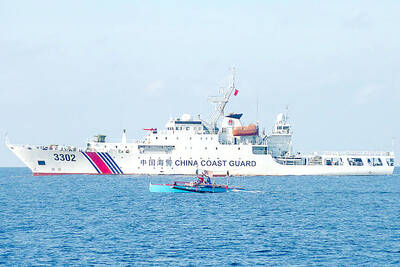
EXPANSIONIST: China deploys an average of 40 to 50 warships and coast guard vessels daily in the South China Sea, despite pledges not to militarize the region, an official said China is attempting to expand its influence across the First Island Chain and increase pressure on Japan by sending coast guard vessels into waters off of Taiwan under the pretext of maritime negotiations with Japan and the Philippines, a national security official said yesterday. China’s recent actions in the waters east of Taiwan and Japan and the Philippines’ exclusive economic zones (EEZ) are attempts to establish dominance in First Island Chain waters, said the official who declined to be named, adding that this is “expansion disguised as law enforcement.” Framing China’s actions solely as a cross-strait issue is a serious misjudgment that
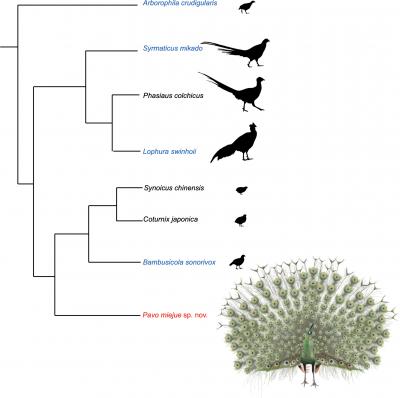
Through analyzing fossil evidence, a research team at National Taiwan University (NTU) discovered the largest endemic bird to have lived in Taiwan, naming it Pavo miejue, or extinct peafowl (滅絕孔雀). The Mikado pheasant, which is printed on the back of the NT$1,000 bank note, was previously believed to be the biggest endemic bird to Taiwan. The research team’s findings suggest that Pavo miejue lived during the Pleistocene epoch tens of thousands of years ago. It is the first endemic extinct bird species discovered and formally named in Taiwan. The study was coauthored by NTU Institute of Ecology and Evolutionary Biology professor Tsai Cheng-hsiu (蔡政修),
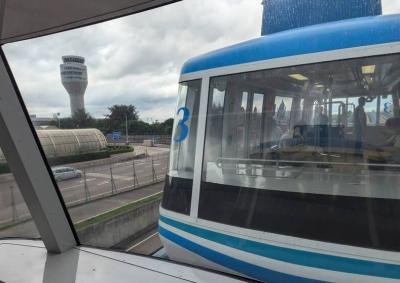
Taiwan Taoyuan International Airport is to suspend its automated Skytrain service connecting Terminal 1 and Terminal 2 starting on July 1 to facilitate connection works for the upcoming Terminal 3, the airport operator said today. Passengers and staff who need to travel between the two terminals after the suspension can instead use the Taoyuan MRT or the airport's 24-hour shuttle bus service, Taoyuan International Airport Corp said. The Taoyuan MRT Airport Line directly links the two terminals, while the shuttle buses are to operate around the clock, the company added. The Skytrain provides free transportation between the airport’s two terminals for travelers and
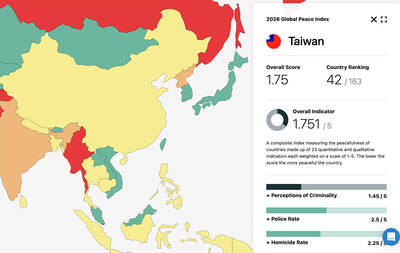
Taiwan ranked 42nd in terms of peacefulness among 163 countries, down five places from last year, according to this year’s Global Peace Index. With an overall score of 1.751, Taiwan dropped from 37th last year, the report published by the global Institute for Economics and Peace showed. The overall score measures a country’s level of peacefulness using 23 quantitative and qualitative indicators across three domains — ongoing domestic and international conflict, societal safety and security, and militarization. While Taiwan ranked 42nd worldwide, it was listed in ninth place among the 19 Asian-Pacific countries in the report, after New Zealand, Singapore, Japan, Malaysia,


 RSS
RSS