

A much-talked-about documentary depicting how the nation’s environment has been ravaged prompted Premier Jiang Yi-huah (江宜樺) to demand that Cabinet officials “take an iron fist” to environmental problems, Executive Yuan Deputy Secretary-General Chien Tai-lang (簡太郎) said yesterday.
Chien told a press conference following an intergovernmental meeting that Jiang has ordered Cabinet members to carry through “forcefully” policies that have become necessary because environmental preservation is a task that “allows for no delay.”
The Cabinet yesterday held the first meeting of an ad hoc task force led by Chien and attended by vice heads of related government branches.
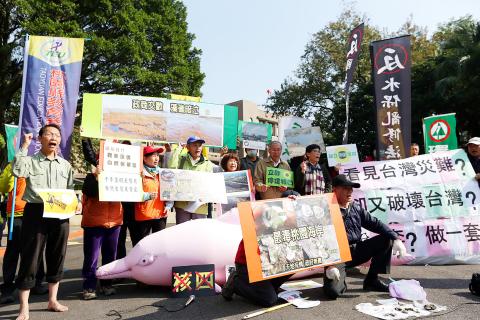
Photo: CNA
Jiang ordered the establishment of the task force after he attended a screening of the film Beyond Beauty: Taiwan From Above (看見台灣) by Chi Po-lin (齊柏林) that documents Taiwan by using aerial photography.
Government agencies were divided into five teams to work on 16 major national conservation issues exposed by the documentary and will present an initial report to Jiang in one month, Chien said.
Among the issues were illegal mining of gravel and sand, sediments in water reservoirs, land subsidence induced by pumping excessive underground water, excessive hillside development and river pollution, he said.
The task force categorized the 16 issues into four topics — mining of sand and gravel, management of coasts and hillsides, environmental quality and development in sensitive areas — with government branches related to each of the topics being assembled in a group to work on the issues, Chien said.
The Ministry of Justice and the Ministry of the Interior were in the fifth group, charged with ensuring necessary enforcement measures take place to crack down on illegal activities that damage the environment, he added.
The task force will meet every two weeks to draft short, medium and long-term solutions to environmental problems, Chien said.
“We will take a holistic approach and not just focus on the 16 problems,” he added.
Earlier yesterday about a dozen representatives from environmental groups protested outside the Executive Yuan and accused the government of continuing environmental destruction.
The film shows how state land is being excessively developed, and the damage caused by illegal gravel mining or inappropriate land use, but the Cabinet is still trying to amend laws that would loosen restrictions on development in reservoir water catchment areas, the protesters said.
Taiwan Environmental Protection Union founding chairman Shih Hsin-min (施信民) said that if the government really watches the film and “sees Taiwan” (the literal translation of the film’s Chinese name), it would cancel the construction of the Fourth Nuclear Power Plant, retire nuclear plants currently in operation, stop destroying high-quality farmland and stop any development in water catchment areas, among other measures.
Wang Chung-ming (王鐘銘), spokesman for a self-help group against land expropriation for the Danhai New Town phase-two project, said the vacancy rate is already very high in the new town’s phase-one area, yet the government still wants to develop the 1,168-hectare second-phase area that will include 871 hectares of farmland or forest land, “which will destroy natural ecology and human rights.”
A total of 400 foreign “high- level” professionals have been naturalized as Republic of China (Taiwan) citizens over the past decade as the government has eased nationality rules to attract talent from a wider range of fields, the Ministry of the Interior said yesterday. The 400th high-level professional, who works in the electronics industry, was approved for ROC citizenship on Aug. 26, the MOI said. The MOI quoted the newly naturalized citizen as saying that Taiwan is a leader in fields such as semiconductors, electronics manufacturing, artificial intelligence development and energy technology. He also said
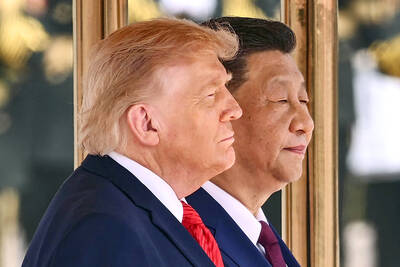
China has warned that it could cancel a planned US-China leaders’ summit if Washington approves new arms sales to Taiwan, a Japanese media outlet quoted sources as saying yesterday. US President Donald Trump, “apparently eager to showcase some diplomatic achievements ahead of November’s midterm congressional elections, places great importance on holding the summit with Chinese President Xi Jinping (習近平),” Japan’s Kyodo News reported. “While preparing for Xi’s upcoming trip, China has restated its position that the Taiwan issue is a ‘red line’ in bilateral relations,” the report said. The report said that when Xi met with Trump in Beijing in May, Xi said
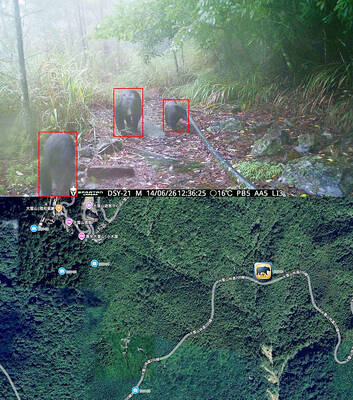
RARE PEEK: The footage released showed one of the bears staying in a cave for as long as 70 days, providing the first record of Formosan black bear’s overwintering The Forestry and Nature Conservation Agency yesterday released tracking records of released Formosan black bears for the first time, showing that they get much closer to human settlements than previously thought. The agency said it had captured two bears, Da Qu-ali (達古阿里) and Aziman (阿里曼), in indigenous villages in Hualien County and began to track them with a camera-mounted satellite collar after releasing them back into the wild. The results confirmed that the bears have moved from deep mountain areas into lowland hills closer to human communities, leading to an increase in human-bear conflicts, it said. The agency has introduced artificial intelligence-assisted early
DIPLOMATIC TOUR: Chinese President Xi Jinping began a series of overseas visits last month to Kyrgyzstan, Egypt and India, aimed at securing leverage, an official said Recent Chinese diplomatic and military moves are aimed at creating pressure ahead of a planned meeting between Chinese President Xi Jinping (習近平) and US President Donald Trump, National Security Council adviser Huang Chung-yen (黃重諺) said. Trump when visiting China in May extended an invitation to Xi to visit Washington on Sept. 24. China is yet to officially announce plans for Xi’s visit to the US. In an interview with the Liberty Times (sister paper of the Taipei Times) on Thursday, Huang said Xi’s overseas visits, China’s “gray zone” activities along the First Island Chain and efforts to expand its trade surplus with the


 RSS
RSS