


The Ministry of Justice (MOJ) yesterday promised to temporarily suspend the demolition of the Huaguang Community (華光社區) in Taipei while the city government evaluates the remains of the former Taihoku Prison at the site.
“We will patiently wait and suspend the demolition work while the city reviews whether the remains of the former prison have historic value,” ministry official Lu Che-ko (盧哲科) told a press conference at the legislature in Taipei.
At the press conference, Democratic Progressive Party Legislator Pasuya Yao (姚文智) and members of the Taiwan Association of University Professors (TAUP) voiced their concerns over historic relics at the site.
A Taipei City Government Cultural Assets Review Committee meeting about the site is scheduled to be held on Monday.
“Several buildings in the community have temporarily been designated historic by the Taipei City Government, therefore the MOJ should stop its demolition work until the review committee comes to a final decision,” Yao said. “I would propose preserving not only the historic buildings, but also the green areas, which could be connected to neighborhoods around Yongkang Street and National Taiwan Normal University to make it an area of interest to tourists, with culture and a green belt.”
“We’ve always stayed in touch with Taipei’s Department of Cultural Affairs to make sure our demolitions do not harm historic buildings or trees,” Lu replied.
TAUP chairman Lu Chung-chin (呂宗津), an electrical engineering professor at National Tsing Hua University, said that preserving historical assets is far more important than development.
“The former Taihoku Prison bears witness to the struggles of Taiwanese during the Japanese colonial period,” said Chuang Wan-shou (莊萬壽), emeritus professor at Chang Jung Christian University’s Graduate Institute of Taiwan Studies. “This is the prison in which many people were jailed — including Chiang Wei-shui (蔣渭水) who led the resistance movement.”
Huaguang Community was once dormitories for prison employees during the Japanese colonial period. Although most of the prison complex was torn down, many individual buildings still stand.
When refugees and troops fled to Taiwan with the Chinese Nationalist Party (KMT) regime in 1949, many were unofficially allowed to take up residence in the area.
However, a decade ago the government decided to develop the area into a financial and commercial district, and the ministry, which took over ownership of the land from the Japanese colonial government, filed lawsuits against the residents.

The military has spotted two Chinese warships operating in waters near Penghu County in the Taiwan Strait and sent its own naval and air forces to monitor the vessels, the Ministry of National Defense (MND) said. Beijing sends warships and warplanes into the waters and skies around Taiwan on an almost daily basis, drawing condemnation from Taipei. While the ministry offers daily updates on the locations of Chinese military aircraft, it only rarely gives details of where Chinese warships are operating, generally only when it detects aircraft carriers, as happened last week. A Chinese destroyer and a frigate entered waters to the southwest

A magnitude 6.1 earthquake struck off the coast of Yilan County at 8:39pm tonight, the Central Weather Administration (CWA) said, with no immediate reports of damage or injuries. The epicenter was 38.7km east-northeast of Yilan County Hall at a focal depth of 98.3km, the CWA’s Seismological Center said. The quake’s maximum intensity, which gauges the actual physical effect of a seismic event, was a level 4 on Taiwan’s 7-tier intensity scale, the center said. That intensity level was recorded in Yilan County’s Nanao Township (南澳), Hsinchu County’s Guansi Township (關西), Nantou County’s Hehuanshan (合歡山) and Hualien County’s Yanliao (鹽寮). An intensity of 3 was

Japanese Prime Minister Sanae Takaichi’s comment last year on Tokyo’s potential reaction to a Taiwan-China conflict has forced Beijing to rewrite its invasion plans, a retired Japanese general said. Takaichi told the Diet on Nov. 7 last year that a Chinese naval blockade or military attack on Taiwan could constitute a “survival-threatening situation” for Japan, potentially allowing Tokyo to exercise its right to collective self-defense. Former Japan Ground Self-Defense Force general Kiyofumi Ogawa said in a recent speech that the remark has been interpreted as meaning Japan could intervene in the early stages of a Taiwan Strait conflict, undermining China’s previous assumptions
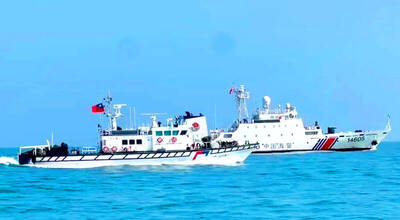
Instead of focusing solely on the threat of a full-scale military invasion, the US and its allies must prepare for a potential Chinese “quarantine” of Taiwan enforced through customs inspections, Stanford University Hoover fellow Eyck Freymann said in a Foreign Affairs article published on Wednesday. China could use various “gray zone” tactics in “reconfiguring the regional and ultimately the global economic order without a war,” said Freymann, who is also a nonresident research fellow at the US Naval War College. China might seize control of Taiwan’s links to the outside world by requiring all flights and ships entering or leaving Taiwan


 RSS
RSS