


New Taipei City (新北市) Mayor Eric Chu (朱立倫) yesterday reiterated that the Fourth Nuclear Power Plant should not begin operation until it is completely safe.
"If the safety of the Fourth Nuclear Power Plant cannot be assured, it should absolutely not begin operation,” Chu, a member of the Chinese Nationalist Party (KMT), said in response to a media query on growing public concerns over the safety of nuclear power plants.
“Safety is the priority, the same standard applies to the Jinshan and Guosheng nuclear power plants — if there are any safety concerns, the operation of these two nuclear power plants should be terminated immediately,” he said.
Currently, there are three nuclear power plants in operation: two in New Taipei City and one in Pingtung County. The fourth — yet to be completed — is in New Taipei City’s Gongliao District (貢寮).
While taking Chu’s remarks as supportive of the anti-nuclear campaign, activists urged Chu and other politicians to do more than just talk.
“I think many pan-blue politicians are speaking about nuclear safety now because they can feel that an increasing number of people have turned against nuclear power,” Green Citizens’ Action Alliance deputy secretary-general Hung Shen-han (洪申翰) said. “Chu said the Fourth Nuclear Power Plant should not begin operation until its safety can be guaranteed, but I don’t think that’s possible, given Taiwan’s unstable geological composition and population density.”
“So I think they should simply say no to nuclear power and do something to put an end to it,” he added.
Pan Han-shen (潘翰聲), a member of Green Party Taiwan’s Central Executive Committee, said: “If Chu and Taipei Mayor Hau Lung-bin (郝龍斌) truly care about nuclear safety, they should have Taipei City and New Taipei City work together to hold a nuclear disaster drill to see how the 5 million to 6 million people living in the two cities can be safely and quickly evacuated in the event of a nuclear disaster.”
The public has become more concerned with the safety of nuclear power plants after the Fukushima Dai-ichi nuclear power plant disaster caused by the earthquake and tsunami that hit Japan on March 11, 2011.
In addition, a number of technical problems that occurred during tests at the Fourth Nuclear Power Plant, which could lead to a severe nuclear disaster if they occurred during regular operations, have deepened public fears over nuclear power.
A number of Taiwanese celebrities, including the band Mayday (五月天) singer-songwriter Chen Sheng (陳昇) and singer Hsin (信), have expressed their opposition to nuclear power.
Meanwhile, dozens of mothers, including celebrities and public figures such as veteran show host Momoko Tao (陶晶瑩) and Fubon Cultural and Educational Foundation board director Irene Chen (陳藹玲) have recently formed an association aimed at collecting more than 100,000 signatures for a petition against the Fourth Nuclear Power Plant.
The association’s main demands are that Taiwan Power Co (Taipower, 台電), which runs the nation’s three operating nuclear power plants, make public the actual situations and data at the plants, that it establish a platform for communication with the public, that construction of the Fourth Nuclear Power Plant be stopped immediately and that the government plans new energy policies.
New Taipei City (新北市) Mayor Eric Chu (朱立倫) yesterday reiterated that the Fourth Nuclear Power Plant should not begin operation until it is completely safe.
“If the safety of the Fourth Nuclear Power
The move came after the Ministry of Economic Affairs confirmed on Thursday that it was allocating additional funds for preparatory work at the Fourth Nuclear Power Plant.
In Ministry of Economic Affairs Minister Shih Yen-shiang’s (施顏祥) report at the legislative Economic committee, he said that after 18 improvements at the plant are completed before June, the government would be able to give lawmakers a definite timetable and the precise amount of additional budget needed.
He added that the current estimation is that the total budget spent on the Fourth Nuclear Power Plant would reach more than NT$300 billion (US$10.37 billion), but if the plant is abandoned and the three operating plants are shut down in a few years, electricity prices could soar by 40 percent.

Considering that most countries issue more than five denominations of banknotes, the central bank has decided to redesign all five denominations, the bank said as it prepares for the first major overhaul of the banknotes in more than 24 years. Central bank Governor Yang Chin-lung (楊金龍) is expected to report to the Legislative Yuan today on the bank’s operations and the redesign’s progress. The bank in a report sent to the legislature ahead of today’s meeting said it had commissioned a survey on the public’s preferences. Survey results showed that NT$100 and NT$1,000 banknotes are the most commonly used, while NT$200 and NT$2,000
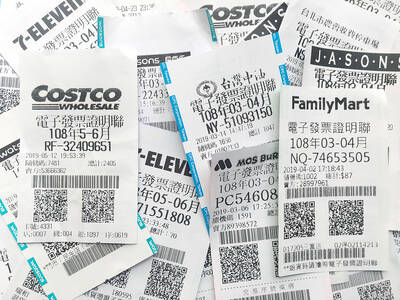
A NT$39 receipt for two bottles of tea at a FamilyMart was among the NT$10 million (US $312,969) special prize winners in the January-February uniform invoice lottery. FamilyMart said that two NT$10 million-winning receipts were issued at its stores, as well as two NT$2 million grand prizes and three NT$200,000 first prizes. The two NT$10 million receipts were issued at stores in Pingtung County and Yilan County’s Dongshan Township (冬山). One winner spent just NT$39 on two bottles of tea, while another spent NT$80 on water, tea and coffee, the company said. Meanwhile, 7-Eleven reported three NT$10 million winners — in New Taipei

The Centers for Disease Control (CDC) yesterday reported the first case of a new COVID-19 subvariant — BA.3.2 — in a 10-year-old Singaporean girl who had a fever upon arrival in Taiwan and tested positive for the disease. The girl left Taiwan on March 20 and the case did not have a direct impact on the local community, it said. The WHO added the BA.3.2 strain to its list of Variants Under Monitoring in December last year, but this was the first imported case of the COVID-19 variant in Taiwan, CDC Deputy Director-General Lin Ming-cheng (林明誠) said. The girl arrived in Taiwan on

ANNUAL EVENT: Two massive Pokemon balloons are to be set up in Daan Park, with an event zone operating from 10am to 6pm This year’s Taipei Floral Picnic is to be held at Daan Park today and tomorrow, featuring an exclusive Pokemon Go event, a themed food market, a coffee rave picnic area and stage performances, the Taipei Department of Information and Tourism said yesterday. Two massive Pokemon balloons are to be set up in the park as attractions, with an exclusive event zone operating from 10am to 6pm, it said. Participants who complete designated tasks on-site would have a chance to receive limited-edition souvenirs, it added. People could also try the newly launched game Pokemon Pokopia in the trial area, the department said. Three PokeStops are


 RSS
RSS