


Democratic Progressive Party (DPP) Legislator Hsiao Bi-khim (蕭美琴) yesterday left for Shanghai to participate in a seminar on cross-strait relations, but emphasized that she was doing so in a private capacity.
Hsiao said she was invited to the seminar on the peaceful development of cross-strait -relations, organized by the Shanghai Institute for East Asia Studies, as a board member of the Taiwan Foundation for Democracy (TFD), a semi-governmental non-profit organization, in a press release issued yesterday afternoon.
“I will be going to the seminar as a TFD board member and I have notified the party headquarters about the visit,” she said.
Hsiao is scheduled to return to Taipei tomorrow, her assistant Chang Chih-hao (張志豪) said.
The annual seminar, which has entered its third year, takes place on alternate years in Taipei and Shanghai, and is held by the TFD and the Shanghai Institute for East Asia Studies, which was established in 1995.
The visit is notable because of Hsiao’s position as a DPP lawmaker amid a new political -atmosphere in the party after its loss in the January presidential election, a result many observers say was brought about by the DPP’s failure in engaging Beijing politically and economically.
In March, New Taipei City (新北市) office director Lo Chih-cheng (羅致政), the DPP spokesperson at the time, became the first DPP official to visit China after the election when he visited Yunnan Province for a symposium on cross-strait development organized by a think tank affiliated with the Chinese government’s Taiwan Affairs Office.
Lo said he attended the symposium in a private capacity as a Soochow University professor and did not represent the DPP on the trip.
Visits to China by DPP members will likely become common in the future, in particular after DPP Chairman Su Tseng-chang (蘇貞昌) vowed to “be flexible” in the party’s approach to engagement with Beijing and after former DPP chairperson Tsai Ing-wen (蔡英文) told a recent interview that she does not rule out visiting China if the time is ripe.
However, the DPP has drawn a red line for its members’ participation in Chinese activities.
According to party spokesperson Wang Min-sheng (王閔生), the Straits Forum and the annual forum between the Chinese Nationalist Party (KMT) and the Chinese Communist Party remain off-limits for DPP members because of the political ramifications and implications of the two events.
To participate in other activities, DPP members must simply notify party headquarters before their departure, Wang said.
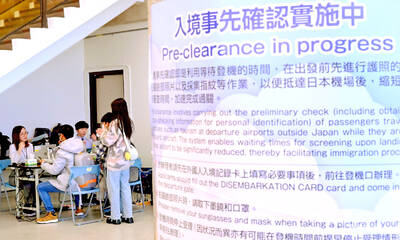
A preclearance service to facilitate entry for people traveling to select airports in Japan would be available from Thursday next week to Feb. 25 at Taiwan Taoyuan International Airport, Taoyuan International Airport Corp (TIAC) said on Tuesday. The service was first made available to Taiwanese travelers throughout the winter vacation of 2024 and during the Lunar New Year holiday. In addition to flights to the Japanese cities of Hakodate, Asahikawa, Akita, Sendai, Niigata, Okayama, Takamatsu, Kumamoto and Kagoshima, the service would be available to travelers to Kobe and Oita. The service can be accessed by passengers of 15 flight routes operated by

GIVE AND TAKE: Blood demand continues to rise each year, while fewer young donors are available due to the nation’s falling birthrate, a doctor said Blood donors can redeem points earned from donations to obtain limited edition Formosan black bear travel mugs, the Kaohsiung Blood Center said yesterday, as it announced a goal of stocking 20,000 units of blood prior to the Lunar New Year. The last month of the lunar year is National Blood Donation Month, when local centers seek to stockpile blood for use during the Lunar New Year holiday. The blood demand in southern Taiwan — including Tainan and Kaohsiung, as well as Chiayi, Pingtung, Penghu and Taitung counties — is about 2,000 units per day, the center said. The donation campaign aims to boost

ENHANCING EFFICIENCY: The apron can accommodate 16 airplanes overnight at Taoyuan airport while work on the third runway continues, the transport minister said A new temporary overnight parking apron at Taiwan Taoyuan International Airport is to start operating on Friday next week to boost operational efficiency while the third runway is being constructed, the Ministry of Transportation and Communications said yesterday. The apron — one of the crucial projects in the construction of the third runway — can accommodate 16 aircraft overnight at the nation’s largest international airport, Minister of Transportation and Communications Chen Shih-kai (陳世凱) told reporters while inspecting the new facility yesterday morning. Aside from providing the airport operator with greater flexibility in aircraft parking during the third runway construction,
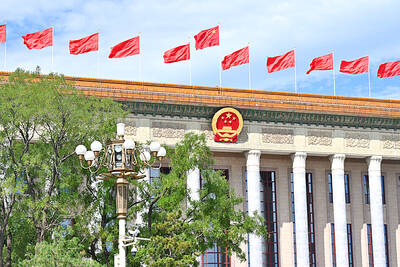
MORE FALL: An investigation into one of Xi’s key cronies, part of a broader ‘anti-corruption’ drive, indicates that he might have a deep distrust in the military, an expert said China’s latest military purge underscores systemic risks in its shift from collective leadership to sole rule under Chinese President Xi Jinping (習近平), and could disrupt its chain of command and military capabilities, a national security official said yesterday. If decisionmaking within the Chinese Communist Party has become “irrational” under one-man rule, the Taiwan Strait and the regional situation must be approached with extreme caution, given unforeseen risks, they added. The anonymous official made the remarks as China’s Central Military Commission Vice Chairman Zhang Youxia (張又俠) and Joint Staff Department Chief of Staff Liu Zhenli (劉振立) were reportedly being investigated for suspected “serious


 RSS
RSS