


A study from the National Communications Commission (NCC) shows that while most parents in Taiwan would like their children to watch more news and educational TV programs, school-age children prefer watching television dramas featuring popular teen idols.
The nation’s media regulator last year commissioned a research institute to examine the influence of TV programs and commercials on the behavior of children aged four to 12. The results, which were released earlier this month, showed that more than 60 percent of children aged 10 to 12 said TV influenced them more than anything else.
The children also said that TV helped them to improve their language skills, gain new knowledge and learn about interpersonal relations.
Ranked in order of popularity, their favorite TV programs were Office Girls (小資女孩向前衝), Rookies’ Diary (新兵日記), daily news programs, Family Harmony (家和萬事興), In Time with You (我可能不會愛你) and Independent Heroes (廉政英雄).
Most of these shows are romantic dramas or TV series.
Asked why they liked watching these programs, responses ranged from “the actors are funny” and “the main characters are handsome or beautiful” to “the dialogue is hilarious” or “the plots are interesting or touching.” However, the study found clear discrepancies between the preference of parents and children.
When parents were asked to name the TV programs they would rather their children watched, the responses in order of popularity were shows on the Discovery Channel, All Pass (百萬小學堂) and other game shows, Animal Planet, National Geographic and news programs.
In the study, about 6 percent of children aged 10 to 12 said their parents often talked to them about what they should watch on TV; about 31 percent reported that their parents only occasionally discussed TV with them; approximately 42 percent responded that they seldom talked to their parents about TV programs, and nearly 21 percent said they never did.
Meanwhile, a large percentage of the children in this age group said they spent “more than four hours” or “between two and two-and-a-half hours” a day watching TV during the holidays. The programs they watched were mainly aired between 4pm and 10pm.
While 66 percent of parents said they knew and were clear about the TV rating system, about 30 percent said they were not clear about the system and less than 4 percent said that they were unaware of the system.
In view of the influence TV programs can have on children, the NCC said that it plans to review the current TV rating system and is considering a quality-based labeling system for children’s and teenager’s programs.

The military has spotted two Chinese warships operating in waters near Penghu County in the Taiwan Strait and sent its own naval and air forces to monitor the vessels, the Ministry of National Defense (MND) said. Beijing sends warships and warplanes into the waters and skies around Taiwan on an almost daily basis, drawing condemnation from Taipei. While the ministry offers daily updates on the locations of Chinese military aircraft, it only rarely gives details of where Chinese warships are operating, generally only when it detects aircraft carriers, as happened last week. A Chinese destroyer and a frigate entered waters to the southwest
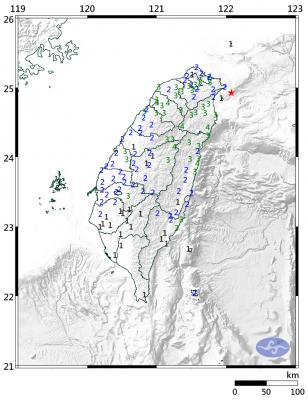
A magnitude 6.1 earthquake struck off the coast of Yilan County at 8:39pm tonight, the Central Weather Administration (CWA) said, with no immediate reports of damage or injuries. The epicenter was 38.7km east-northeast of Yilan County Hall at a focal depth of 98.3km, the CWA’s Seismological Center said. The quake’s maximum intensity, which gauges the actual physical effect of a seismic event, was a level 4 on Taiwan’s 7-tier intensity scale, the center said. That intensity level was recorded in Yilan County’s Nanao Township (南澳), Hsinchu County’s Guansi Township (關西), Nantou County’s Hehuanshan (合歡山) and Hualien County’s Yanliao (鹽寮). An intensity of 3 was

Japanese Prime Minister Sanae Takaichi’s comment last year on Tokyo’s potential reaction to a Taiwan-China conflict has forced Beijing to rewrite its invasion plans, a retired Japanese general said. Takaichi told the Diet on Nov. 7 last year that a Chinese naval blockade or military attack on Taiwan could constitute a “survival-threatening situation” for Japan, potentially allowing Tokyo to exercise its right to collective self-defense. Former Japan Ground Self-Defense Force general Kiyofumi Ogawa said in a recent speech that the remark has been interpreted as meaning Japan could intervene in the early stages of a Taiwan Strait conflict, undermining China’s previous assumptions
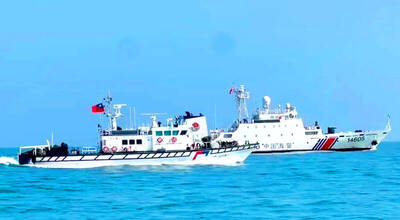
Instead of focusing solely on the threat of a full-scale military invasion, the US and its allies must prepare for a potential Chinese “quarantine” of Taiwan enforced through customs inspections, Stanford University Hoover fellow Eyck Freymann said in a Foreign Affairs article published on Wednesday. China could use various “gray zone” tactics in “reconfiguring the regional and ultimately the global economic order without a war,” said Freymann, who is also a nonresident research fellow at the US Naval War College. China might seize control of Taiwan’s links to the outside world by requiring all flights and ships entering or leaving Taiwan


 RSS
RSS