


Democratic Progressive Party Chairperson Tsai Ing-wen (蔡英文) on Wednesday held closed-door talks in Washington with members of the administration of US President Barack Obama, defense officials, senators and members of Congress from both parties to discuss the future of US-Taiwan relations.
Participants in the meeting later refused to comment on the substance of the talks, but a US Department of State source said that they had gone well and that US officials had been impressed by Tsai’s “eloquence.”
A congressional source said that Tsai had been “impressive” and that she had worked hard to convince US officials that a Democratic Progressive Party (DPP) administration would not unnecessarily provoke Beijing.
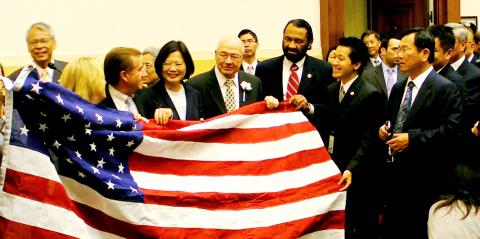
Photo: CNA
“We could work with her. She has a pragmatic approach and understands the reality of the situation,” the source told the Taipei Times.
At a crowded congressional reception on Wednesday night — about 20 representatives and senators from both sides of the aisle attended — Tsai thanked the US Congress for its “commitments to the security of Taiwan, particularly regarding arms sales that are so critical to our defense.”
“My party believes that today we need to engage in a national dialogue to develop a full ‘Taiwan consensus’ that safeguards our sovereignty and brings us to the table with any and all others as equal partners,” Tsai said.
Representative Ileana Ros-Lehtinen, chairman of the House of Representatives Foreign Affairs Committee, heaped praise on Tsai and presented her with a US flag that had been flown earlier in the day over the Capitol building as members rushed forward to be photographed with her.
The reception, held in a committee room in the Rayburn House Office Building on Capitol Hill, attracted officials ranging from American Institute in Taiwan Chairman Raymond Burghardt to a frail-looking Senator Daniel Inouye, the Democrat who chairs the Defense Appropriations Committee and who could be a major ally in the fight to persuade US President Barack Obama to sell advanced F-16C/D aircraft to Taiwan.
Also present was Representative to Washington Jason Yuan (袁健生), who delivered a short speech praising democracy and appeared genuinely pleased to greet Tsai.
The reception was organized and hosted by the Formosa Association for Public Affairs (FAPA), while FAPA executive Coen Blaauw acted as master of ceremonies.
“It is imperative that policymakers in Taiwan understand how Washington works,” FAPA president Bob Yang (楊英育) said.
He said that thanks to Tsai’s leadership, the DPP was again a viable political party ready to take the helm.
Tsai was scheduled to leave Washington for New York and Boston yesterday on a US tour that will take her to Texas and California.

FUKUOKA SITUATION: Japanese media reported that the pathogen is expected to be identified by the summer, while the CDC downplayed the idea that it was hMPV A “mysterious cold-like illness” reported in Japan’s Fukuoka Prefecture does not seem to be a new disease, but Japanese authorities have been asked about the situation, the Centers for Disease Control (CDC) said yesterday. The Fukuoka Prefectural Medical Association on Wednesday told a news conference that a “mystery cold” that has become a hot topic on social media is “highly likely to be caused by some kind of viral infection,” Japan’s KBC News reported. “Many people are experiencing symptoms starting with a sore throat, followed by a runny nose, phlegm and a severe cough,” KBC News reported, citing association officials. Health authorities are

Nvidia Corp CEO Jensen Huang (黃仁勳) arrived in Taiwan yesterday ahead of upcoming AI and technology events, saying he plans to meet with clients and Taiwan Semiconductor Manufacturing Co Chairman C.C. Wei (魏哲家) during his visit. After landing at Taipei Songshan Airport, Huang posed for photos with fans and handed out Yakult drinks to reporters and supporters waiting at the scene, saying he has “a lot to do” during the trip. Asked about reports that Nvidia’s planned headquarters site in Taipei’s Beitou Shilin Technology Park could break ground on May 27, Huang said that if the company holds an event, he would

Carrefour Taiwan is to begin using a new name from the start of July, but it cannot divulge the name until then, the chairman of the supermarket chain's parent company said today. President Chain Store Co chairman Lo Chih-hsien (羅智先) was asked by reporters after a shareholders' meeting to confirm whether the company has settled on a new name for the supermarket brand. In March, the government-registered name of two Carrefour Taiwan branches was quietly changed to "Le Chia Kang" (樂家康) in Chinese, raising speculation that has been selected as the name. Lo said that because of local regulations and contractual obligations, the
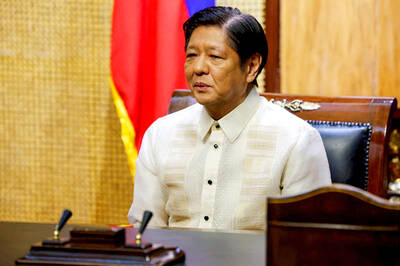
The Philippines would likely be involved in any conflict over Taiwan due to its proximity to the democracy claimed by China, President Ferdinand Marcos Jr said, reiterating a stance that risks angering Beijing. “In the Philippines, we do not have a choice because Taiwan is so close to the Philippines and we have almost 200,000 Filipino nationals living and working in Taiwan,” Marcos said in an interview with Japanese media in Manila on Monday. The Philippine leader’s comments come ahead of a state visit to Japan next week, where he is to meet with Japanese Prime Minister Sanae Takaichi to discuss security


 RSS
RSS