


The year 2027 is regarded as the year China would likely gain the capability to invade Taiwan, not the year it would launch an invasion, Taiwanese defense experts said yesterday.
The experts made the remarks after President William Lai (賴清德) told a news conference on Wednesday that his administration would introduce a NT$1.25 trillion (US$39.8 billion) special defense budget bill to boost Taiwan’s overall defense posture over the next eight years.
Lai said that Beijing aims for military unification of Taiwan by 2027. The Presidential Office later clarified that what Lai meant was that China’s goal is to “prepare for military unification of Taiwan by 2027.”
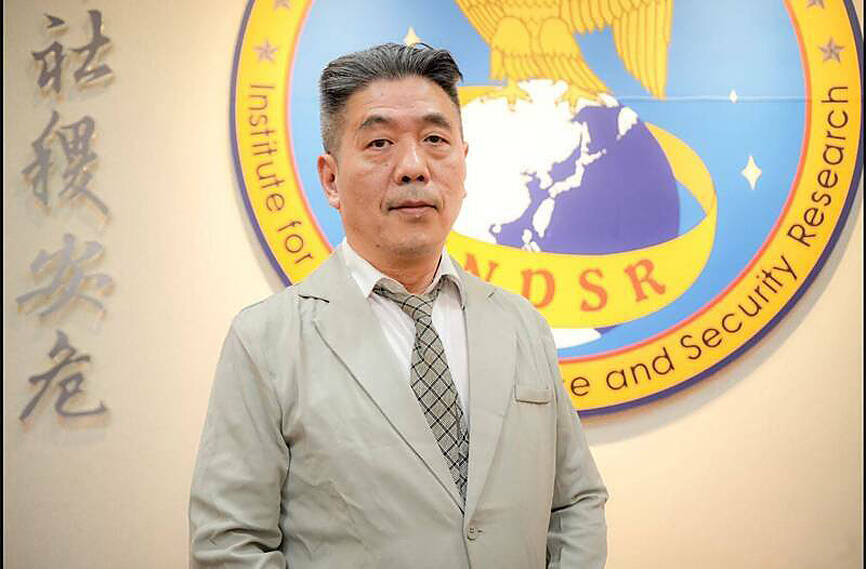
Photo: Taipei Times
Su Tzu-yun (蘇紫雲), director of the Division of Defense Strategy and Resources at the military-funded Institute for National Defense and Security Research, on Thursday said that former top US Indo-Pacific commander Philip Davidson in 2021 predicted that China would attain the military capability to mount an invasion by 2027.
Although the timeframe — later coined the Davidson window — is frequently discussed in the context of Chinese military development, it does not mean that experts believe Beijing would launch an invasion that year, or that it would win if such an attack were attempted, Su said.
For China, obtaining the military capabilities to invade Taiwan enables the Chinese People’s Liberation Army (PLA) to try waging war, but does not guarantee victory, he said.
Davidson’s discussions of the timeframe are speculations based on Chinese President Xi Jinping’s (習近平) publicly stated force modernization goals revolving around scheduled milestone events on the Chinese administrative-political calendar, Su said.
The years 2027, 2035 and 2049 are the years that Xi is anticipated to seek a fourth term as China’s supreme leader, the centennial benchmark of the PLA’s force modernization plan and the People’s Republic of China’s 100th founding anniversary respectively, Su said.
For that reason, Beijing is expected to set 2027 as the year the PLA must acquire the capabilities to conduct an offensive campaign against Taiwan, he said.
Taiwan’s regular military spending accounts for 3.23 percent of GDP, which is low, he said.
Lai’s pledge on Wednesday to invest in national defense is a remedial measure aimed at addressing urgent needs, not a permanent answer to the underlying problem, he said.
While the president’s defense pledge could potentially boost total military spending to 5 percent of GDP by 2030, the appropriate solution should be to achieve the expenditure via the regular defense budget, Su said.
The impact of the COVID-19 pandemic, US-China trade disputes, China’s economic decline and Xi’s military purge have introduced uncertainties about Beijing’s ability to meet the PLA’s force modernization timetable, said Shen Ming-shih (沈明室), another researcher at the institute.
It is unknown whether Xi would remain in power past 2027 and the likelihood of the Chinese leader resorting to invading Taiwan for internal political ends has significantly declined, Shen said.
Additionally, Xi’s repeated public calls on the PLA to be prepared to invade Taiwan suggest that the Chinese military has not achieved its modernization goals, he said.
The Davidson window remains prominent in expert discourse because the concrete dates it furnishes are useful for informing strategic planning, including Taiwan’s timetable for acquiring F-16 jets and M1 tanks, he said.
The public should refrain from incorrectly interpreting Lai’s comments surrounding his pledge to boost defense spending as a prediction that China would attack in 2027, Shen said.
The strategic environment, China’s internal political struggles leading up to the 21st National Congress of the Chinese Communist Party and the PLA’s level of preparedness would likely play major roles in determining whether China would invade, he said.
However, Taiwan’s military capabilities and preparedness — which dictate its deterrence capabilities — remain the most important factors, Shen said.
As there is no possible method to accurately predict if and when war would break out, the best and only measure for the nation is to be prepared to repel a Chinese invasion in 2027, he said.
FUKUOKA SITUATION: Japanese media reported that the pathogen is expected to be identified by the summer, while the CDC downplayed the idea that it was hMPV A “mysterious cold-like illness” reported in Japan’s Fukuoka Prefecture does not seem to be a new disease, but Japanese authorities have been asked about the situation, the Centers for Disease Control (CDC) said yesterday. The Fukuoka Prefectural Medical Association on Wednesday told a news conference that a “mystery cold” that has become a hot topic on social media is “highly likely to be caused by some kind of viral infection,” Japan’s KBC News reported. “Many people are experiencing symptoms starting with a sore throat, followed by a runny nose, phlegm and a severe cough,” KBC News reported, citing association officials. Health authorities are

Nvidia Corp CEO Jensen Huang (黃仁勳) arrived in Taiwan yesterday ahead of upcoming AI and technology events, saying he plans to meet with clients and Taiwan Semiconductor Manufacturing Co Chairman C.C. Wei (魏哲家) during his visit. After landing at Taipei Songshan Airport, Huang posed for photos with fans and handed out Yakult drinks to reporters and supporters waiting at the scene, saying he has “a lot to do” during the trip. Asked about reports that Nvidia’s planned headquarters site in Taipei’s Beitou Shilin Technology Park could break ground on May 27, Huang said that if the company holds an event, he would

Carrefour Taiwan is to begin using a new name from the start of July, but it cannot divulge the name until then, the chairman of the supermarket chain's parent company said today. President Chain Store Co chairman Lo Chih-hsien (羅智先) was asked by reporters after a shareholders' meeting to confirm whether the company has settled on a new name for the supermarket brand. In March, the government-registered name of two Carrefour Taiwan branches was quietly changed to "Le Chia Kang" (樂家康) in Chinese, raising speculation that has been selected as the name. Lo said that because of local regulations and contractual obligations, the
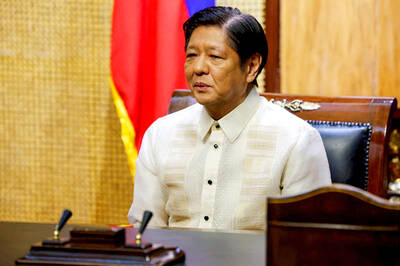
The Philippines would likely be involved in any conflict over Taiwan due to its proximity to the democracy claimed by China, President Ferdinand Marcos Jr said, reiterating a stance that risks angering Beijing. “In the Philippines, we do not have a choice because Taiwan is so close to the Philippines and we have almost 200,000 Filipino nationals living and working in Taiwan,” Marcos said in an interview with Japanese media in Manila on Monday. The Philippine leader’s comments come ahead of a state visit to Japan next week, where he is to meet with Japanese Prime Minister Sanae Takaichi to discuss security


 RSS
RSS