


The Chinese Communist Party (CCP) is building large-scale military infrastructure at five sites along the eastern coast of China, the Mainland Affairs Council (MAC) said in a recent report.
The latest issue of the council’s Mainland China Situation Quarterly said satellite photos showed military infrastructure such as air force and naval bases being constructed along the eastern coast of China.
That means the CCP might be preparing for potential conflict in Taiwan, it said, adding that there are five such construction sites from north to south.
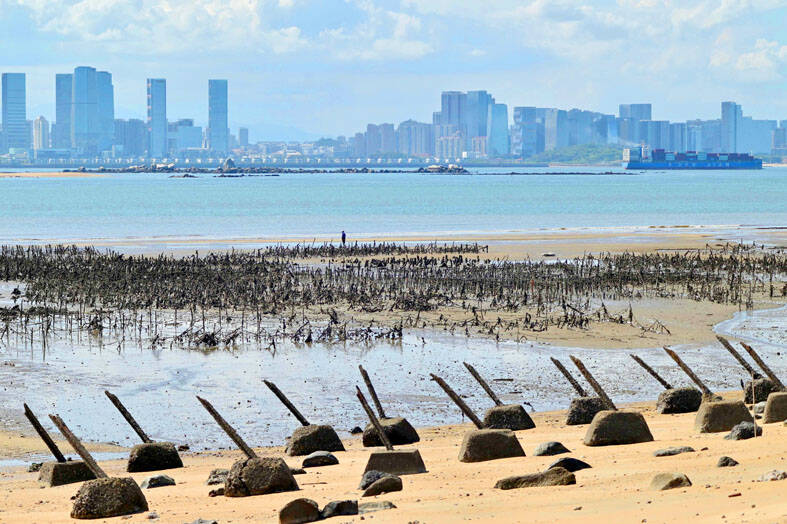
Photo: Sam Yeh, AFP
A naval base has been built in Shanghai’s Pudong New Area, with underground oil storage tanks, railway branch lines and amphibious bases under construction over the past few years, it said.
More than 10 amphibious warships berthed at the naval base in May, including a Type 075 amphibious assault ship, with a combined personnel capacity of about 5,000, it said.
Naval facilities were also built at Zhejiang Province’s Yueqing Bay, including a large wharf that allows numerous vessels to berth and operate there, the council said.
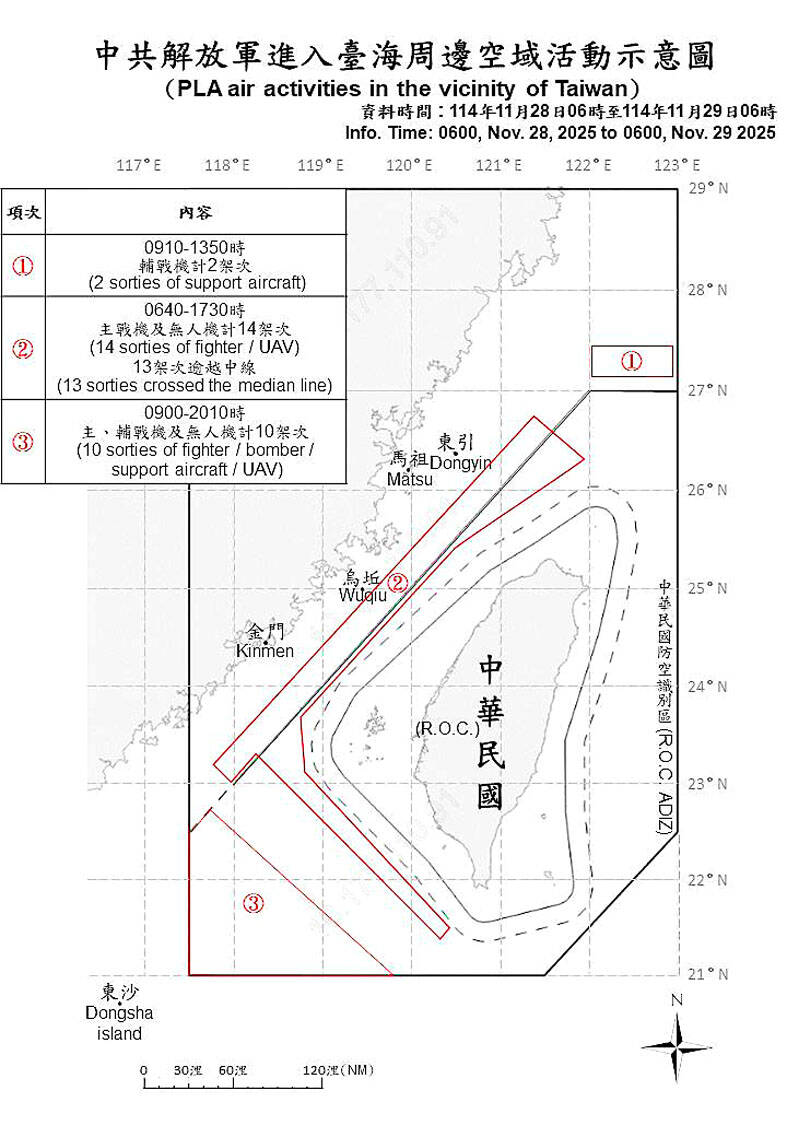
Photo courtesy of the Ministry of National Defense
Infrastructure has been added to Fuzhou Changle International Airport in recent years to provide more space for warplanes’ operations, such as frontline fuel stations or military logistics hubs, it said.
The Xiamen Xiangan International Airport on Dadeng Island — where the area of land reclamation has doubled in recent years — is under construction, with massive railway and highway systems linking to the air cargo hub, the council said.
The airport could be operated militarily when needed and is only 3.7km from Kinmen County, it said.
Helipads and maintenance hangars were added to the newly built helicopter base in Zhangpu County, which could pave the way to seize Penghu County, it said.
Data from the US Department of Defense showed that the Chinese People’s Liberation Army Rocket Force’s (PLARF) stockpile — including nuclear and conventional missiles — has increased by nearly 50 percent over the past four years to about 3,500 missiles, the MAC said, adding that it remained unclear regarding how many of the missiles are deployed along China’s eastern coast and aimed at Taiwan.
However, satellite photos showed that the PLARF has in recent years built larger military bases and more missile launchers along the eastern coast of China, the council said.
They also showed that soldiers engaged in missile-launching drills around farmlands, hidden valleys, high-speed highways and coastal convex banks facing Taiwan, it said.
The overwhelmingly large number of missiles possessed by the CCP is intended to send a political message that Taiwanese resistance is meaningless and that US intervention is impossible, it said, citing the researchers.
Information from multiple sources also showed that Moscow is assisting Beijing in enhancing airborne and special operation capabilities for seizing Taiwan and its outlying islands, the council said.
In related news, the Ministry of National Defense yesterday said its data showed 26 Chinese military aircraft and 10 vessels were detected around Taiwan between 6pm on Friday and 6am yesterday.
Twenty-three of the warplanes crossed the Taiwan Strait’s median line and entered Taiwan’s northern, central and southwestern air defense identification zones, the ministry said.
From 7:40am yesterday, 12 military aircraft were detected conducting operations at sea, crossing the median line, and entering the south and southeast of the air defense identification zone before heading to the western Pacific for “long-range offshore” training, it said.
The armed forces monitored the situation and employed aircraft, navy vessels and coastal missile systems in response to the detected activities, it said.
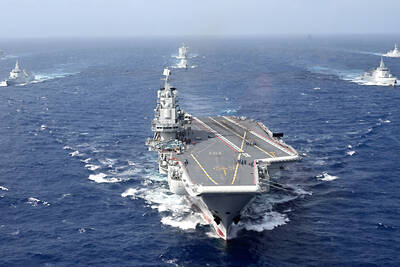
PROVOCATIVE: Chinese Deputy Ambassador to the UN Sun Lei accused Japan of sending military vessels to deliberately provoke tensions in the Taiwan Strait China denounced remarks by Japan and the EU about the South China Sea at a UN Security Council meeting on Monday, and accused Tokyo of provocative behavior in the Taiwan Strait and planning military expansion. Ayano Kunimitsu, a Japanese vice foreign minister, told the Council meeting on maritime security that Tokyo was seriously concerned about the situation in the East China and South China seas, and reiterated Japan’s opposition to any attempt to change the “status quo” by force, and obstruction of freedom of navigation and overflight. Stavros Lambrinidis, head of the EU delegation to the UN, also highlighted South China Sea
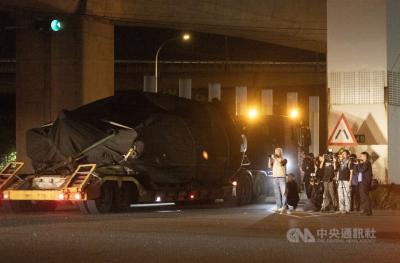
The final batch of 28 M1A2T Abrams tanks purchased from the US arrived at Taipei Port last night and were transported to the Armor Training Command in Hsinchu County’s Hukou Township (湖口), completing the military’s multi-year procurement of 108 of the tanks. Starting at 12:10am today, reporters observed more than a dozen civilian flatbed trailers departing from Taipei Port, each carrying an M1A2T tank covered with black waterproof tarps. Escorted by military vehicles, the convoy traveled via the West Coast Expressway to the Armor Training Command, with police implementing traffic control. The army operates about 1,000 tanks, including CM-11 Brave Tiger
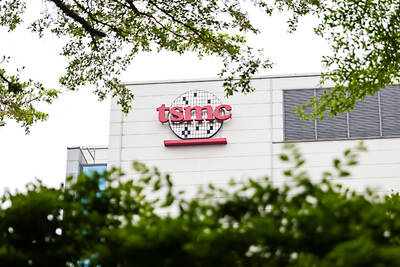
Taiwan Semiconductor Manufacturing Co (TSMC, 台積電), the world’s largest contract chipmaker, said it expects its 2-nanometer (2nm) chip capacity to grow at a compound annual rate of 70 percent from this year to 2028. The projection comes as five fabs begin volume production of 2-nanometer chips this year — two in Hsinchu and three in Kaohsiung — TSMC senior vice president and deputy cochief operating officer Cliff Hou (侯永清) said at the company’s annual technology symposium in Silicon Valley, California, last week. Output in the first year of 2-nanometer production, which began in the fourth quarter of last year, is expected to
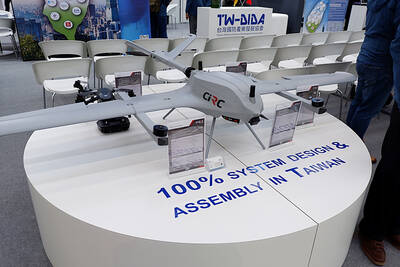
Taiwan’s drone exports surged past US$100 million in the first quarter, exceeding last year’s full-year total, with the Czech Republic emerging as the largest buyer, the Ministry of Economic Affairs said. Exports of complete drones reached US$115.85 million in the period, about 1.2 times the total recorded for all of last year, the ministry said in a report. Exports to the Czech Republic accounted for about US$100 million, far outpacing other markets. Poland, last year’s top destination, recorded about US$11.75 million in the first quarter. Taiwan’s drone exports have expanded rapidly in the past few years, with last year’s total


 RSS
RSS