


There is no need to amend the law to exempt Chinese spouses from single allegiance to the Republic of China (ROC), President William Lai (賴清德) said yesterday, adding that such changes would only increase the public’s doubts toward new residents from China and would not improve social harmony.
Taiwan is a democratic, diverse and free country, he said.
“No matter which ethnic group you belong to, where you come from or when you arrive, as long as you identify with Taiwan, you are masters of this country,” he said.
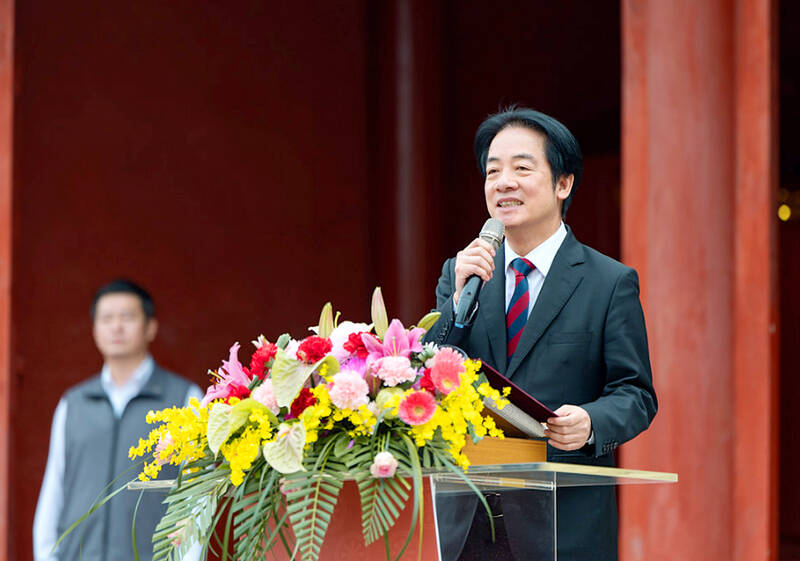
Photo: screen grab from the Presidential Office’s Flickr page
Taiwan is a democratic nation that follows the rule of law, where immigrants are all equally protected by the law, he said, adding that those who contravene the rules must be dealt with according to the law.
“This has nothing to do with ethnicity or identity. Before the law, everyone is equal,” he said.
Nationality Act (國籍法) amendments are unnecessary and redundant, Lai said.
There is no need to revise the act to specially exempt immigrants from China from pledging singular loyalty to the ROC, he said, adding that the move would not be beneficial to immigrants and could increase social concerns, undermining social harmony.
“Don’t love in a way that leads to harm,” Lai said, urging legislators to think twice about revising the law and to work together to safeguard national security, promote unity and focus on making Taiwan more progressive.
Lai also expressed his gratitude for the efforts and contributions of the hundreds of thousands of immigrants in Taiwan.
There are countless heartwarming stories of immigrants integrating into Taiwanese society, Lai said.
He cited as an example South Korean YouTuber Kim Jin-young, better known by her handle “ggu_Kim,” who recently obtained her residency status and used the NT$10,000 cash handout she received from the government to pay for a large billboard in South Korea promoting Taiwan as a travel destination.
Another example is Larisa Bakurova, a gymnastics champion from Ukraine, who, after marrying a Taiwanese, fully dedicated herself to her profession and trained young Taiwanese athletes to shine on the international stage, Lai said.
He also mentioned Chinese spouse Qiu Qiaozhu (邱巧珠) from Fujian, who married into a family in Yunlin County and joined her husband’s family egg wholesale business.
She has not forgotten to give back to the community and is helping the disadvantaged, Lai said.
In related news, the Chinese Nationalist Party’s (KMT) proposed amendment to the Nationality Act, led by caucus whip Fu Kun-chi’s, was yesterday referred to the legislature’s Internal Administration Committee for review.
The proposed amendment follows several recent cases in which Chinese spouse of Taiwanese nationals were removed from office after failing to provide proof that they had relinquished their People's Republic of China (PRC) nationality.
The draft amendment to the Nationality Act stipulates that the political rights of residents from China should be governed by the Act Governing Relations Between the People of the Taiwan Area and the Mainland Area (臺灣地區與大陸地區人民關係條例)
Under this framework, Chinese spouses who have household registration in Taiwan would no longer be subject to Article 20 of the Nationality Act.
Article 20 requires ROC nationals who hold a foreign nationality to renounce it within one year of assuming public positions, with failure to comply resulting in removal from office.
According to the bill's explanatory note, the Nationality Act currently governs only the acquisition, loss, restoration, and revocation of ROC nationality, and does not clearly define its applicability to mainland Chinese residents.
In practice, this has created confusion between Article 20's renunciation requirement and the provisions of the cross-strait relations act, undermining legal clarity and predictability, according to the bill's authors.
It is believed to be impossible for China-born spouses to provide proof they had renounced their Chinese citizenship because Beijing does not issue the necessary documents since it considers Taiwan as a part of China and its residents as its own citizens.
Under PRC law, Chinese nationals who have settled abroad and been naturalized as a foreign national "shall" automatically lose Chinese nationality.
The KMT argues that Chinese spouses' political rights should be evaluated under the cross-strait relations act, which already provides a distinct framework for household registration, employment, and eligibility to stand for election -- and that this special law should take precedence to avoid misapplication of the Nationality Act.
Fu's proposed amendment was placed on yesterday's plenary agenda by the Legislature's Procedure Committee. As no objections were raised during the reading of reports, the bill was referred to committee for further deliberation.
The committee is slated to hold a public hearing next week on the amendment, at which they would discuss other countries’ regulations on naturalized citizens or dual nationals holding public office; whether the current rules on foreign nationals, naturalized citizens or dual nationals holding public office are appropriate; and other legislative recommendations for amending the Nationality Act.
Additional reporting by CNA, Liu Wan-lin and Chen Cheng- yu

Auckland rang in 2026 with a downtown fireworks display launched from New Zealand’s tallest structure, Sky Tower, making it the first major city to greet the new year at a celebration dampened by rain, while crowds in Taipei braved the elements to watch Taipei 101’s display. South Pacific countries are the first to bid farewell to 2025. Clocks struck midnight in Auckland, with a population of 1.7 million, 18 hours before the famous ball was to drop in New York’s Times Square. The five-minute display involved 3,500 fireworks launched from the 240m Sky Tower. Smaller community events were canceled across New Zealand’s
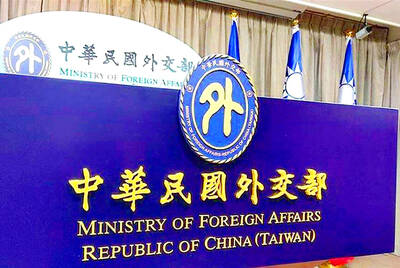
The Ministry of Foreign Affairs (MOFA) yesterday said it is closely monitoring developments in Venezuela, and would continue to cooperate with democratic allies and work together for regional and global security, stability, and prosperity. The remarks came after the US on Saturday launched a series of airstrikes in Venezuela and kidnapped Venezuelan President Nicolas Maduro, who was later flown to New York along with his wife. The pair face US charges related to drug trafficking and alleged cooperation with gangs designated as terrorist organizations. Maduro has denied the allegations. The ministry said that it is closely monitoring the political and economic situation
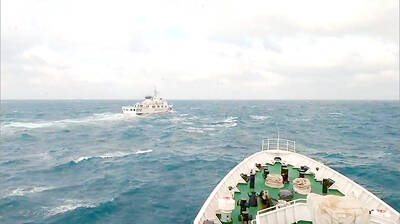
‘SLICING METHOD’: In the event of a blockade, the China Coast Guard would intercept Taiwanese ships while its navy would seek to deter foreign intervention China’s military drills around Taiwan this week signaled potential strategies to cut the nation off from energy supplies and foreign military assistance, a US think tank report said. The Chinese People’s Liberation Army (PLA) conducted what it called “Justice Mission 2025” exercises from Monday to Tuesday in five maritime zones and airspace around Taiwan, calling them a warning to “Taiwanese independence” forces. In a report released on Wednesday, the Institute for the Study of War said the exercises effectively simulated blocking shipping routes to major port cities, including Kaohsiung, Keelung and Hualien. Taiwan would be highly vulnerable under such a blockade, because it

UNRELENTING: China attempted cyberattacks on Taiwan’s critical infrastructure 2.63 million times per day last year, up from 1.23 million in 2023, the NSB said China’s cyberarmy has long engaged in cyberattacks against Taiwan’s critical infrastructure, employing diverse and evolving tactics, the National Security Bureau (NSB) said yesterday, adding that cyberattacks on critical energy infrastructure last year increased 10-fold compared with the previous year. The NSB yesterday released a report titled Analysis on China’s Cyber Threats to Taiwan’s Critical Infrastructure in 2025, outlining the number of cyberattacks, major tactics and hacker groups. Taiwan’s national intelligence community identified a large number of cybersecurity incidents last year, the bureau said in a statement. China’s cyberarmy last year launched an average of 2.63 million intrusion attempts per day targeting Taiwan’s critical


 RSS
RSS