


A trial run of the north concourse of Taiwan Taoyuan International Airport’s new Terminal 3 is to commence today, the Ministry of Transportation and Communications said yesterday.
The eight additional boarding gates would allow for more aircraft parking spaces that are expected to boost the airport’s capacity by 5.8 million passengers annually, Deputy Minister of Transportation and Communications Lin Kuo-shian (林國顯) said.
The concourse, designed by a team led by British architect Richard Rogers, provides a refreshing space, Lin said, adding that travelers would enjoy the tall and transparent design that allows sunshine to stream into the concourse through glass curtain walls.
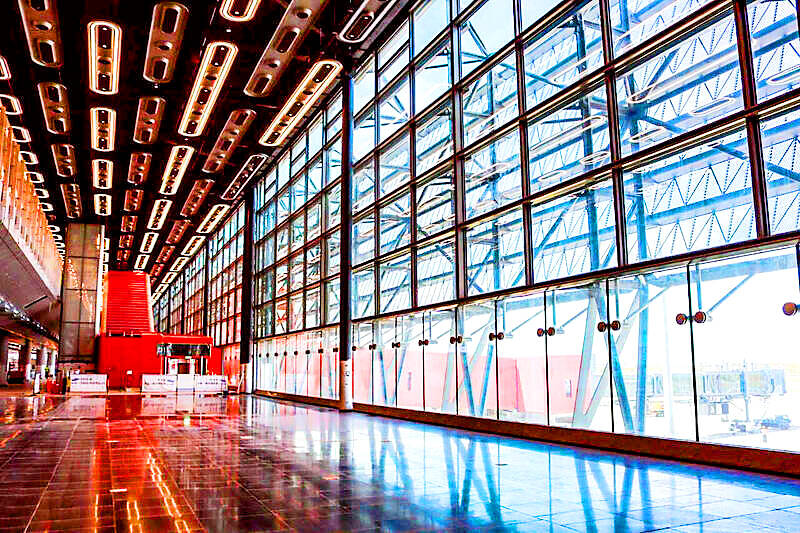
Photo courtesy of Taoyuan International Airport Corp
The other two terminals have a total capacity of 37 million passengers, which is insufficient to meet increasing demand.
Terminal 3 is under construction in phases and is projected to be fully completed by 2027, providing additional capacity for 45 million passengers, further increasing the airport’s overall capacity to 82 million passengers per year, the ministry said.
Travelers can use eight new boarding gates, with eight departure lounges, D11 to D18, it said.
It is only a 15-minute walk from Terminal 2 to the farthest boarding gate at the concourse thanks to moving walkways, it added.
Shuttles are also available for people with reduced mobility.
Travelers departing from the north concourse must check in and go through customs from Terminal 2, as the main structure of Terminal 3 has yet to be completed.
Those who arrive at the concourse would also collect their luggage at Terminal 2.
Additional reporting by CNA
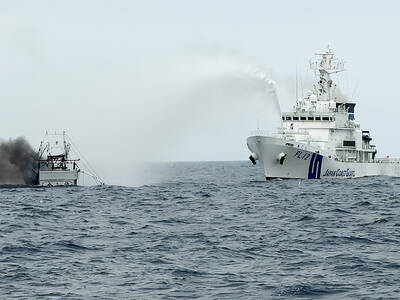
CREDIT-GRABBER: China said its coast guard rescued the crew of a fishing vessel that caught fire, who were actually rescued by a nearby Taiwanese boat and the CGA Maritime search and rescue operations do not have borders, and China should not use a shipwreck to infringe upon Taiwanese sovereignty, the Coast Guard Administration (CGA) said yesterday. The coast guard made the statement in response to the China Coast Guard (CCG) saying it saved a Taiwanese fishing boat. The Chuan Yu No. 6 (全漁6號), a fishing vessel registered in Keelung, on Thursday caught fire and sank in waters northeast of Diaoyutai Islands (釣魚台). The vessel left Keelung’s Badouzih Fishing Harbor (八斗子漁港) at 3:35pm on Sunday last week, with seven people on board — a 62-year-old Taiwanese captain surnamed Chang (張) and six

The Legislative Yuan’s Finance Committee yesterday approved proposed amendments to the Amusement Tax Act (娛樂稅法) that would abolish taxes on films, cultural activities and competitive sporting events, retaining the fee only for dance halls and golf courses. The proposed changes would set the maximum tax rate for dance halls and golf courses at 50 and 20 percent respectively, with local governments authorized to suspend the levies. Article 2 of the act says that “amusement tax shall be levied on tickets sold or fees charged by amusement places, facilities or activities” in six categories: “Cinema; professional singing, story-telling, dancing, circus, magic show, acrobatics
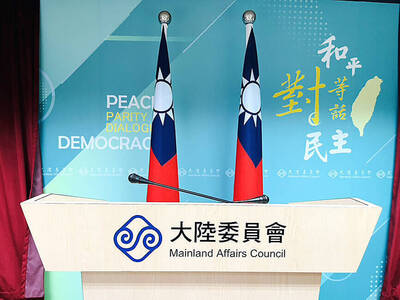
RISKY BUSINESS: The ‘incentives’ include initiatives that get suspended for no reason, creating uncertainty and resulting in considerable losses for Taiwanese, the MAC said China’s “incentives” failed to sway sentiment in Taiwan, as willingness to work in China hit a record low of 1.6 percent, a Ministry of Labor survey showed. The Directorate-General of Budget, Accounting and Statistics (DGBAS) also reported that the number of Taiwanese workers in China has nearly halved from a peak of 430,000 in 2012 to an estimated 231,000 in 2024. That marked a new low in the proportion of Taiwanese going abroad to work. The ministry’s annual survey on “Labor Life and Employment Status” includes questions respondents’ willingness to seek employment overseas. Willingness to work in China has steadily declined from

Tainan, Taipei and New Taipei City recorded the highest fines nationwide for illegal accommodations in the first quarter of this year, with fines issued in the three cities each exceeding NT$7 million (US$220,639), Tourism Administration data showed. Among them, Taipei had the highest number of illegal short-term rental units, with 410. There were 3,280 legally registered hotels nationwide in the first quarter, down by 14 properties, or 0.43 percent, from a year earlier, likely indicating operators exiting the market, the agency said. However, the number of unregistered properties rose to 1,174, including 314 illegal hotels and 860 illegal short-term rental


 RSS
RSS