


Lawmakers yesterday unanimously approved an amendment to categorize rice wine as cooking wine, a move that has provoked concerns in the EU and US over a possible breach of Taiwan’s compliance with its WTO obligations.
The revision to the Tobacco and Liquor Tax Act (菸酒稅法) will lower the tax on a 600ml bottle of rice wine to NT$5.4 per bottle, from NT$29.25 when it was previously defined as “distilled liquor” as requested by the WTO. In turn, this will reduce the price of the popular cooking ingredient to NT$25 per bottle.
The amendment also applies to imported cooking rice wine, meaning that local products will not be receiving preferential treatment.
The Chinese Nationalist Party (KMT)-dominated legislature also approved by vote an amendment initiated by the party to revise the Civil Servants Election and Recall Act (公職人員選舉罷免法), criticized by the Democratic Progressive Party (DPP) as serving KMT interests.
The revised act stipulates that the boundary demarcation of constituencies from the seventh legislative term should be applied to next year’s election and that the boundaries only be reviewed every 10 years.
The move would annul a proposal drafted by the government under which the number of seats in Greater Tainan would see a one-seat increase in the next legislative term, while the number of districts in Greater Kaohsiung would have one less seat than in the current legislative term.
DPP Legislator William Lai (賴清德) accused the KMT of sacrificing the interests of people in Greater Tainan for the sake of the party, as the KMT thought it would be easier for the party to have its lawmakers elected in Kaohsiung than in Tainan, traditionally a DPP stronghold.
Lai said that as the population of Greater Tainan exceeds 1.8 million, it is entitled by Article 4 of the Constitution to an additional seat.
KMT Legislator Chang Hsien-yao (張顯耀) said the revision was to ensure the constituency boundaries would not be changed too often.
The DPP failed in another vote to add changes to the Amendments to the Act Governing Preferential Treatment for Retired Presidents and Vice Presidents (卸任總統副總統禮遇條例) introduced by the KMT.
According to the amended act, all preferential treatment given to former presidents and vice presidents who are convicted in a first trial over charges of sedition, treason and corruption would be suspended. At present, that treatment will not be suspended until a final verdict is given. The number of bodyguards assigned to former presidents and vice presidents who are convicted of corruption in a first trial will also be reduced.
Also See: Taiwan faces tough WTO fight to slash rice wine tax

Taiwanese were praised for their composure after a video filmed by Taiwanese tourists capturing the moment a magnitude 7.5 earthquake struck Japan’s Aomori Prefecture went viral on social media. The video shows a hotel room shaking violently amid Monday’s quake, with objects falling to the ground. Two Taiwanese began filming with their mobile phones, while two others held the sides of a TV to prevent it from falling. When the shaking stopped, the pair calmly took down the TV and laid it flat on a tatami mat, the video shows. The video also captured the group talking about the safety of their companions bathing
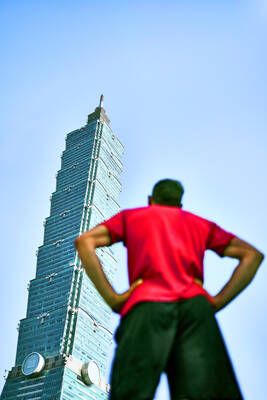
US climber Alex Honnold is to attempt to scale Taipei 101 without a rope and harness in a live Netflix special on Jan. 24, the streaming platform announced on Wednesday. Accounting for the time difference, the two-hour broadcast of Honnold’s climb, called Skyscraper Live, is to air on Jan. 23 in the US, Netflix said in a statement. Honnold, 40, was the first person ever to free solo climb the 900m El Capitan rock formation in Yosemite National Park — a feat that was recorded and later made into the 2018 documentary film Free Solo. Netflix previewed Skyscraper Live in October, after videos

Starting on Jan. 1, YouBike riders must have insurance to use the service, and a six-month trial of NT$5 coupons under certain conditions would be implemented to balance bike shortages, a joint statement from transportation departments across Taipei, New Taipei City and Taoyuan announced yesterday. The rental bike system operator said that coupons would be offered to riders to rent bikes from full stations, for riders who take out an electric-assisted bike from a full station, and for riders who return a bike to an empty station. All riders with YouBike accounts are automatically eligible for the program, and each membership account

A classified Pentagon-produced, multiyear assessment — the Overmatch brief — highlighted unreported Chinese capabilities to destroy US military assets and identified US supply chain choke points, painting a disturbing picture of waning US military might, a New York Times editorial published on Monday said. US Secretary of Defense Pete Hegseth’s comments in November last year that “we lose every time” in Pentagon-conducted war games pitting the US against China further highlighted the uncertainty about the US’ capability to intervene in the event of a Chinese invasion of Taiwan. “It shows the Pentagon’s overreliance on expensive, vulnerable weapons as adversaries field cheap, technologically


 RSS
RSS