


Farmers who had their land expropriated by the government for development projects yesterday protested a draft act to facilitate industrial development, expressing concern that the bill could turn the government into a tool of large corporations.
“The government compensated us with a little over NT$9,000 per ping [3.3m²], when our farmland was expropriated, but the published real estate price is more than NT$40,000 per ping,” Wang Wan-ying (王婉盈), a farmer from Taichung County whose land was taken over by the government to be made part of Central Taiwan Science Park, said at a press conference at the legislature.
Wang said she was also concerned about her family's future.
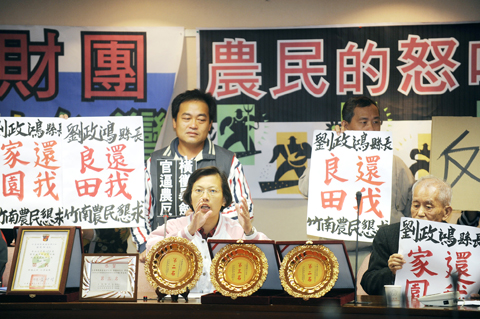
PHOTO: GEORGE TSORNG, TAIPEI TIMES
“Premier Wu Den-yih (吳敦義) may want to lower the unemployment rate by creating more industrial parks, but taking land from farmers is killing us — what are we going to do without land?” she asked.
“It’s ironic that my family was one of the farming families trained by the government in advanced agricultural techniques, because now it’s the government that’s destroying our livelihood,” Wang said, while displaying several awards to her family for excellence in agricultural production.
Wang’s family is not an isolated case.
Farmers from Miaoli, Changhua, Hsinchu and Hualien counties whose land was also expropriated for either industrial parks or resorts joined Wang in her protest.
Democratic Progressive Party (DPP) Legislator Lin Shu-fen (林淑芬) said that the newly developed industrial parks were the result of the Act for Upgrading Industries (促進產業升級條例), which expired at the end of last year.
However, the government has drafted an act on innovative industries — which also includes clauses authorizing governments to help expropriate land for certain business investments — as an extension of the expired law.
“Thousands of hectares are still unused in previously completed industrial parks, so the government has no reason to take more land from farmers until all the previously expropriated land has been put to good use,” Lin said. “I suspect that the government is doing so not for the public interest. Rather, they are doing so in the interest of large corporations and real estate developers.”
The Alliance for Fair Tax Reform, which supports the farmers, agreed and cited the project to move the Taipei Detention Center in Tucheng City, Taipei County, as an example.
According to the plan, Taipei County Government will expropriate 126 hectares of land to build the new Taipei Detention Center; however, the detention center would only take up around 10 to 20 hectares. The rest would be turned into residential and commercial districts.
“Such a case is not an isolated one, rather, it is just one example of how the government and corporations work together to exploit the disadvantaged,” the alliance said.

FUKUOKA SITUATION: Japanese media reported that the pathogen is expected to be identified by the summer, while the CDC downplayed the idea that it was hMPV A “mysterious cold-like illness” reported in Japan’s Fukuoka Prefecture does not seem to be a new disease, but Japanese authorities have been asked about the situation, the Centers for Disease Control (CDC) said yesterday. The Fukuoka Prefectural Medical Association on Wednesday told a news conference that a “mystery cold” that has become a hot topic on social media is “highly likely to be caused by some kind of viral infection,” Japan’s KBC News reported. “Many people are experiencing symptoms starting with a sore throat, followed by a runny nose, phlegm and a severe cough,” KBC News reported, citing association officials. Health authorities are

Nvidia Corp CEO Jensen Huang (黃仁勳) arrived in Taiwan yesterday ahead of upcoming AI and technology events, saying he plans to meet with clients and Taiwan Semiconductor Manufacturing Co Chairman C.C. Wei (魏哲家) during his visit. After landing at Taipei Songshan Airport, Huang posed for photos with fans and handed out Yakult drinks to reporters and supporters waiting at the scene, saying he has “a lot to do” during the trip. Asked about reports that Nvidia’s planned headquarters site in Taipei’s Beitou Shilin Technology Park could break ground on May 27, Huang said that if the company holds an event, he would

The Ministry of Finance this afternoon announced the winning numbers for the March-April uniform invoice lottery. The winning number for the NT$10 million (US$318,060) special prize is 19531471, and the winning number for the NT$2 million grand prize is 85941329. Three numbers were drawn for the NT$200,000 first prize: 07225810, 20231230 and 83518781. Those with receipts matching the last seven digits of any of the first-prize numbers will win the NT$40,000 second prize, while those matching the last six digits will win the NT$10,000 third prize. Those whose receipts match the last five digits of the first-prize numbers can claim the NT$4,000 fourth prize,
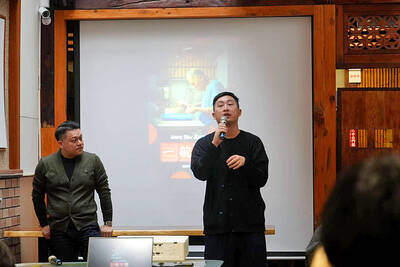
Taiwan Travelogue (臺灣漫遊錄), which earlier this week became the first Taiwanese novel to win the International Booker Prize, is to be adapted into a television series through a Taiwan-Japan coproduction, producer Chang Chen-yu (張辰漁) said yesterday. Chang, a producer at World Softest Production Film Co, wrote on Facebook that the company had been searching for projects with international appeal that retain a strong Taiwanese identity after colleagues and Japanese partners strongly recommended the novel. After reading the book, Chang said he immediately decided to pursue the screen rights. “A great story has the power to transcend time and borders, and connect countless people,”


 RSS
RSS