


Straits Exchange Foundation (SEF) Chairman Chiang Pin-kung (江丙坤) yesterday said that Taipei and Beijing were likely to sign an economic cooperation framework agreement (ECFA) in June.
As Taipei hopes to ink the proposed pact by the first half of the year, June would be a good time to do so if the SEF and its Chinese counterpart, the Association for Relations Across the Taiwan Strait (ARATS), could wrap up negotiations next month or by May, Chiang said on the sidelines of an event marking the SEF’s 19th anniversary.
The two sides held the first round of official negotiations on the planned accord in January and Taipei is set to host the second round this month.
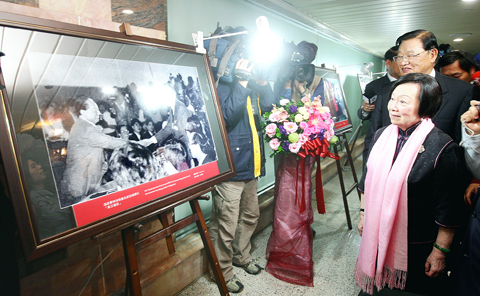
PHOTO: CNA
Chiang said the time and place for the second round of official talks are being arranged and he was still waiting for authorization from the Mainland Affairs Council (MAC) to negotiate with ARATS on three issues during his upcoming meeting with ARATS Chairman Chen Yunlin (陳雲林).
Chiang and Chen agreed in December to address three issues in the next meeting: an ECFA proposal, protection of intellectual property rights (IPR) and avoiding double taxation.
The Ministry of Economic Affairs has drafted an IPR protection proposal, Chiang said, adding that the SEF would proceed to arrange high-level talks for both sides to finalize the wording as soon as the government gives it the go-ahead.
Commenting on rumors that Taipei has cut the “early harvest” items from about 500 to 200, Chiang said it was just media speculation, adding that negotiations were a matter of give-and-take.
It was natural to make more demands at the beginning and the two sides would not know what the final items would be until the negotiations conclude, he said.
Asked to comment on Chinese Prime Minister Wen Jiabao’s (溫家寶) remark that Beijing was willing to “yield interests” to Taiwan, Chiang said it was the consensus of the two sides to sign an ECFA as soon as possible.
“The negotiation team’s job is to seek the best interests for Taiwan’s economic development,” he said. “It’s hard to determine whether he [Wen] is sincere about what he said until the end of negotiations.”
Also present at yesterday’s event was Cecilia Koo (辜嚴倬雲), the widow of former SEF chairman Koo Chen-fu (辜振甫). She tearfully recalled her late husband and his “favorite job” as cross-strait negotiator.
Describing her late husband as the “most patriotic businessman,” Cecilia Koo said he committed himself to striving for the legitimacy of the Republic of China on Taiwan.
Cecilia Koo said people on both sides of the Strait share the same ancestry and are all yan huang zisun (炎黃子孫), or descendants of emperors Yan and Huang — but added that each side is self-governed and it is important for both sides to get along peacefully.
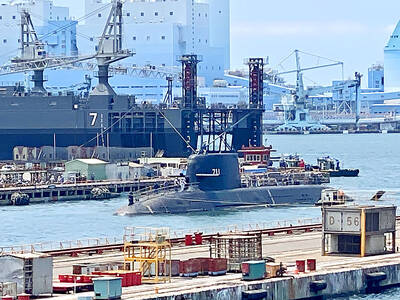
AGING: While Japan has 22 submarines, Taiwan only operates four, two of which were commissioned by the US in 1945 and 1946, and transferred to Taiwan in 1973 Taiwan would need at least 12 submarines to reach modern fleet capabilities, CSBC Corp, Taiwan chairman Chen Cheng-hung (陳政宏) said in an interview broadcast on Friday, citing a US assessment. CSBC is testing the nation’s first indigenous defense submarine, the Hai Kun (海鯤, Narwhal), which is scheduled to be delivered to the navy next month or in July. The Hai Kun has completed torpedo-firing tests and is scheduled to undergo overnight sea trials, Chen said on an SET TV military affairs program. Taiwan would require at least 12 submarines to establish a modern submarine force after assessing the nation’s operational environment and defense
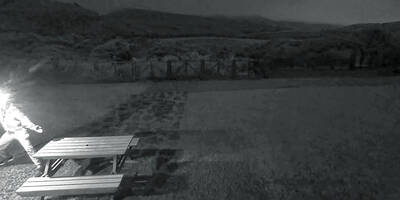
Yangmingshan National Park authorities yesterday urged visitors to respect public spaces and obey the law after a couple was caught on a camera livestream having sex at the park’s Qingtiangang (擎天崗) earlier in the day. The Shilin Police Precinct in Taipei said it has identified a suspect and his vehicle registration number, and would summon him for questioning. The case would be handled in accordance with public indecency charges, it added. The couple entered the park at about 11pm on Thursday and began fooling around by 1am yesterday, the police said, adding that the two were unaware of the park’s all-day live
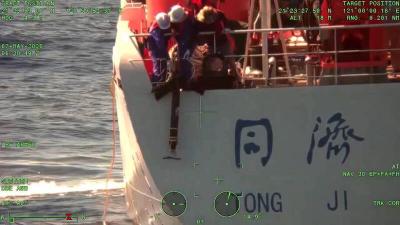
The coast guard today said that it had disrupted "illegal" operations by a Chinese research ship in waters close to the nation and driven it away, part of what Taipei sees a provocative pattern of China's stepped up maritime activities. The coast guard said that it on Thursday last week detected the Chinese ship Tongji (同濟號), which was commissioned only last year, 29 nautical miles (54km) southeast of the southern tip of Taiwan, although just outside restricted waters. The ship was observed lowering ropes into the water, suspected to be the deployment of scientific instruments for "illegal" survey operations, and the coast

A former soldier and an active-duty army officer were yesterday indicted for allegedly selling classified military training materials to a Chinese intelligence operative for a total of NT$79,440. The Taipei District Prosecutors’ Office indicted Chen Tai-yin (陳泰尹) and Lee Chun-ta (李俊達) for contravening the National Security Act (國家安全法) and the Anti-Corruption Act (貪污治罪條例). Chen left the military in September 2013 after serving alongside then-staff sergeant Lee, now an army lieutenant, at the 21st Artillery Command of the army’s Sixth Corps from 2011 to 2013, according to the indictment. Chen met a Chinese intelligence operative identified as “Wang” (王) through a friend in November


 RSS
RSS