


By Flora Wang
STAFF REPORTER
The legislature is girding for a fight tomorrow as lawmakers remain divided on amending the Act Governing Food Sanitation (食品衛生管理法) to ban “risky” US beef products despite a looming deadline to push through legislation.
Democratic Progressive Party (DPP) caucus whip Wang Sing-nan (王幸男) told reporters yesterday the caucus might paralyze tomorrow’s plenary session if no agreement is reached on the wording of relevant proposals by tomorrow.
The DPP caucus has objected to a proposed amendment submitted by the Chinese Nationalist Party (KMT) last Tuesday to authorize the government to “draw up measures to inspect beef products from areas where the risk of mad cow disease has been under control.”
The caucus has also expressed concern that the KMT’s proposal doesn’t mention “banning” US beef. It has accused the KMT of trying to violate a legislative consensus to prohibit the import of risky US beef products.
The government lifted a ban on US bone-in beef, as well as offal and ground beef from cattle younger than 30 months, on Nov. 2.
Legislators reached a consensus on Nov. 6 that the legislature should amend the law to ban potentially dangerous bovine intestines, ground beef, spinal cords, brains, skulls and eyes from being imported. They agreed to complete the amendment by tomorrow.
KMT caucus whip Lin Yi-shih (林益世) said the KMT would not forcibly push through its proposal tomorrow if lawmakers failed to reach a consensus.
KMT caucus secretary-general Lu Hsueh-chang (呂學樟) said the legislature’s move was meant to safeguard public health.
If the DPP boycotts the plenary session, it would prove that the party doesn’t care about the public’s health, Lu said.
Meanwhile, in response to a march on Saturday by thousands of people demanding the government reopen negotiations on beef imports with the US, Presidential Office Spokesman Wang Yu-chi (王郁琦) said yesterday the government has heard the criticism.
The Presidential Office and Executive Yuan would continue to negotiate with the legislature on proposed revisions to the food safety laws, Wang said.
“We will amend the law in a way that will protect public health and not violate our international obligation,” Wang said.
The amendments must not tamper with the spirit of the WTO and World Organization for Animal Health (OIE), he said.
ADDITIONAL REPORTING BY KO SHU-LING
Also See: [ LETTERS ]

The military has spotted two Chinese warships operating in waters near Penghu County in the Taiwan Strait and sent its own naval and air forces to monitor the vessels, the Ministry of National Defense (MND) said. Beijing sends warships and warplanes into the waters and skies around Taiwan on an almost daily basis, drawing condemnation from Taipei. While the ministry offers daily updates on the locations of Chinese military aircraft, it only rarely gives details of where Chinese warships are operating, generally only when it detects aircraft carriers, as happened last week. A Chinese destroyer and a frigate entered waters to the southwest

The eastern extension of the Taipei MRT Red Line could begin operations as early as late June, the Taipei Department of Rapid Transit Systems said yesterday. Taipei Rapid Transit Corp said it is considering offering one month of free rides on the new section to mark its opening. Construction progress on the 1.4km extension, which is to run from the current terminal Xiangshan Station to a new eastern terminal, Guangci/Fengtian Temple Station, was 90.6 percent complete by the end of last month, the department said in a report to the Taipei City Council's Transportation Committee. While construction began in October 2016 with an
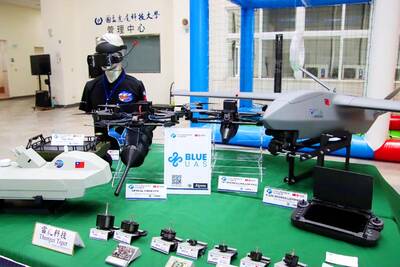
NON-RED SUPPLY: Boosting the nation’s drone industry is becoming increasingly urgent as China’s UAV dominance could become an issue in a crisis, an analyst said Taiwan’s drone exports to Europe grew 41.7-fold from 2024 to last year, with demand from Ukraine’s fight against Russian aggression the most likely driver of growth, a study showed. The Institute for Democracy, Society and Emerging Technology (DSET) in a statement on Wednesday said it found that many of Taiwan’s uncrewed aerial vehicle (UAV) sales were from Poland and the Czech Republic. These countries likely transferred the drones to Ukraine to aid it in its fight against the Russian invasion that started in 2022, it said. Despite the gains, Taiwan is not the dominant drone exporter to these markets, ranking second and fourth

Japanese Prime Minister Sanae Takaichi’s comment last year on Tokyo’s potential reaction to a Taiwan-China conflict has forced Beijing to rewrite its invasion plans, a retired Japanese general said. Takaichi told the Diet on Nov. 7 last year that a Chinese naval blockade or military attack on Taiwan could constitute a “survival-threatening situation” for Japan, potentially allowing Tokyo to exercise its right to collective self-defense. Former Japan Ground Self-Defense Force general Kiyofumi Ogawa said in a recent speech that the remark has been interpreted as meaning Japan could intervene in the early stages of a Taiwan Strait conflict, undermining China’s previous assumptions


 RSS
RSS