


Taiwan’s drone exports to Europe grew 41.7-fold from 2024 to last year, with demand from Ukraine’s fight against Russian aggression the most likely driver of growth, a study showed.
The Institute for Democracy, Society and Emerging Technology (DSET) in a statement on Wednesday said it found that many of Taiwan’s uncrewed aerial vehicle (UAV) sales were from Poland and the Czech Republic.
These countries likely transferred the drones to Ukraine to aid it in its fight against the Russian invasion that started in 2022, it said.
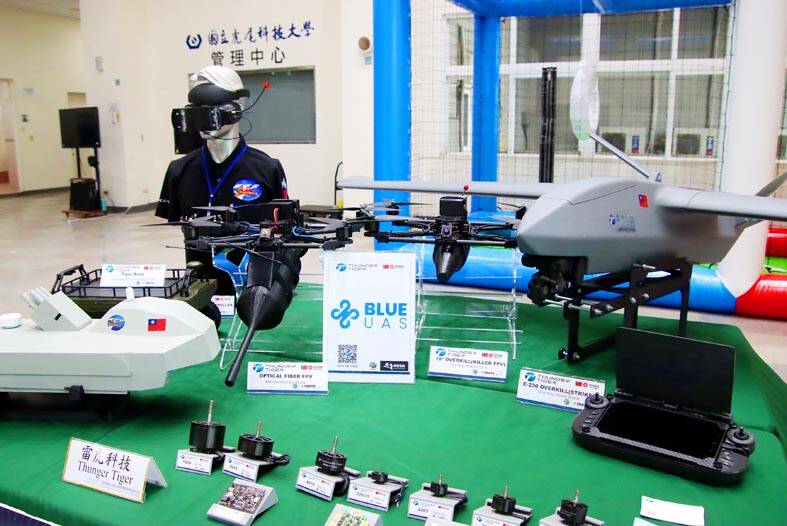
Photo: Lin Yi-chang, Taipei Times
Despite the gains, Taiwan is not the dominant drone exporter to these markets, ranking second and fourth in Poland and Czechia respectively, the DSET said, adding that China remained the leader in drone manufacturing.
Taiwan-EU strategic cooperation is less tightly integrated than the relationship between Taiwan and the US, it said.
Unlike the US, decoupling from Chinese supply chains is not a priority for the EU, as the bloc is more interested in securing critical resources from uninvolved third parties than excluding China, the DSET said.
The EU Defence Readiness Roadmap 2030 emphasizes defense cooperation between bloc members, NATO members, Japan and India, without reference to Taiwan, it said.
Lithuania is the only EU country that has a state policy to decouple from Chinese supply chains for national defense, it added.
The DSET called on the government to create a trustworthy, Europe-facing procurement interface that allows product origin tracing and vetting to facilitate the sale of drones and subsystems.
Taiwanese enterprises should expand drone depots and technical support facilities in Europe to shorten upgrade and maintenance cycles, as well as create standardized certification tests and documentations that guarantee quality and performance to increase their competitiveness, it said.
Investment in flight control stacking, secure communications, and integration of user interface and upgrade pipelines would help close an important gap in the capabilities of Taiwanese drones, the DSET said.
A Nikkei Asia report on Wednesday cited the study, saying that Taiwan is making a significant investment in drones as an export industry and a defensive capability to deter China’s military threat.
President William Lai (賴清德) has pushed for a self-sufficient drone industry as a part of the nation’s asymmetric defense doctrine, which is strongly backed by the US, following the success Ukraine achieved in fending off numerically superior Russian forces, it said.
“Boosting Taiwan’s drone industry has gained an additional sense of urgency because, in a crisis, China’s dominance of the UAV supply chain could jeopardize companies Beijing dislikes and imperil flows,” it added .
“Many drones exported from Taiwan to Central and Eastern Europe are procured by private Ukrainian actors and then routed to Ukraine, while Taiwanese-made batteries, motors, flight controllers and airframes are now steadily supplied to local firms,” it quoted DSET analyst Samara Duerr as saying.
That indicated that a “non-China” supply chain is emerging, she was quoted as saying.

NATIONAL SECURITY: Authorities are working to confirm the identities of the military personnel involved and investigating possible illegal conduct and regulatory violations Authorities are probing possible national security implications after Kinmen police and immigration officers on Sunday found a Chinese woman allegedly posing as a tourist while engaging in prostitution involving more than 10 military personnel. The woman, surnamed Chen (陳), has since been deported, authorities said, adding that investigators are still working to confirm the identities of those implicated, as the records only listed code names and aliases. The case stemmed from a report received by the Kinmen District Prosecutors’ Office on Friday last week from the Jinhu Precinct of the Kinmen County Police Bureau. On Sunday, police, along with the National Immigration

GLOBALGIVING: ‘ Caving to external pressure is not acceptable for an organization that has cultivated justice reform and human rights for 30 years,’ one NGO said A slew of non-government organizations (NGOs) have withdrawn from the GlobalGiving fundraising platform after it announced it would use “Chinese Taipei” instead of “Taiwan” from next month. The Taiwan Good Rice Association wrote on Facebook on Friday that it was informed on April 28 via a teleconference call of the change, which was made because the platform wanted to operate in China. Taiwan Good Rice is to terminate all cooperative relationships with GlobalGiving in response to the platform’s “unilateral and non-negotiable” decision to remove references to Taiwan, the NGO said. “Taiwan is in the official name of Taiwan Good Rice Association and the

HEAVY WEATHER: Typhoon Jangmi is due to crash straight into the Ryukyus as airlines look to shift flights to larger aircraft or cancel flights to Okinawa entirely Taiwan’s international air carriers announced flight adjustments over the weekend as Typhoon Jangmi is forecast to hit the Ryukyu Islands today and tomorrow. The Central Weather Administration (CWA) upgraded Jangmi from a tropical storm to a typhoon at 8am yesterday, with the eye located 580km south of Naha city. It was moving north at 19kph. Today, China Airlines’ CI-120, CI-121, CI-122 and CI-123 flights between Taoyuan and Naha, Okinawa, have been canceled as well as CI-132 and CI-133 between Kaohsiung and Naha. EVA Air’s BR-112, BR-113, BR-186 and BR-185 flights between Taoyuan and Naha are also canceled. Low-cost carrier Tigerair Taiwan canceled IT-230,
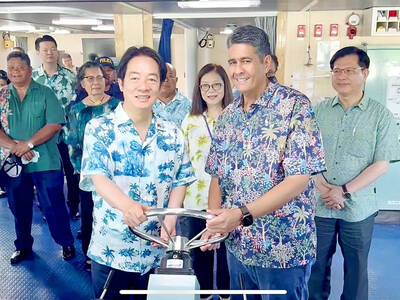
MULTIPRONGED APPROACH: China has sought to pressure Palau across a number of fronts, but the island nation has staunchly resisted overtures to ditch Taiwan Palau has been firm in backing Taiwan despite Chinese pressure that uses tourism economics, cyberattacks and criminal infiltration as tools to threaten the Pacific ally into renouncing its recognition of Taiwan as a sovereign state. The Presidential Office yesterday announced that Vice President Hsiao Bi-khim (蕭美琴) would visit Palau from Saturday to Wednesday next week at the invitation of Palauan President Surangel Whipps Jr. Whipps in April said in an interview that China had outspokenly asked Palau to “denounce Taiwan.” “And we have said: ‘We have no enemies, but nobody tells us who our friends are,’” he said. Whipps has told reporters multiple times


 RSS
RSS