


Colleges and universities in Taiwan will see their lowest enrollment and highest vacancies when the new school semester begins next month, the latest enrollment statistics released by the Joint Board of the College Recruitment Commission showed.
A total of 76,434 students enrolled in Taiwanese universities, resulting in a record high of 6,802 vacancies on campuses and a record-high college admission rate of 97.14 percent, commission statistics showed. That was up from 4,788 vacancies and a college admission rate of 97.1 percent for last school year, it said.
Both admission rates and vacancies at higher learning institutions have been steadily rising in recent years.
Taiwan’s falling birth rate and the rapid increase in the number of colleges and universities that have opened in Taiwan in the past 15 years are the main reasons behind this trend.
In 1986, there were 28 four-year colleges and universities across Taiwan, but the number rose to 147 last year — the result of a government policy to make it easier for high school students to get into university.
The Ministry of Education on Friday urged colleges with low enrollment to protect the interests of students and teaching staff despite the low enrollment.
Ho Cho-fei (何卓飛), director of the ministry’s Department of Higher Education, asked low-enrollment colleges and universities to remain committed to giving their students sufficient training, no matter how small their student population is.
To cope with this problem, Ho said the ministry would work out a mechanism to require schools with low enrollment to transform or withdraw from the market.
Eighteen college and university departments in Taiwan failed to recruit any students for the coming semester, commission figures showed.
Hsing Kuo University of Management in Tainan City had the highest number of vacancies at 1,465, with five of its 13 departments unable to attract a single applicant.
Only 14 would-be freshmen were recruited by Hsing Kuo, despite a total of 1,479 vacancies.
Four departments at Leader University in Tainan City also posted zero enrollment, with the university recruiting 49 potential freshmen.
One department each at Mingdao University and NanHua University also failed to attract a single student.

SECURITY: Starlink owner Elon Musk has taken pro-Beijing positions, and allowing pro-China companies to control Taiwan’s critical infrastructure is risky, a legislator said Starlink was reluctant to offer services in Taiwan because of the nation’s extremely high penetration rates in 4G and 5G services, the Ministry of Digital Affairs said yesterday. The ministry made the comments at a meeting of the legislature’s Transportation Committee, which reviewed amendments to Article 36 of the Telecommunications Management Act (電信管理法). Article 36 bans foreigners from holding more than 49 percent of shares in public telecommunications networks, while shares foreigners directly and indirectly hold are also capped at 60 percent of the total, unless specified otherwise by law. The amendments, sponsored by Chinese Nationalist Party (KMT) Legislator Ko

The military has spotted two Chinese warships operating in waters near Penghu County in the Taiwan Strait and sent its own naval and air forces to monitor the vessels, the Ministry of National Defense (MND) said. Beijing sends warships and warplanes into the waters and skies around Taiwan on an almost daily basis, drawing condemnation from Taipei. While the ministry offers daily updates on the locations of Chinese military aircraft, it only rarely gives details of where Chinese warships are operating, generally only when it detects aircraft carriers, as happened last week. A Chinese destroyer and a frigate entered waters to the southwest
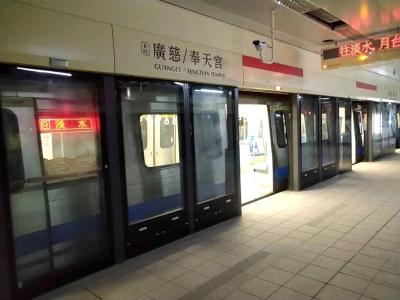
The eastern extension of the Taipei MRT Red Line could begin operations as early as late June, the Taipei Department of Rapid Transit Systems said yesterday. Taipei Rapid Transit Corp said it is considering offering one month of free rides on the new section to mark its opening. Construction progress on the 1.4km extension, which is to run from the current terminal Xiangshan Station to a new eastern terminal, Guangci/Fengtian Temple Station, was 90.6 percent complete by the end of last month, the department said in a report to the Taipei City Council's Transportation Committee. While construction began in October 2016 with an
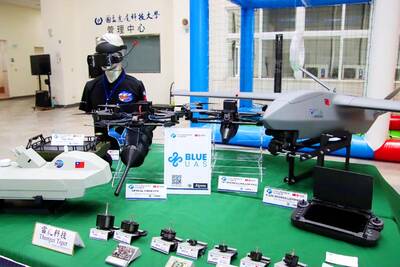
NON-RED SUPPLY: Boosting the nation’s drone industry is becoming increasingly urgent as China’s UAV dominance could become an issue in a crisis, an analyst said Taiwan’s drone exports to Europe grew 41.7-fold from 2024 to last year, with demand from Ukraine’s fight against Russian aggression the most likely driver of growth, a study showed. The Institute for Democracy, Society and Emerging Technology (DSET) in a statement on Wednesday said it found that many of Taiwan’s uncrewed aerial vehicle (UAV) sales were from Poland and the Czech Republic. These countries likely transferred the drones to Ukraine to aid it in its fight against the Russian invasion that started in 2022, it said. Despite the gains, Taiwan is not the dominant drone exporter to these markets, ranking second and fourth


 RSS
RSS