


Yu Wen (余文), a former secretary to President Ma Ying-jeou during his time as Taipei mayor, was released on parole yesterday after serving nine months in jail.
Wu was found guilty of graft and sentenced to 14 months for using fraudulent receipts to claim reimbursements from Ma’s special mayoral allowance fund.
Yu was a city government staffer when Ma was accused of misusing his special allowance during his eight-year tenure as mayor.
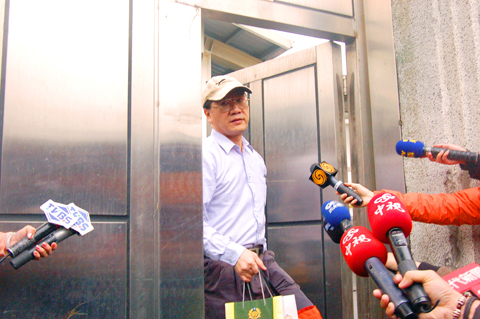
PHOTO: YU JUI-JEN, TAIPEI TIMES
The case began more than two years ago when the Special Investigation Panel of the Taiwan High Court Prosecutors’ Office indicted Ma and Yu on charges of corruption.
Prosecutors alleged that Ma had embezzled more than NT$12 million (US$400,000) from the mayoral fund with Yu’s help.
Prosecutors discovered that Ma had donated more than NT$11 million to charities during the same period.
Yu admitted to forging receipts to apply for funds for Ma.
The Taipei District Court handed down the first verdict on Aug. 14, 2007.
Ma was found not guilty of corruption. Yu, however, was sentenced to 14 months, which was later reduced to 12 months by the Taiwan High Court. The guilty verdict and jail sentence were upheld by the Supreme Court.
Yu was released early because of good behavior. He left Taipei Prison at about 10:30am, where he was immediately approached by reporters.
Asked whether he felt Ma should have pardoned him, he said: “I made the mistakes myself, so I should take responsibility.”
Yu told reporters he was thankful for the “many friends and family” who had supported him, but made no mention of the president.
He said he did not feel he had been wronged by the judicial system, because he had made mistakes in applying for the reimbursements for Ma’s expenses from the fund.
Yu denied corruption, saying, “I did not take one cent.”
When asked whether he felt he had been used as a scapegoat, Yu declined to respond, but said he would face his future with courage.
Yu said it would be best if he could find a job, but that no one at the Presidential Office had contacted him about the matter.
Before beginning his job hunt, Yu said he would spend some time with his family and enjoy his long-awaited freedom, adding that he had never truly appreciated his freedom until he lost it.
A tearful Yu said he wanted to apologize to his parents for the distress he had caused them and to thank his wife for taking care of their two children while he was away.
Yu said he had received much encouragement from many people during his imprisonment, but did not specify whether Ma had was one of them.
In accordance with tradition, Yu had a haircut and put on new clothes and shoes before returning to his hometown of Taichung.
When asked whether Ma would help Yu find a job, Presidential Office Spokesman Wang Yu-chi (王郁琦) yesterday said the office had been in contact with Yu’s family and would be happy to assist Yu in any way should he require any assistance.
Wang said the Presidential Office regretted that Yu had not received a probationary sentence. Yu should have been entitled to it because it was his first criminal offense and “just a receipt problem,” Wang said.
Wang declined to comment on why Ma had not pardoned Yu, saying that Ma did not make anything difficult for him.

NATIONAL SECURITY: Authorities are working to confirm the identities of the military personnel involved and investigating possible illegal conduct and regulatory violations Authorities are probing possible national security implications after Kinmen police and immigration officers on Sunday found a Chinese woman allegedly posing as a tourist while engaging in prostitution involving more than 10 military personnel. The woman, surnamed Chen (陳), has since been deported, authorities said, adding that investigators are still working to confirm the identities of those implicated, as the records only listed code names and aliases. The case stemmed from a report received by the Kinmen District Prosecutors’ Office on Friday last week from the Jinhu Precinct of the Kinmen County Police Bureau. On Sunday, police, along with the National Immigration

GLOBALGIVING: ‘ Caving to external pressure is not acceptable for an organization that has cultivated justice reform and human rights for 30 years,’ one NGO said A slew of non-government organizations (NGOs) have withdrawn from the GlobalGiving fundraising platform after it announced it would use “Chinese Taipei” instead of “Taiwan” from next month. The Taiwan Good Rice Association wrote on Facebook on Friday that it was informed on April 28 via a teleconference call of the change, which was made because the platform wanted to operate in China. Taiwan Good Rice is to terminate all cooperative relationships with GlobalGiving in response to the platform’s “unilateral and non-negotiable” decision to remove references to Taiwan, the NGO said. “Taiwan is in the official name of Taiwan Good Rice Association and the

HEAVY WEATHER: Typhoon Jangmi is due to crash straight into the Ryukyus as airlines look to shift flights to larger aircraft or cancel flights to Okinawa entirely Taiwan’s international air carriers announced flight adjustments over the weekend as Typhoon Jangmi is forecast to hit the Ryukyu Islands today and tomorrow. The Central Weather Administration (CWA) upgraded Jangmi from a tropical storm to a typhoon at 8am yesterday, with the eye located 580km south of Naha city. It was moving north at 19kph. Today, China Airlines’ CI-120, CI-121, CI-122 and CI-123 flights between Taoyuan and Naha, Okinawa, have been canceled as well as CI-132 and CI-133 between Kaohsiung and Naha. EVA Air’s BR-112, BR-113, BR-186 and BR-185 flights between Taoyuan and Naha are also canceled. Low-cost carrier Tigerair Taiwan canceled IT-230,

Chinese Nationalist Party (KMT) Chairwoman Cheng Li-wun (鄭麗文) yesterday briefed her party’s Central Standing Committee regarding her scheduled visit to the US between Monday next week and June 16, saying that her purpose would be to persuade the US that the Republic of China (ROC) Constitution was a “one China” constitution that would foster stable and peaceful cross-strait relations. The ROC Constitution is the most important defense for all Taiwanese citizens, as it upholds our democracy and has contributed to our robust economy, which aligns with international and US interests, she said. “We would not be troublemakers and drag the US under,”


 RSS
RSS