


The Taipei District Court early yesterday morning granted a request by prosecutors to detain former president Chen Shui-bian (陳水扁) in connection with corruption allegations, making him the first former president in the nation’s history to be arrested.
Chen is accused of embezzling about NT$15 million (US$450,000) while in office, money laundering, taking bribes and forgery.
The court decision capped 24 hours of high political drama, which saw a defiant Chen being led away in handcuffs, taken to hospital after claiming he had been assaulted by a bailiff and finally put behind bars.
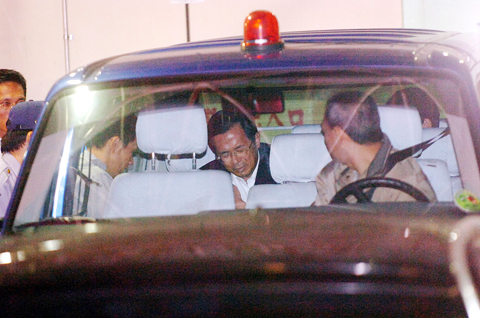
PHOTO: GEORGE TSORNG, TAIPEI TIMES
Chen was escorted to court at about 4:30pm on Tuesday for a hearing on a request for his detention following seven hours of questioning by prosecutors from the Supreme Prosecutors’ Office’s Special Investigation Panel (SIP).
Taipei District Court spokesman Huang Chun-min (黃俊明) said judges Liu Huang-chi (劉煌基), Yeh Li-chi (葉力祺) and Liu Hsiu-chun (劉秀君) began the hearing to consider the detention request at about 8pm on Tuesday night. During the hearing, Chen complained he had been hit by one of the guards while leaving the prosecutors’ office.
At about 11pm, Liu interrupted the hearing and ordered that Chen be sent to the National Taiwan University Hospital for an examination.
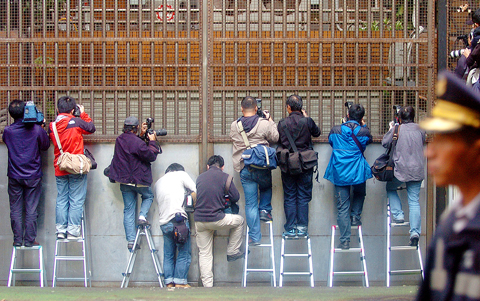
PHOTO: CHANG CHIA-MING, TAIPEI TIMES
Prosecutors reviewed video footage to determine when Chen was allegedly hit, but SIP spokesman Chen Yun-nan (陳雲南) said later that no evidence was found to back the claim.
Although doctors confirmed that the former president had strained an arm muscle, there was no evidence to prove that the injury was the result of a blow.
Chen Shui-bian was then escorted back to the court and the hearing resumed at 1am. At 7:05am, the three judges reached a decision, granting the detention request.
Chen Shui-bian left the court at about 8am under the protection of National Security Bureau (NSB) special agents and police, arriving at the Taipei Detention Center in Tucheng (土城), Taipei County, at about 8:30am.
At about the same time, Ministry of Justice Deputy Minister Huang Shih-ming (黃世銘) told a press conference that although the former president had been detained, he would have certain privileges because he was innocent until proven guilty.
“He can choose whether he wants a single room,” Huang said. “One of the NSB agents responsible for his security will also be allowed to stay with him to act as a liaison officer.”
Huang said Chen Shui-bian’s security was now the responsibility of the detention center, although NSB agents would be called whenever he was summoned for hearings or questioning.
In a statement yesterday, Chen Shui-bian’s office said the former president would relinquish his right to appeal the detention ruling in protest at what he called “political persecution” and a “political vendetta” against him.
Chen Shui-bian’s lawyer, Cheng Wen-long (鄭文龍), said in a statement that it would be pointless for the former president to appeal because the SIP had already reached a verdict and “the script has already been written.”
“It is political persecution and a political vendetta,” Cheng said.
The statement said Chen Shui-bian had expected to be detained and that this was a sacrifice he would endure.
He was willing to bear the cross of persecution, but he would like to see all other Democratic Progressive Party (DPP) politicians — who he said were innocent — released, the statement said.
The office issued another statement denying that Chen Shui-bian had broken the law and criticizing the SIP for ignoring a Supreme Court ruling, which acquitted President Ma Ying-jeou (馬英九) of corruption charges on the grounds that Ma’s use of “special allowance funds” during his tenure as Taipei mayor exceeded the amount he received.
Chen Shui-bian’s office accused the SIP of being influenced by politics and bowing to the media, which it said is under the control of the Ma administration. The office also accused the SIP of violating Chen Shui-bian’s rights.
Saying the SIP had not obtained enough evidence to detain the former president, the statement said prosecutors had used diplomatic missions for political infighting and disregarded Chen Shui-bian’s efforts and the contribution he made to national security and Taiwan’s international space.
“Prosecutors and investigators have reached a point that they are acting arbitrarily and the judiciary autocratically,” the statement said.
The statement also argued that Chen Shui-bian was innocent of all charges and should be acquitted.
On the alleged misuse of Chen’s “state affairs fund,” the statement said the court should refer to Ma’s not guilty verdict and clear the former president’s name.
The statement said Chen claimed more than NT$190 million in “state affairs funds” and spent about NT$203 million during his two terms in office. Chen did not embezzle the money, it said.
It was “ludicrous” for prosecutors to claim that Chen Shui-bian and former National Security Council secretary-general Chiou I-jen (邱義仁) had claimed the money from the Ministry of Foreign Affairs’ “secret funds,” the statement said, adding that Chen had never pocketed any of the money.
Regarding political donations, the statement said Chen had admitted he had falsely declared leftover campaign funds and that some of the money was wired overseas without his knowledge.
Prosecutors, however, could not use his confession as a political tool or assume that political donations were bribes, the statement said.
As all politicians have leftover campaign funds and political donations, the statement requested a complete investigation into all election finances of all politicians — especially presidential candidates — since 1996.
The statement also criticized the Chinese Nationalist Party (KMT) for casting doubt on the legitimacy of other parties’ assets, given its own substantial assets. At issue was not whether Chen Shui-bian would be convicted, the statement said, but rather the urgent and serious issue of election funds, political donations and stolen party assets.
ADDITIONAL REPORTING BY AFP

A signaling system malfunction disrupted high-speed rail (HSR) services beginning at 8am today, with trains temporarily reduced to three northbound and three southbound trains per hour as authorities conduct inspections. The malfunction occurred on a section of track in Miaoli County during pre-operation checks early this morning, forcing northbound and southbound trains to use a single track, the HSR operator said. The regular schedule has been replaced with three hourly trains offering only nonreserved seating in each direction, stopping at every station, it said, adding that business class cars would still have reserved seating. Departures from terminal stations are scheduled at the top
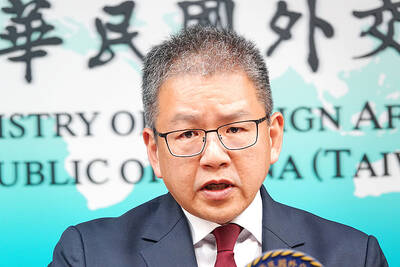
Taiwan is still in the process of assessing the possibility of recruiting workers from Eswatini, the Ministry of Foreign Affairs said yesterday, adding that its goal is to help Eswatini upgrade its vocational training centers. If there are plans to recruit workers from Eswatini, safeguarding national security, protecting public health and ensuring the employment rights of Taiwanese would be prerequisites, Department of West Asian and African Affairs Director-General Yen Chia-liang (顏嘉良) told a news conference. Key considerations would also include filling labor shortages in specific industries, and fostering bilateral professional and technical exchanges, he said. Yen was asked about the progress of labor

VERBOSE VESSELS: A CGA cutter and a China Coast Guard exchanged verbal barbs for more than a day in Taiwanese-controlled waters before the Chinese vessel left The Taiwanese and Chinese coast guards had a standoff near the strategically located Pratas Islands (Dongsha Islands, 東沙群島) in the north of the South China Sea, the Coast Guard Administration (CGA) said yesterday. The two sides engaged in intense radio exchanges over sovereignty claims during the 33-hour standoff. China Coast Guard vessel 3501 eventually left the restricted waters, 26.6 nautical miles (49.2km) west of the Pratas Islands, at 5pm yesterday, the CGA said. Lying approximately between southern Taiwan and Hong Kong, the Taiwan-controlled Pratas are seen by some security experts as vulnerable to Chinese attack due to their distance — more than

A US uncrewed surface vessel (USV) encountered multiple Chinese warships during an autonomous transit of the Taiwan Strait, US defense company Seasats said in a statement on Wednesday. Seasats announced that a Lightfish USV had completed the first autonomous transit of the Taiwan Strait. Over five days, the USV traversed the entire length of the Strait while constantly monitoring surface vessel traffic, the company said. The Lightfish encountered multiple Chinese warships, one of which was a Chinese People’s Liberation Army Navy (PLAN) Type 056 corvette, it said. The Chinese vessels were operating “well within Taiwan’s exclusive economic zone without transmitting their identity via the


 RSS
RSS