


Legislative Speaker Wang Jin-pyng (
"The parties' relationship could be described as a knot, as the two are entwined together," Wang told reporters.
A day after the government-sponsored statute aimed at divesting the KMT of its stolen assets was placed on the legislative agenda as a result of an about-face by the PFP, heavyweights from both parties visited Wang one after the other yesterday morning, presumably to discuss the issue.
The PFP's actions have been interpreted by some as a revenge attack after the reputation of Chairman James Soong (
Soong, who initially hoped to represent the pan-blue camp as a candidate in the year-end Taipei mayoral election, declared his candidacy as an independent last Tuesday.
Reports in the Chinese-language United Daliy News and China Times on Saturday said that Ma, during an interview with a foreign news outlet, had talked about holding secret meetings with Soong in a bid to talk the PFP chairman out of running in the election. Ma allegedly told the journalists that he had been unsuccessful because he could not meet Soong's conditions.
Although the KMT immediately denied the report, the PFP said the episode would complicate its relations with the KMT.
Denying speculation that placing the statute on the legislative agenda was merely a bluff, PFP Legislator Hwang Yih-jiau (
"Even though the foundations established by Soong would also be subject to the statute, we still advocate reviewing the statute on party assets," Hwang said.
Hwang made the comment in response to a report in yesterday's Chinese-language Liberty Times (the Taipei Times' sister newspaper), in which a KMT heavyweight was quoted as saying that Soong's foundations were established with KMT assets which Soong amassed when he served as the party's secretary-general.
KMT caucus whip Tsai Chin-lung (
"We just didn't expect it to happen so fast. During the regular KMT-PFP meeting [on Monday], we had a good conversation," Tsai said. "We initially thought that [Tuesday's] Procedure Committee meeting would proceed as we had discussed with the PFP on Monday. Not until 10 minutes before the Procedure Committee meeting did the PFP inform us that it would allow the statute [to be placed on the agenda]."
Ma said that his party was not opposed to the statute in principle, but that it opposed the fact that it targeted the KMT.
"We are not afraid of facing the party asset issue, but we don't accept any attempts to liquidate us," Ma said at KMT headquarters.
According to Ma, the KMT will propose its own version of the political party law which will deal with the party asset issue.
Ma acknowledged that some of the KMT's assets were acquired inappropriately, but argued that it had offered a report detailing its assets on Aug. 23 and had promised to deal with the issue as soon as possible.
Meanwhile, anti-President Chen Shui-bian (陳水扁) campaign leader Shih Ming-teh (施明德) said yesterday that he had called Soong last week to persuade him to place the controversial statute on the agenda.
"Party assets are a historic burden for the KMT. If [the party] doesn't deal with [the issue] now, it will follow the party like a shadow to the 2007 legislative election and the 2008 presidential election," the former DPP chairman said.
The anti-Chen campaign's newfound support for the statute, however, met with a negative response from some of its supporters, who said they had joined the campaign to demand Chen's resignation, rather than to fight the KMT.
Shih responded that it was normal for protesters to have different opinions.

SPACE VETERAN: Kjell N. Lindgren, who helps lead NASA’s human spaceflight missions, has been on two expeditions on the ISS and has spent 311 days in space Taiwan-born US astronaut Kjell N. Lindgren is to visit Taiwan to promote technological partnerships through one of the programs organized by the US for its 250th national anniversary. Lindgren would be in Taiwan from Tuesday to Saturday next week as part of the US Bureau of Educational and Cultural Affairs’ US Speaker Program, organized to celebrate the 250th anniversary of the signing of the Declaration of Independence, the American Institute in Taiwan (AIT) said in a statement yesterday. Lindgren plans to engage with key leaders across the nation “to advance cutting-edge technological partnerships and inspire the next generation of scientists and engineers,”
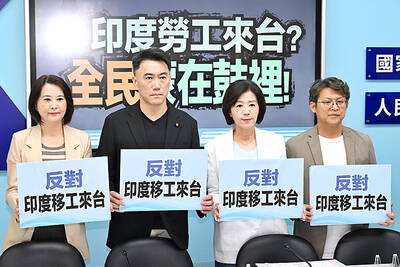
The Chinese Nationalist Party (KMT) caucus yesterday said it opposes the introduction of migrant workers from India until a mechanism is in place to prevent workers from absconding. Minister of Labor Hung Sun-han (洪申翰) on Thursday told the Legislative Yuan that the first group of migrant workers from India could be introduced as early as this year, as part of a government program. The caucus’ opposition to the policy is based on the assessment that “the risk is too high,” KMT caucus secretary-general Lin Pei-hsiang (林沛祥) said. Taiwan has a serious and long-standing problem of migrant workers absconding from their contracts, indicating that

UNREASONABLE SURVEILLANCE: A camera targeted on an road by a neighbor captured a man’s habitual unsignaled turn into home, netting him dozens of tickets The Taichung High Administrative Court has canceled all 45 tickets given to a man for failing to use a turn signal while driving, as it considered long-term surveillance of his privacy more problematic than the traffic violations. The man, surnamed Tseng (曾), lives in Changhua County and was reported 45 times within a month for failing to signal while driving when he turned into the alley where his residence is. The reports were filed by his neighbor, who set up security cameras that constantly monitored not only the alley but also the door and yard of Tseng’s house. The surveillance occurred from July
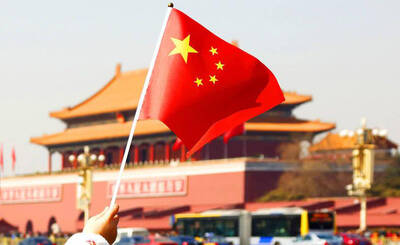
TRADE-OFF: Beijing seeks to trade a bowl of tempura for a Chinese delicacy, an official said, while another said its promises were attempts to interfere in the polls The government must carefully consider the national security implications of building a bridge connecting Kinmen County and Xiamen, China, the Public Construction Commission (PCC) said yesterday. PCC Commissioner Derek Chen (陳金德), who is also a minister without portfolio, made the remarks in a meeting of the legislature’s Transportation Committee, after Democratic Progressive Party Legislator Hsu Fu-kuei (徐富癸) asked about China’s proposal of new infrastructure projects to further connect Kinmen and Lienchiang (Matsu) counties with Xiamen. China unveiled the bridge plan, along with nine other policies for Taiwan, on Sunday, the last day of Chinese Nationalist Party (KMT) Chairwoman Cheng Li-wun’s (鄭麗文) visit


 RSS
RSS