


The Chinese Nationalist Party (KMT) and the Chinese Communist Party (CCP) signed a secret accord before last year's presidential election, paving the way for senior KMT officials to visit China, the Democratic Progressive Party (DPP) legislative caucus alleged yesterday.
KMT Vice Chairman Chiang Pin-kun's (
The DPP caucus also called on Chiang, who is due back tomorrow, not to sign any agreement with the Chinese government, saying that he could face life imprisonment were he to do so.
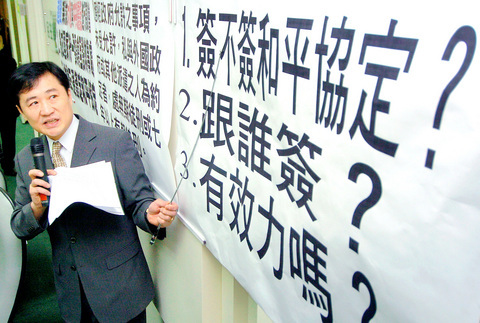
PHOTO: LIAO CHENG-HUI, TAIPEI TIMES
DPP caucus Secretary-General Chen Chin-jun (
The parties agreed to arrange meetings for high-ranking KMT officials, including Lien. They also agreed to form a unification committee, and push for direct links and the signing of a peace accord.
Despite Lien's losing the election, the agreement has gradually materialized as evidenced by three recent incidents, Chen said.
The first was Taipei Mayor Ma Ying-jeou's (
Second, the KMT sent a delegation on Monday led by Chiang to visit China with the hope of pushing for cooperation and reconciliation with the CCP.
Chiang's visit will be followed by Lien's visit to China in June, when he is scheduled to hold a summit with Chinese Communist Party Secretary-General Hu Jintao (
Chen said that the KMT owes the public an explanation as to whether the delegation's purpose in visiting China is to "sell out Taiwan."
"I'd like to know what kind of deal the KMT strikes with the CCP, and what it will trade with China for its own gain," he said.
Hsu Kuo-yung (
Article 113 of the Criminal Code stipulates that persons not authorized by the government who take the liberty of signing a contract or agreement with a foreign government are subject to a minimum sentence of seven years in prison and a maximum sentence of life imprisonment.
DPP caucus whip Lai Ching-teh (
"I hope the KMT sees clearly what the Chinese government is up to and refrains from falling into the snare set up by China," Lai said.
While over 90 percent of Taiwanese people say they oppose China's "Anti-Secession" Law, and the legislature has passed a resolution condemning the bill, Lai said that the KMT is sending the wrong message to China by sending a delegation there.
In response, KMT Legislator Kuo Su-chun (
"Such a groundless and audacious charge is defamatory and slanderous," she said.
"Instead of dampening our enthusiasm to do something for the country, I hope the DPP government recognize the effort we put in to better cross-strait relations, since it cannot, refuses to or doesn't have the guts to do anything," she said.
While President Chen Shui-bian (
"What the DPP is good at is nothing but fabricating unwarranted accusations and smearing others' reputations," he said.

FUKUOKA SITUATION: Japanese media reported that the pathogen is expected to be identified by the summer, while the CDC downplayed the idea that it was hMPV A “mysterious cold-like illness” reported in Japan’s Fukuoka Prefecture does not seem to be a new disease, but Japanese authorities have been asked about the situation, the Centers for Disease Control (CDC) said yesterday. The Fukuoka Prefectural Medical Association on Wednesday told a news conference that a “mystery cold” that has become a hot topic on social media is “highly likely to be caused by some kind of viral infection,” Japan’s KBC News reported. “Many people are experiencing symptoms starting with a sore throat, followed by a runny nose, phlegm and a severe cough,” KBC News reported, citing association officials. Health authorities are

Nvidia Corp CEO Jensen Huang (黃仁勳) arrived in Taiwan yesterday ahead of upcoming AI and technology events, saying he plans to meet with clients and Taiwan Semiconductor Manufacturing Co Chairman C.C. Wei (魏哲家) during his visit. After landing at Taipei Songshan Airport, Huang posed for photos with fans and handed out Yakult drinks to reporters and supporters waiting at the scene, saying he has “a lot to do” during the trip. Asked about reports that Nvidia’s planned headquarters site in Taipei’s Beitou Shilin Technology Park could break ground on May 27, Huang said that if the company holds an event, he would

The Ministry of Finance this afternoon announced the winning numbers for the March-April uniform invoice lottery. The winning number for the NT$10 million (US$318,060) special prize is 19531471, and the winning number for the NT$2 million grand prize is 85941329. Three numbers were drawn for the NT$200,000 first prize: 07225810, 20231230 and 83518781. Those with receipts matching the last seven digits of any of the first-prize numbers will win the NT$40,000 second prize, while those matching the last six digits will win the NT$10,000 third prize. Those whose receipts match the last five digits of the first-prize numbers can claim the NT$4,000 fourth prize,
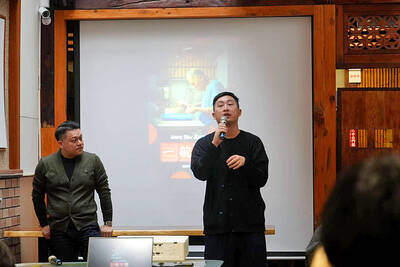
Taiwan Travelogue (臺灣漫遊錄), which earlier this week became the first Taiwanese novel to win the International Booker Prize, is to be adapted into a television series through a Taiwan-Japan coproduction, producer Chang Chen-yu (張辰漁) said yesterday. Chang, a producer at World Softest Production Film Co, wrote on Facebook that the company had been searching for projects with international appeal that retain a strong Taiwanese identity after colleagues and Japanese partners strongly recommended the novel. After reading the book, Chang said he immediately decided to pursue the screen rights. “A great story has the power to transcend time and borders, and connect countless people,”


 RSS
RSS