


At 4:49pm on Oct. 21, Puyuma Express No. 6432, operated by Taiwan Railways Administration, careered off the tracks while navigating a bend at high speed outside Sinma Train Station in Yilan County. The major derailment caused 18 deaths and left more than 200 people injured. Hsieh Pei-po, then seven years old, was one of the passengers, returning to Taitung with his family after attending a wedding in northern Taiwan. Hsieh sustained serious injuries to his skull and brain and fell into a coma. For a time, doctors thought Hsieh’s chances of survival were extremely slim.
After receiving emergency treatment at Lotung Bo-Ai Hospital, Hsieh’s condition worsened, and he ascended the Pediatric Glasgow Coma Scale to level 7 (severe). The scale measures the level of consciousness in a brain injury patient on a scale of 1 to 15, the lower the number the more severe the condition. Later Hsieh was transferred between several hospitals in Taipei for further treatment, and in February this year finally emerged from the coma. Hsieh gradually regained consciousness and the ability to hold a basic conversation. He is now able to support himself without needing assistance, and can walk slowly under his own steam.
With his recovery making slow but steady progress, Hsieh’s mother Hsu Mei-chen took her son to Lotung Bo-Ai Hospital last week for a follow-up appointment and cognitive assessment. Before the appointment, Hsu had been hopeful that the metal staples inserted into Hsieh’s skull during emergency treatment would be removed.
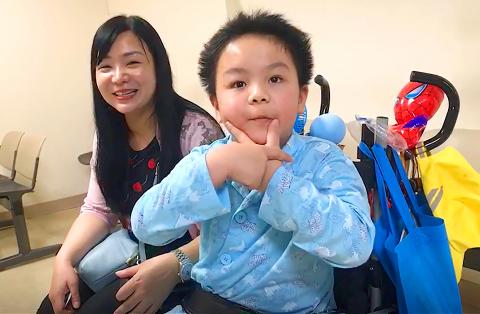
Photo: CNA
照片:中央社
While interacting with medical personnel and reporters, Hsieh was animated, cheery despite his condition and well-mannered, enthusiastically greeting everyone he was introduced to. He also periodically struck dashing poses, framing his face with his hands, sang songs and told his mother that he loved her. Hsieh still needs to undergo further brain surgery: when asked about this, he replied that he was not scared.
Hsu says her son’s condition is improving all the time, but there is still much progress to be made. At present, Hsieh is only able to emulate other people’s speech, and doctors say there is still room for improvement. To give Hsieh more stimuli, and to increase his chances of recovery, the plan is to reintroduce Hsieh to school in September, after the staples are removed. Doctors hope the encouragement provided by interacting and conversing with classmates, coupled with ongoing outpatient rehabilitation, will lead to further progress in Hsieh’s recovery.
Talking to reporters after examining Hsieh, Tu Chao-wei, an attending physician at the hospital’s Department of Neurosurgery, said that when Hsieh initially underwent emergency treatment there was build up of fluid on his brain, in addition to bleeding. These fluids have now been drained away, Tu says, and Hsieh’s bones are continuing to mend. Tu adds that Hsieh’s overall recovery is going well, and confirmed that the next step will be to schedule an operation to remove the metal staples from Hsieh’s skull.
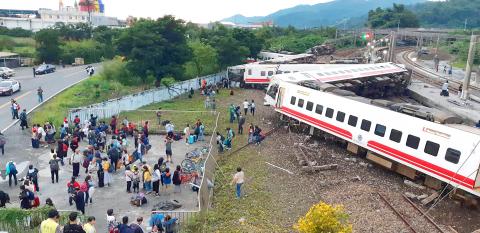
Photo: CNA
照片:中央社
(Translated by Edward Jones, Taipei Times)
台鐵普悠瑪號列車去年在宜蘭翻覆,身受重傷的七歲男童謝沛帛一度昏迷,四個月後甦醒。謝沛帛母親今天帶他到羅東博愛醫院回診,計畫手術取出頭部骨釘,希望可在九月重返校園。
台鐵第6432次普悠瑪號在去年十月二十一日下午四時四十九分,行經宜蘭新馬站時高速過彎出軌翻覆,造成十八人死亡、兩百多人受傷嚴重事故。當時七歲男童謝沛帛與家人一同從台東北上參加婚禮,返程卻搭上這班列車,謝沛帛顱骨與腦部重創,陷入昏迷,情況一度不樂觀。
謝沛帛當時經羅東博愛醫院搶救後,葛式昏迷指數上升至七(葛式昏迷指數是評估腦傷病人昏迷程度的指標,指數由一分到十五分,分數越低,昏迷的程度越嚴重),後來轉院到台北多家醫院接受後續治療,順利在今年二月甦醒,逐漸恢復意識,與人可以進行基礎對話,日前甚至還可以不靠別人攙扶,靠自己力量慢慢步行。
由於謝沛帛身體逐漸恢復轉好,謝沛帛母親徐美珍上週帶著他前往羅東博愛醫院回診,評估腦部狀況,希望取出曾在急救時植入頭部的骨釘。
謝沛帛見到醫護人員與採訪記者時,相當活潑樂觀、有禮,見到人都會熱情問好,還不時用手指擺出帥氣姿勢、唱起歌來,並向媽媽說「我愛妳」。由於未來還需經歷一次頭部手術,謝沛帛勇敢回答「我不怕!」
徐美珍說,沛帛狀況越來越好,但表達能力還要加強,現在多數時間只能模仿別人說話,但醫師說還有進步空間。為讓沛帛能有更多的復健刺激機會,若這次骨釘取出順利,將安排沛帛在九月時重返校園,希望屆時透過與同學間的互相鼓勵及對話學習,再加上門診復健能有更大的突破。
博愛醫院神經外科主治醫師杜肇偉說,當時沛帛在急救時,腦部有積水、出血情況,但目前都已被吸收掉,骨頭也陸續長出,整體復原情況良好,將擇期安排手術拆骨釘。
(中央社)
Follow up
讀後練習
Questions
1. The Puyuma Express train No. 6432 derailed causing over a dozen fatalities and left several hundred people injured. (True/false)
2. Hsieh Pei-po went into a medically-induced coma after sustaining serious head injuries. (True/false)
3. Hsieh’s mother, Hsu Mei-chen, accompanied Hsieh for a follow up appointment at Lotung Bo-Ai Hospital last week. (True/false)
4. Hsieh has now made a full recovery and will return to school in September. (True/false)
5. The train was found to have been traveling at nearly twice the permissible speed limit as it entered a curve in the tracks. The driver turned off a speed-limiting device before the crash due to problems accelerating the train. However a design flaw meant train dispatchers were not automatically alerted of this change. Who do you think (if anyone) should be held responsible: the driver, the train’s manufacturer, or the Taiwan Railways Administration? Discuss.
6. Should financial compensation be provided to injured survivors and bereaved families? If compensation is paid as a lump sum, what figure would be appropriate? Should the amount of compensation be linked to the severity of the injury? Discuss.
(Edward Jones, Taipei Times)
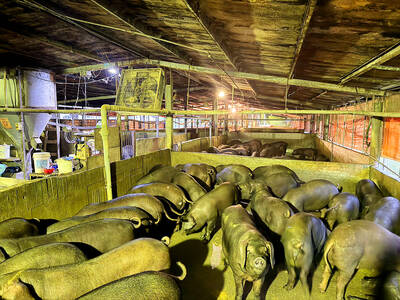
For many people in Taiwan, childhood memories of rural life include pig pens standing beside family homes. Leftover rice, vegetable scraps and soup from daily meals were poured into buckets and fed to pigs. This practice of feeding pigs with household food waste was once a common way of life, both an economic choice and an expression of agricultural society’s deep respect for conserving resources. From a practical standpoint, pigs are omnivorous animals capable of efficiently digesting food scraps that humans can no longer eat. For rural households, food waste cost almost nothing, yet it could be converted into pork, a

Tango unfolds in a dimly lit room, where a haunting melody ushers two dancers into a close embrace. Here, music and movement merge into a silent yet passionate conversation, expressing longing, memory and shared purpose. What makes tango truly magical is the deep interaction and spontaneous improvisation between partners. Tango began in the late 19th century in Buenos Aires, Argentina’s bustling capital. Born in the poor working-class neighborhoods and busy port areas, this dance emerged from a melting pot of cultures. European immigrants, African slaves and local residents all contributed to its unique character. From these rich influences, tango

Sea star wasting disease (SSWD) is a strange and serious illness affecting sea stars, or starfish. This disease causes sea stars to develop painful lesions, lose their arms, and eventually turn into a gooey, melted mess. Since it was first observed in 2013, millions of sea stars along the Pacific coast of North America have died from this __1__. Although viruses were once considered a possible cause, researchers now believe that environmental stressors and microorganisms are primarily __2__ for sea star wasting disease. One of the main environmental triggers appears to be warmer ocean water. When the water heats

Continued from yesterday(延續自昨日) https://www.taipeitimes.com/News/lang The loss of sea stars significantly impacts the ocean ecosystem. Sea stars are important __6__ that help control populations of mussels and sea urchins. Among them, the sunflower star is one of the largest and fastest sea stars and is adept at preying on sea urchins. Without sea stars, sea urchins can __7__ in numbers and devastate kelp forests. These forests are essential __8__ for many marine animals and also help capture carbon from the atmosphere, which is vital in the fight against climate change. The mystery behind SSWD is still __9__, but it is clear that


 RSS
RSS