


For many people in Taiwan, childhood memories of rural life include pig pens standing beside family homes. Leftover rice, vegetable scraps and soup from daily meals were poured into buckets and fed to pigs. This practice of feeding pigs with household food waste was once a common way of life, both an economic choice and an expression of agricultural society’s deep respect for conserving resources.
From a practical standpoint, pigs are omnivorous animals capable of efficiently digesting food scraps that humans can no longer eat. For rural households, food waste cost almost nothing, yet it could be converted into pork, a high-value source of protein. In an era before industrialized feed and when cash income was limited, feeding pigs with kitchen leftovers was a low-risk, clearly rewarding sideline. It also provided families with a form of financial security: pigs could be sold for cash during festivals, emergencies, or times of special need.
Culturally, pigs have held special symbolic meaning in East Asian societies. In Chinese writing, the character for “home” (家) incorporates the image of a pig (豕) beneath a roof, reflecting the close relationship between pig-keeping and household livelihood. Raising pigs was not merely a productive activity; it symbolized savings, stability and future security. Within this context, food waste was not considered garbage, but “still usable food.”
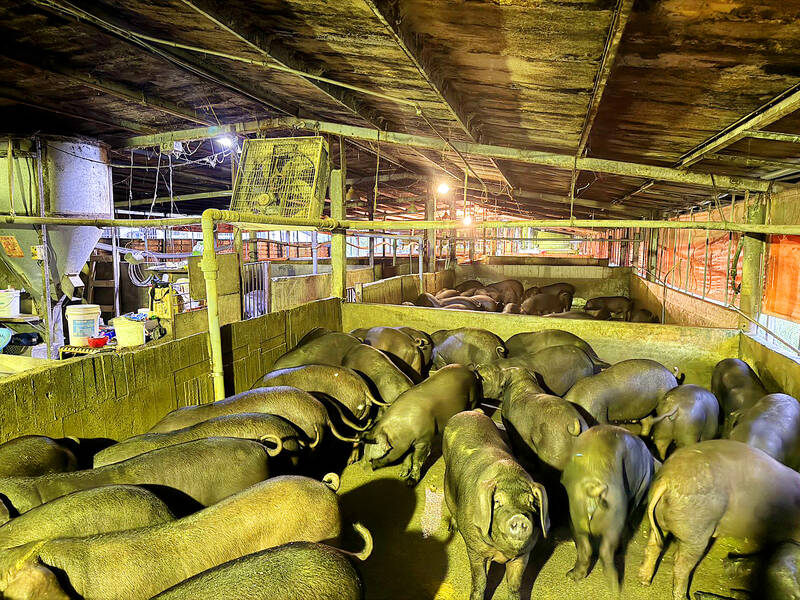
Photo courtesy of a pig farmer 照片:豬農提供
This practice was by no means unique to Taiwan. Across East Asia, Southeast Asia, and even rural Europe, feeding pigs with leftover food — often referred to as swill feeding — was once widespread.
Black pigs, in particular, were often fed with household food waste — not because they can only eat scraps, but because this feeding method matched their biological traits and farming context. Black pigs are local, slow-growing breeds with strong digestive tolerance, capable of handling foods with variable composition and higher energy content, such as cooked leftovers. Food waste is typically rich in fats and starches, which, combined with the pigs’ slower growth, encourages intramuscular fat accumulation and results in pork that is more flavorful, tender and less likely to dry out when cooked.
However, as urbanization and large-scale livestock farming accelerated in the latter half of the twentieth century, the limitations of this system became increasingly apparent. Population concentration led to higher animal density, while globalization made food sources far more complex. A recycling system that worked well on a small, local scale gradually turned into a potential source of systemic risk.

Photo courtesy of Hsinchu County Government 照片:新竹縣政府提供
In Taiwan, the 1997 outbreak of foot-and-mouth disease marked a major turning point. The mass culling of pigs and the collapse of pork exports forced the government to reconsider traditional pig-farming practices.
The truly decisive shift, however, came after 2018, when African swine fever (ASF) spread across Asia. The ASF virus is exceptionally resilient: it can survive for weeks or even months in cooked food and processed meat products. Because food waste often comes from mixed and difficult-to-trace sources and may not be heated evenly, it became a high-risk pathway for viral transmission. As a result, Taiwan — like many other countries — introduced strict laws prohibiting the feeding of pigs with food waste that has not undergone high-temperature sterilization.
In October this year, Taiwan recorded its first confirmed case of ASF. Epidemiological investigations suggested that unsteamed food waste was the likely point of entry. To block further spread of the virus, the Executive Yuan approved a sunset clause on Dec. 4: starting in 2027, feeding pigs with food waste will be completely banned nationwide. Before the ban takes full effect, a one-year transition period will allow limited, conditional use of food waste, alongside subsidies to help farmers shift to alternative feed systems.
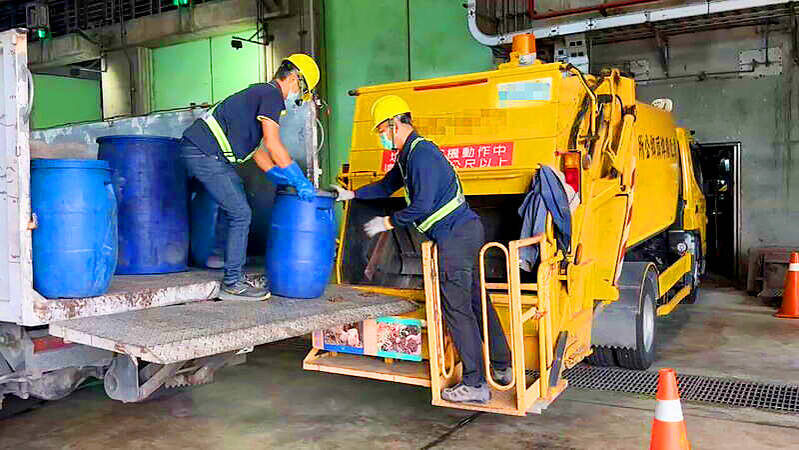
Photo courtesy of Changhua county Environmental protection 照片:彰化縣環保局提供
This transformation represents an adaptation to modern realities, fulfilling the demands of biosecurity, public health, and large-scale agriculture in a globalized world.
(Lin Lee-kai, Taipei Times)
在許多台灣人的童年記憶中,農村住家旁常可見豬圈,家中吃剩的飯菜、菜葉與湯水,順手倒進桶中餵豬。這種「廚餘養豬」的做法,在過去並非特例,而是一種普遍存在的生活方式。它既是經濟選擇,也承載著農業社會對資源珍惜的價值觀。

Photo: Chen Wen-chan, Liberty Times 照片:自由時報記者陳文嬋
從實用角度來看,豬是高度雜食的動物,能有效消化人類無法再食用的剩餘食物。對農村家庭而言,廚餘幾乎零成本,卻能轉化為豬肉這種高價值蛋白質來源。在飼料尚未工業化、現金收入有限的年代,廚餘養豬是一種風險低、回報明確的副業模式,也使家庭在年節或急需用錢時,能透過賣豬獲得現金。
在文化層面,豬在東亞社會具有特殊象徵意義。漢字「家」字下方的「豕」反映了豬與家庭經濟的緊密關係。養豬不只是生產行為,更是儲蓄與保障的象徵。廚餘在這樣的脈絡中,並不被視為垃圾,而是「尚可利用的食物」,倒廚餘餵豬成為日常生活的一部分,也體現了農業社會「物盡其用、不輕易丟棄」的倫理。
這種做法在歷史上並非台灣獨有。從東亞、東南亞到歐洲農村,皆存在以剩食餵豬的傳統。
黑豬的飼養,人們特別偏好使用廚餘,並非因為黑豬只能吃廚餘,而是由於其品種特性。黑豬屬於地方型品種,生長速度慢、腸胃耐受度高,能消化成分不固定、能量較高的剩飯菜與熟食。廚餘富含油脂與澱粉,搭配黑豬慢速生長的特性,有利於肌間脂肪累積,其油花分布使肉質較香、較甜、料理時不易乾柴。
然而,隨著二十世紀後半葉都市化與畜牧業規模化,廚餘養豬開始顯露其侷限。人口集中使動物飼養密度提高,全球化使得食品來源日益複雜,原本在小尺度下運作良好的循環系統,逐漸成為潛在風險。
在台灣,1997年的口蹄疫是重要轉折點,大量豬隻撲殺與出口市場中斷,促使政府重新檢視養豬模式。
真正的決定性改變則來自2018年後非洲豬瘟在亞洲的擴散。非洲豬瘟病毒對環境極具耐受性,能在熟食與肉製品中存活數週甚至數月,而廚餘來源複雜、加熱不均,成為病毒傳播的高風險管道。因此,台灣與多數國家皆立法嚴格禁止未經高溫滅菌的廚餘餵豬。
今年10月,台中出現台灣首例非洲豬瘟,疫調推論未蒸煮的廚餘是破口。為了阻擋病毒,行政院在12月4日拍板落日條款,2027年起全面禁止廚餘養豬,並在禁令生效前,提供一年緩衝期,有條件開放廚餘,以及飼料轉型補助。
這種轉變是因應現今狀況所做出的調整,以符合全球化世界中生物安全、公共衛生及大規模農業的需求。
(台北時報林俐凱)


In 2023, an 80-year-old woman in Taipei suffocated her paralyzed son after over five decades of caring for him. Turning herself in immediately, she confessed that worsening health and anxiety about who would care for him after her death had driven her to act. The court, acknowledging her difficult situation, sentenced her to two-and-a-half years in prison while recommending a presidential pardon. This rare judicial recommendation drew a complicated social response. Supporters argue that the mother’s half-century of caregiving renders her deserving of compassion instead of incarceration, believing that allowing her to live her final years in dignity and

A: Over 130,000 college graduates are about to enter the workforce upon graduation. B: According to a survey, the top 10 most desired careers among Taiwanese are: independent content creator, civil servant, information engineer, financial professional, medical worker, content planner, flight attendant, news anchor, designer and fitness trainer. A: What are the “dream jobs” for young Gen Zers? B: The top three for men are YouTuber, pro gamer and engineer. For women, they are writer, social media editor and YouTuber. A: Every profession has its champion. Just look at Taiwanese fire dancer Yang Li-wei — who was on fire

★ Bilingual Story is a fictionalized account. 雙語故事部分內容純屬虛構。 The mango looked perfect. It sat on the fruit stand like a small sunset, red on one side and gold on the other. “I’ll take this one,” said Daniel. The fruit seller shook her head. “Not that one.” Daniel was surprised. “Why not? It looks beautiful.” “Yes,” she said, “but beautiful is not always ready.” She picked up another mango and held it near his nose. “First, smell here.” Daniel smelled the top of the mango. It was sweet and warm. “Good mangoes have a smell,” she said. “Next, feel the weight.”

A: While AI is reshaping the world, “Money Talks News” revealed seven career fields that are “AI-proof.” First is the healthcare field, like nursing jobs, personal care aides, and social work specialists. B: This type of job is indeed in high demand. So what’s next? A: Up next are skill-based positions, like electricians, mechanics, and construction workers. Then there’s the field of education, like teachers, tutors, and education specialists. Fourth is the mental health field, like jobs in counseling, therapy, and social work. B: I didn’t expect teaching to be safe from AI. What else is


 RSS
RSS