


An American flew a green lawn chair suspended by giant party balloons from Oregon to Idaho earlier this month.
Kent Couch landed safely after gliding some 378km on the wind above the desert, according to the Oregonian newspaper.
“He’s crazy,” said his wife, Susan. “It’s never been a dull moment since I married him.”
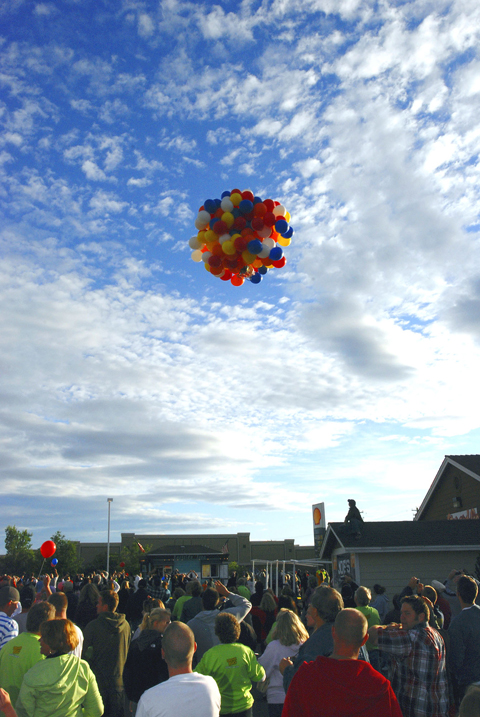
PHOTO: AP
Couch left from the parking lot of a gas station he owns in Bend, Oregon. He landed in a horse pasture outside of Cambridge, Idaho.
“If I had the time and money and people, I’d do this every weekend,” the Oregonian reported Couch as saying. “Things just look different from up there. You’re moving so slowly. The best thing is the peace, the serenity.
“You can hear a dog bark at 15,000 feet (4,500m).”
When Couch wanted to go higher, he dumped some of the 170 liters of cherry Kool-Aid he brought with him. When he wanted to go lower, he popped some of the 150 helium-filled balloons that took him aloft.
He traveled at about 32km per hour.
The journey was Couch’s third balloon flight. Couch was inspired by a TV show about a 1982 lawn chair flight over Los Angeles by truck driver Larry Walters.
(STAFF WRITER, WITH DPA)
本月稍早,一名美國人靠著大型派對氣球讓一個綠色躺椅飄升上空,並乘著它從美國奧勒崗州飛到愛達荷州。
據《奧勒崗人報》報導,肯特.考區在沙漠上空乘風飛行了約三百七十八公里後平安降落。
他的太太蘇珊說:「他瘋了,我嫁給他以後,就不曾無聊過。」
考區從他在奧勒崗州班德市經營的加油站的停車場升空,降落在愛達荷州劍橋郊區的一個馬場的草地上。
《奧勒崗人報》在報導中引述考區的話說:「如果有時間、經費和人群,我每個週末都會這樣做。從上面看下來,事情都不一樣了。你非常緩慢地移動,享受最棒的安祥和寧靜。」
「你在一萬五千英呎(四千五百公尺)的高空上還可以聽到狗吠聲。」
考區希望飛高一點時,就丟掉一些他帶上天的一百七十公升Kool-Aid櫻桃汽水。想飛低一點時,就把帶他飛上天的一百五十顆氦氣氣球戳破一些。
他以每小時約三十二公里的速度飛行。
這是考區的第三次氣球飛行。考區的靈感來源是一個電視節目,節目中介紹了卡車司機賴瑞.瓦特斯一九八二年乘坐躺椅飛越洛杉磯的事蹟。(德通社�翻譯:袁星塵)

Whether they are a Siamese, Persian, Maine Coon, or Domestic Shorthair, there are hundreds of millions of cats living with people around the world. But despite their popularity as pets, the history of cat domestication has remained difficult for scientists to decipher. A new genome study is providing some insight into the matter by determining the timing of a key milestone in feline domestication - the introduction of domestic cats into Europe from North Africa. Domestic cats pounced into Europe roughly 2,000 years ago in early imperial Roman times, the researchers found, probably thanks to maritime trade. Some of these furry trailblazers

In English, “name idioms” are part of what makes English fascinating. Let’s put a few examples under the microscope. Doubting Thomas This expression stems from the Bible. Thomas, one of Jesus’s disciples, refused to believe Jesus had been resurrected from the dead. He declared he wouldn’t accept it until he could see the nail marks in Jesus’s hands and touch his wounds himself. Today, this idiom refers to someone who won’t believe something without concrete evidence. For instance, if your friend’s expertise is reliable, but you’re still suspicious, you might be a “doubting Thomas.” Smart Aleck The origin of this phrase likely comes from

A: Hey, the world’s major dictionaries just unveiled their words of the year for 2025. B: Yup, the Cambridge Dictionary chose the word “parasocial,” which refers to a connection that someone feels between themselves and a famous person they don’t really know. A: One-sided parasocial relationships with celebrities, influencers and even AI chatbots have clearly become more common. B: The Oxford Dictionary picked “rage bait” — online content designed to elicit anger by being frustrating, provocative or offensive in order to increase traffic to Web sites or social media accounts. A: The Collins Dictionary picked “vibe coding.” Let’s

1. 事故在昨天下午發生。 ˇ The accident happened yesterday afternoon. χ The accident was happened yesterday afternoon. 註︰happen, belong, disappear, fail 是不及物動詞,不能用被動語態。詞組 to break out, to take place 也是如此。 2. 在維多利亞時代,民主是有錢人的特權。 ˇ In the Victorian Age, democratic privileges belonged to the rich only. χ In the Victorian Age, democratic privileges was belonged to the rich only. 註︰belong 是不及物動詞,不能用被動語態。 3. 他雖然一句話也沒說,可是心裏感覺自己是失敗了。 ˇ Though he didn’t say a word, in his heart he felt he had failed. χ Though he didn’t say a word, in his heart he felt he was failed. 註︰fail 是不及物動詞,不能用被動語態。 4. 我們雖然遭受嚴重的天然災害,但一定能克服困難。 ˇ Though we suffer from serious natural disasters, we are sure to overcome all difficulties. χ Though we are suffered from serious


 RSS
RSS