


Whether they are a Siamese, Persian, Maine Coon, or Domestic Shorthair, there are hundreds of millions of cats living with people around the world. But despite their popularity as pets, the history of cat domestication has remained difficult for scientists to decipher.
A new genome study is providing some insight into the matter by determining the timing of a key milestone in feline domestication - the introduction of domestic cats into Europe from North Africa.
Domestic cats pounced into Europe roughly 2,000 years ago in early imperial Roman times, the researchers found, probably thanks to maritime trade. Some of these furry trailblazers may have been brought by sailors to hunt mice on ships that plied the Mediterranean carrying grain from the fertile fields of Egypt to ports serving Rome and other cities in the sprawling Roman Empire.

Photo: AP 照片:美聯社
The findings contradict a long-held idea that domestication occurred in prehistoric times, perhaps 6,000 to 7,000 years ago, as farmers from the ancient Near East and Middle East first moved into Europe, bringing cats with them.
“We show that the earliest domestic cat genomes in Europe are found from the Roman imperial period onwards,” starting in the first century AD, said paleogeneticist Claudio Ottoni of the University of Rome Tor Vergata, lead author of the study published on Nov. 27 in the journal Science.
The study used genetic data from feline remains from 97 archaeological sites across Europe and the Near East as well as from present-day cats. The researchers analyzed 225 bones of cats — domestic and wild — ranging from about 10,000 years ago to the 19th century AD, and generated 70 ancient feline genomes.
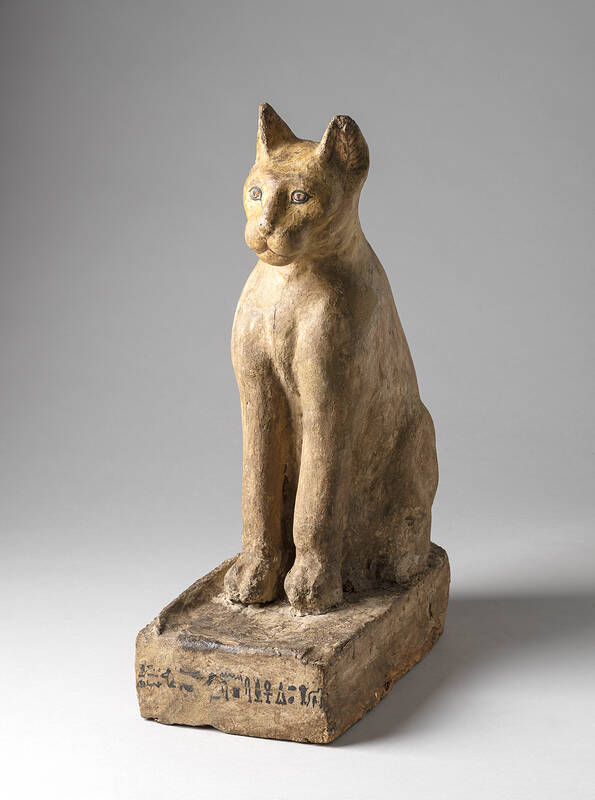
Photo: Wikimedia Commons 照片:維基共享資源
The researchers found that cat remains from prehistoric sites in Europe belonged to wildcats, not early domestic cats.
Dogs were the first animal domesticated by people, descended from an ancient wolf population separate from modern wolves. The domestic cat came later, descended from the African wildcat.
“The introduction of the domestic cat to Europe is important because it marks a significant moment in their long-term relationship with humans. Cats aren’t just another species arriving on a new continent. They’re an animal that became deeply integrated into human societies, economies and even belief systems,” University of Rome Tor Vergata paleogeneticist and study co-author Marco De Martino said.
Photo: AP 照片:美聯社
The genome data identified two introductions of cats to Europe from North Africa. Roughly 2,200 years ago, people brought wildcats from northwestern Africa to the island of Sardinia, whose present-day wildcat population descended from these migrants.
But those were not domestic cats. It was a separate dispersal from North Africa about two centuries later that formed the genetic basis of the modern domestic cat in Europe.
The study’s findings suggest that there was not a single core region of cat domestication, but that several regions and cultures in North Africa played a role, according to zooarchaeologist and study co-author Bea De Cupere of the Royal Belgian Institute of Natural Sciences.

Photo: Reuters 照片:路透
“The timing of the genetic waves of introduction from North Africa coincides with periods when trade around the Mediterranean intensified strongly. Cats likely traveled as efficient mouse hunters on grain ships but possibly also as valued animals with religious and symbolic significance,” De Cupere said.
Cats were important in ancient Egypt, whose pantheon included feline deities and whose royalty kept pet cats, sometimes mummifying them for burial in elaborate coffins.
The ancient Roman army, with outposts arrayed across Europe, and its entourage played an instrumental role in the dispersal of domestic cats throughout the continent, as attested to by feline remains discovered at the sites of Roman military camps.
The earliest domestic cat in Europe identified in the study — one genetically similar to present-day domestic cats — dated to between 50BC and 80AD from the Austrian town of Mautern, site of a Roman fort along the Danube River.
The study, however, does not unravel the timing and location of the initial feline domestication.
“Cat domestication is complex,” Ottoni said, “and what we can tell now is the timing of the introduction of domestic cats to Europe from North Africa. We can’t really say much what happened before and where.”
(Reuters)
無論是暹羅貓、波斯貓、緬因貓,還是米克斯貓(即混種短毛貓),全世界跟人類一起生活的貓多達數億隻。貓雖然是深受喜愛的寵物,但貓馴化的歷史卻讓科學家一直難以釐清。
一項新的基因組研究提供了關鍵線索,確定家貓從北非被引進歐洲的時間點——這是貓馴化過程一個重要的里程碑。
研究人員發現,家貓大約在兩千年前的羅馬帝國早期進入歐洲,可能是透過海上貿易傳入。這些率先踏足歐洲的毛茸茸先鋒,有的可能是被水手帶上船,用來捕捉船上橫行的老鼠,許多船隻載運埃及肥沃平原生產的穀物,往返地中海港口,供應羅馬以及龐大的羅馬帝國各城市所需。
這項發現推翻了長久以來的假設——認為貓的馴化應該早在史前時代、約六千到七千年前就發生,古代近東與中東的農民遷往歐洲時把貓也帶過去。
「我們的研究顯示,歐洲最早的家貓基因組出現在羅馬帝國時期,也就是從西元一世紀開始」。此研究的第一作者、羅馬第二大學的古基因學家克勞迪奧.歐托尼在11月27日發表於《科學》(Science)期刊的論文中表示。
該論文研究了歐洲及近東97個考古遺址的貓科動物遺骸,以及現代貓的基因資料。研究團隊分析了225份可追溯至約一萬年前至西元19世紀的家貓與野貓骨骼,並產生70份古代貓基因組。
研究人員發現,歐洲史前遺址中的貓遺骸都屬於野貓,而非早期家貓。
狗是人類最早馴化的動物,是由與現代狼族不同的一支古老狼群演化而來;家貓則是後來才出現,源自非洲野貓。
羅馬第二大學古基因學家、該研究共同作者馬可‧德馬提諾表示:「家貓進入歐洲,是牠們與人類關係發展中的重要里程碑。貓不只是來到新大陸的物種,而是深深融入人類社會、經濟,甚至信仰體系的動物」。
基因資料顯示,貓從北非進入歐洲共有兩波。大約2,200年前,人們將西北非的野貓帶到薩丁尼亞島,現今島上的野貓族群就是牠們的後代。
但牠們並非家貓。大約兩百年後,另一波來自北非的貓群才構成今日歐洲家貓的基因基礎。
比利時皇家自然科學研究所動物考古學家、該研究共同作者貝雅‧德庫貝表示,這些發現顯示,貓的馴化並沒有單一核心地區,而是北非多個地區與文化共同參與了此過程。
德庫貝說:「北非貓群的基因傳入時機,與地中海貿易蓬勃發展的時期密切重疊。貓很可能因其捕鼠的高效率而得以搭船,也可能因其宗教或象徵價值而被刻意帶來」。
例如,貓在古埃及具有重要地位,埃及神祇中有貓形象,皇室也飼養貓,甚至將牠們製成木乃伊安置於華麗的棺槨中。
研究顯示,古羅馬軍隊及其隨行人員也對家貓在歐洲的普及扮演了關鍵角色,這從羅馬軍營遺址中發現的大量貓遺骸可得到證實。
該研究認定的歐洲最早家貓——其基因與現代家貓相近——出土於奧地利毛特恩(Mautern),年代介於西元前50年至西元80年間,當時該地是羅馬帝國在多瑙河沿岸的一座軍事堡壘。
不過,這項研究仍無法釐清貓最初被馴化的確切時間與地點。
歐托尼表示:「貓的馴化非常複雜。目前我們能確定的,是家貓從北非傳入歐洲的時間點。至於在那之前發生了什麼、在哪裡開始,我們還無法下定論」。
(台北時報林俐凱編譯)

The US-Israeli war with Iran, which began on Feb. 28, has killed thousands of people, destabilized the Middle East and rocked global energy markets by effectively closing the strait. WHAT IS THE STRAIT OF HORMUZ? Lying between Oman and Iran and linking the Gulf north of it with the Gulf of Oman to the south and the Arabian Sea beyond, the strait is 33km wide at its narrowest point, with a shipping lane just 3km wide in either direction. Perhaps the world’s most important energy shipping channel, the waterway is about 167km long. Following through on an old threat, Tehran effectively closed the strait

Have you ever found yourself desperately feeding coins into a claw machine just because you’ve already spent so much trying to win that stuffed animal? Or maybe you’ve continued watching a boring movie simply because you already paid for the ticket? If so, you’ve experienced the “sunk cost fallacy.” A sunk cost refers to time, money or effort that has already been spent and cannot be recovered. This psychological trap is surprisingly common. You might keep playing a video game you no longer enjoy because you’ve invested countless hours in building your character, or maintain a toxic friendship because you’ve known

A: Which TV drama series have been global hits so far this year? B: The US drama “Stranger Things 5,” South Korean drama “Can This Love Be Translated?” and Chinese megahit “Pursuit of Jade” are all popular lately. A: Isn’t “Pursuit of Jade” the costume idol drama about the romance between a charming marquis and a pig-slaughterer? Actor Zhang Linghe and actress Tian Xiwei are both so attractive. B: Plus, Netflix’s Korean-Japanese gay romance drama “Soul Mate” — starring Korea’s Ok Taec-yeon and Japan’s Hayato Isomura — is set to premiere in May. A: These hit international dramas

1. 他甚至還自認為是個了不起的領導人。 ˇ He even went so far as to think himself a great leader. ˇ He even went so far as to think of himself as a great leader. χ He even went so far as to think himself as a great leader. 註:認為某人或某事為何等樣人或何等樣事,可用 think+受詞+受詞補語,或 think of ... as ...,正句第一句比第二句普遍些。用了 of,後面用 as;沒有 of,就不可以用 as。又如: I thought him quite a joke. I thought of him as quite a joke. 2. 你不應該打擾他休息。 ˇ You should not intrude upon him during his time off. χ You should not intrude him during his time off. 註:intrude 作「闖進」、「打擾」、「侵入」解時,是不及物動詞,後面跟 upon。 3. 男孩正在玩陀螺。 ˇ The boy is playing with his top. χ


 RSS
RSS