


The latest fossil unearthed in Africa allows scientists to link together the most complete chain of human evolution so far.
The 4.2 million-year-old fossil discovered in northeastern Ethiopia helps scientists fill in the gaps of how our human ancestors made the giant leap from one phase of development to another. That's because the newest fossil was found in the region where seven other types of human-like fossils spanning nearly 6 million years and three major phases of human development were previously discovered.
``We just found the chain of evolution, the continuity through time,'' Berhane Asfaw, one of the co-authors of the study said. ``One form evolved to another. This is evidence of evolution in one place through time.''
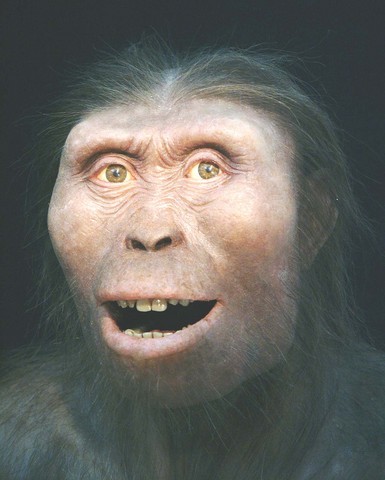
PHOTO: AFP
Although the kind of fossil the scientists discovered is not new, its location is what helps explain the shift from one early phase of human-like development to the next, they say. All eight fossils were within an easy day's walk of each other.
Until now, scientists had individual pictures of human evolution scattered around the world. Finding everything all in one general area makes those pictures more like a short movie about evolution.
``It's like ... a home movie, but a home movie covering 6 million years,'' said study lead author Tim White, co-director of Human Evolution Research Center at the University of California at Berkeley.
Scientists believe this latest discovery will help them connect the dots of human evolution. The new fossil is from a group that is believed to have evolved into modern man at some point. Additionally, the new fossil shows a connection between an even older fossil and modern human beings. (AP)
非洲最新出土的化石讓科學家得以將人類迄今最完整的進化鍊連接起來。
這個在伊索比亞東北部被人發現的四百二十萬年前的化石,有助於科學家填補人類祖先是如何從一個階段大幅進化到下一階段的空白。這是因為這個最新化石被發現的地區,是其他七種近似人類的化石稍早被發現的所在。這七種化石的時間涵括六百萬年,跨越人類三個主要進化階段。
「我們剛剛發現了演化鏈,穿越時光的進程,」這項研究的共同作者之一伯哈尼.亞斯法說:「一種形式進化到另一種。這是一個地區跨越時間的演化證據。」
科學家表示,雖然他們所發現的化石種類並非新化石,其地理位置卻有助於解釋近似人類的動物從早期階段進化到下一階段的發展。這八種化石的發現地都在方圓一天步行的距離內。
迄今,科學家已取得散落在全世界的人類進化的個別圖像。找到了某一概括地區的所有物件,讓這些圖像看起來更像是一部進化的短片。
這項研究的主導作者提姆.懷特說:「這就像是??一部家族史電影,不過卻是橫跨六百萬年的家族史電影。」他也是加州大學柏克萊分校人類進化研究中心的副主任。
科學家相信,最新的發現將有助於他們把人類進化的進程串連起來。這個新化石是從一個群組中發現,在某方面來說,據信這個群組已進化成現代人類。此外,新化石也顯示出更古老的化石與現代人類之間的關連。 (美聯社/翻譯:賴美君)

Taiwan Travelogue, the novel by Taiwanese author Yang Shuang-zi and translated into English by Lin King, won the prestigious International Booker Prize in London on May 19. It marks the first time a Taiwanese literary work has received the International Booker Prize, setting a historic milestone both for Taiwanese literature and for the award itself. Prior to this achievement, Taiwan had only once appeared on the Booker radar, when Taiwanese author Wu Ming-yi was longlisted for the Booker Prize in 2018 with The Stolen Bicycle. The International Booker Prize honors works of fiction translated into English and published in the UK or Ireland.
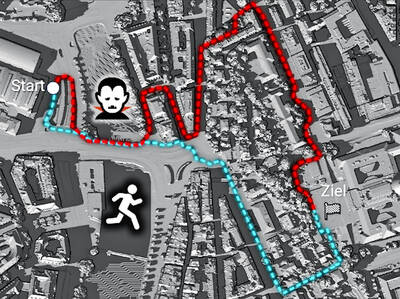
As climate change and urbanization push city temperatures higher, walking outdoors is becoming increasingly uncomfortable in many parts of the world, especially when prolonged time spent in sunlight is involved. As a result, outdoor lovers are now seeking cooler, shaded walking routes. However, most mainstream map apps still do not __1__ shaded footpaths. Enter routing.osm.ch — a Swiss web-based route planner that introduces a novel solution to this problem. Its “Vampire mode,” named after the legendary creatures’ fear of being __2__ natural light, was developed by a Swiss research team led by Professor Stefan Keller. The platform combines open data from

Cities around the world are testing “robotaxis,” hoping that autonomous vehicles will ease traffic and reduce emissions. However, recent analyses suggest these expectations may be overly optimistic. According to consulting firm Kearney, robotaxis could actually make congestion worse rather than better. Because self-driving rides are expected to be cheaper and more convenient than traditional taxis, more people may choose them over walking, biking, or using public transportation. This shift would put more cars on already crowded roads. Another concern is “deadheading,” which refers to robotaxis traveling without passengers between rides. Since autonomous fleets need to reposition themselves throughout the day, these

1. 該協會於全球九十個國家擁有逾一百萬名會員。 ˇ The association consists of over 1 million members in 90 countries. χ The association consists in over 1 million members in 90 countries. 註:consist of 是「由……組成」,而consist in是「在於」、「就是」,比較下列句子: Our department consists of three sections. Success consists in perseverance. Happiness consists in doing one’s duty. 2. 我們的任何錯誤將來都可能帶來麻煩。 ˇ Any mistakes on our part now may lead to problems later on. χ Any mistakes on our part now may lead into problems later on. 註:說「導致」、「引起」用lead to,如to lead to trouble,to lead to disaster,to lead to problems,to lead to something unpleasant等。表示「向某物內部的動向」可用into,如go into a room,to come into a building,to get into trouble等。 3. 這本書是E.M.福斯特的作品,不是喬治.歐威爾。 ˇ This book was written by E. M. Foster, not


 RSS
RSS