

Eight restaurants in Taiwan yesterday secured a one-star rating from the Michelin Guide Taiwan for the first time, while three one-star restaurants from last year’s edition were promoted to two stars.
Forty-three restaurants were awarded one star this year, including 34 in Taipei, five in Taichung and four in Kaohsiung.
Hosu (好嶼), Chuan Ya (川雅), Sushi Kajin (鮨嘉仁), aMaze (心宴), La Vie by Thomas Buhner, Yuan Yi (元一) and Frassi in Taipei and Front House (方蒔) in Kaohsiung received a one-star rating for the first time.
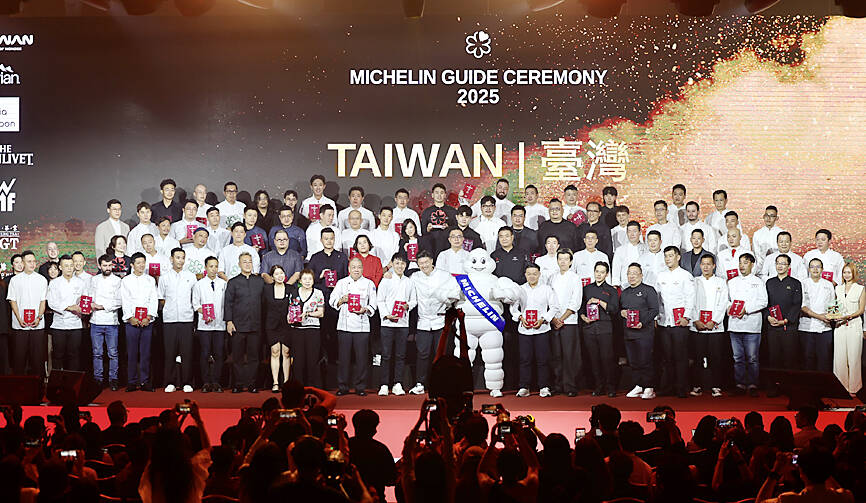
Photo: CNA
Hosu is known for innovative Taiwanese dishes, while Chuan Ya serves Sichuan cuisine and aMaze specializes in fusion cooking. La Vie by Thomas Buhner focuses on European classics, Yuan Yi specializes in tempura, and Frassi and Front House offer French and Italian fare respectively.
Hosu was also awarded a “Green Star” rating for following high sustainability standards in daily operations, while its sommelier, Chen Chi-rong (陳琪蓉), received the Michelin Sommelier Award for Taiwan, the French publication said.
AMaze, which opened in August last year, received the guide’s opening-of-the-year award, while Front House’s sommelier, Kiky Chen (陳玉琦), won the Michelin Service Award.
Seven restaurants were granted two-star ratings, all of which are in Taipei.
Three of the two-star restaurants were upgraded from one star last year: the Japanese-focused Yu Kapo (彧割烹) and Eika (盈科), and A, which serves French cuisine.
Taiwan’s three-star restaurants are Le Palais (頤宮) in Hotel de Chine and Tairroir (態芮) in Taipei, and Taichung’s JL Studio.
Le Palais, which is known for its Cantonese-style roast duck, has won the three-star rating for eight consecutive years, while Taiwanese-French fusion restaurant Tairroir and JL Studio, which serves modern Singaporean cuisine, received the rating for the third year.
Taichung’s Tu Pang (地坊) received the Green Star for the first time.
Two restaurants that made last year’s list have since closed: two-star restaurant Raw, founded by Taiwanese chef Andre Chiang (江振誠), closed at the end of last year and is to be turned into a culinary school; and Taichung’s Le Maison de Wen (文公館), which is known for its Cantonese-French fusion fare, closed on June 29 because of renovations at Fulwon Hotel, where it was located.
Meanwhile, Minimal in Taichung, which was the first ice cream shop to receive a one-star rating from the Michelin Guide, no longer sells meal sets.
Another one-star restaurant, Forchetta, which focused on Mediterranean fusion dishes, reportedly lost its star due to allegations that its ingredients were not fresh and that it underreported workers’ salaries.
Although restaurants in Tainan, New Taipei City, Hsinchu City and Hsinchu County were evaluated, none of them received star ratings this year. Tainan has yet to have any Michelin-starred restaurants since the city was included in the evaluation in 2022.
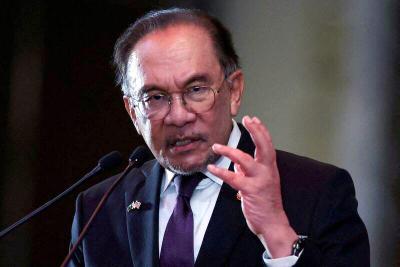
Malaysian Prime Minister Anwar Ibrahim’s remarks that Taiwan is a Chinese province seeking independence threaten regional peace and stability and could undermine Taiwanese businesses’ confidence in investing in Malaysia, the Ministry of Foreign Affairs (MOFA) said today. Anwar recently made remarks implying that Taiwan is a province seeking to separate from China, effectively legitimizing Beijing’s position on using force to take Taiwan, the ministry said in a statement. The Republic of China, Taiwan, is a sovereign, independent country and is not subordinate to the People’s Republic of China, MOFA said, adding that that fact would not be changed no matter
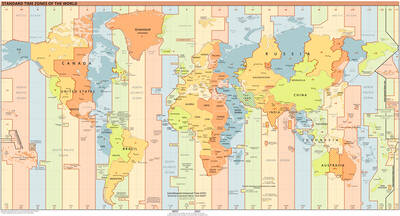
UNNECESSARY?: While some said that the switch would mean more sunlight exposure for workers, others said the government should promote flexible working hours instead An online debate has resurfaced on whether Taiwan should switch to the same time zone as Japan, with supporters citing its geographic location and saying that China would have no right to object. The debate erupted on Threads when users suggested that Taiwan should stop using the same time zone as China, Malaysia and Singapore, GMT+8, and instead switch one hour ahead to the same time zone as Japan and South Korea, GMT+9, which it is geographically closer to. Under GMT+9 the sun would set later year-round, meaning that people would see sunlight after getting off work even in the winter and
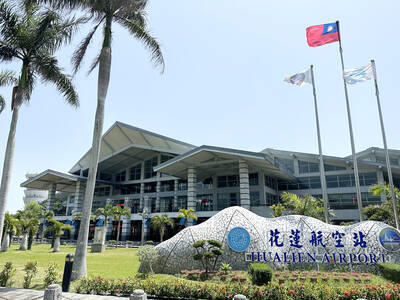
The Civil Aviation Administration (CAA) yesterday confirmed that Uni Air has submitted an application to suspend its Taipei-Hualien flights due to persistently low passenger rates. The airline, which is the only operator of the Taipei-Hualien route, proposed to suspend the service after Mandarin Airlines, another domestic flight carrier, applied to suspend flights to Hualien departing from Kaohsiung and Taichung earlier this year. The average load factor of the Taipei-Hualien flights during the first six months was 24.2 percent, CAA data showed. The average seat occupancy rate dropped even further to 17 percent last month, even though it was the beginning

Philippine President Ferdinand Marcos Jr today said that the Philippines would not allow any attacks from its territory in the event of a conflict in the Taiwan Strait, as it “has no desire to be a belligerent nation in the region.” Marcos later said that his country would continue to follow the “one China” policy while maintaining its existing ties with Taiwan within that framework. The Philippine president made the comments while attending the Foreign Correspondents Association of the Philippines Presidential Luncheon in Manila. He was asked whether he would allow the US military to launch an attack from Philippine bases in the


 RSS
RSS