


Lunar New Year, also known as the Spring Festival, is the most important traditional holiday in Taiwan. It consists of a period of celebrations that starts on New Year's Day, the first day of the first month of the lunar calendar, and ends with the Lantern Festival, the 15th day of the New Year.
農曆新年又稱「春節」,是台灣最重要的傳統節慶。農曆新年的慶典於初一展開,一直延續到正月十五日元宵節。
The origins of the Lunar New Year can be traced back thousands of years. One of the legends is that on New Year's Eve, the cruel and ferocious monster Nian would come out and devour people at random. It was said that Nian was sensitive to loud noises and afraid of the color red, so people set off fireworks and pasted red paper on their doors to scare it away. On New Year's day when people wake up, everyone says ``Gong-xi,'' or congratulations, to celebrate surviving the night.
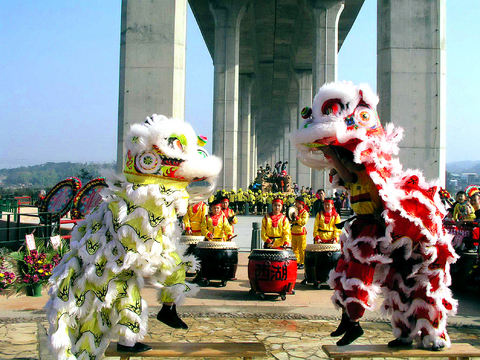
PHOTO: TAIPEI TIMES
農曆新年的起源可以追溯至好幾千年以前。相傳在農曆年的除夕夜,兇殘的「年獸」會跑出來恣意獵食。據說年獸厭惡噪音且懼怕紅色,所以人們會施放鞭炮,並在大門上貼上紅紙,試圖嚇走年獸。因此,隔日一早人們醒來時都會互道一聲「恭喜」,祝賀彼此平安度過這一晚。
Chinese New Year is also a time for people to return home to have a reunion dinner (Nian ye fan) with their family on New Year's Eve. It is usually a large, lavish meal. After dinner, parents and older relatives give children or unmarried members of the family red envelopes with money inside. Those who have been working should also give their parents and grandparents red envelopes. It is believed that putting a red envelope under your pillow will scare Nian away, and thus red envelopes are also called "Ya sui qian," money that suppresses evil spirits.
農曆新年也是人們返鄉團圓,在除夕夜與家人圍爐共享年夜飯的日子,因此年夜飯的佳餚也往往格外豐盛。晚餐過後,父母及長輩會給予孩童或未結婚的家人「紅包」,而已經工作的人,也同樣要給父母親及祖父母紅包。一般相信,將紅包壓在枕頭下可以嚇跑年獸,故紅包也稱為「壓歲錢」。
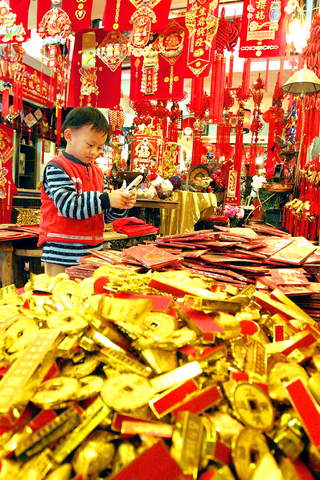
PHOTO: TAIPEI TIMES
All the house cleaning should be finished before New Year's Day to sweep away any ill fortune. On New Year's day, using brooms or dusters to clean the house is not allowed. If someone sweeps or dusts the house on the first day of the lunar month, good fortune will be expelled from his or her home. Taking out the garbage is also forbidden.
家家戶戶務必在初一之前完成大掃除的工作,掃除任何不好的運氣。初一當天也不可以使用掃把或除塵撢子,假如人們在這天掃地或除塵,會將家中的好運掃出屋外。同理,這一天也不可以將家中垃圾丟棄。
On the first day of the lunar month, children traditionally put on new clothes or hats to get a good start to the whole year. Most people go to the temple in the morning to pray for good luck for the whole year. People also prepare sumptuous foods, wines and fruits as a tribute to their ancestors. If someone accidentally breaks a dish or glass, people say ``Peace to all time'' to avoid misfortune.
大年初一當天,孩童都會有穿新衣、戴新帽的傳統,為新年的開始討個好兆頭,許多民眾也會於早上到廟裡拜拜,祈求一整年的好運。家家戶戶也會在家中準備豐盛的菜餚、酒與水果來祭祖。萬一有人不小心打破碗盤或杯子,人們會說「歲歲(碎碎)平安」來破除不祥。
Starting from the first day of the Lunar New Year, there are many celebration activities, like setting off firecrackers and performances of dragon and lion dances. Some families will play the traditional game "mahjong" for fun. It is believed that the winner will gain prospertiy for the whole year.
初一開始會有一連串的慶祝活動,像是放鞭炮、舞龍舞獅的表演等。有些家庭也會打打麻將娛樂,據說贏家可贏得新年發財的好兆頭。
The second day of the New Year is usually called the day of Hui Niang Jia, which means that married daughters should return to their parents' home. It is said that married daughters are forbidden to return home on New Year's day. If they break this rule, it is believed that they will bring poverty to the family.
大年初二是回娘家的日子,出嫁的女兒會在這天返家探視父母。據說結了婚的女兒不可以在初一當天返回父母家中,否則會讓娘家變窮。
The fourth day is the day that the deities come down to the earthly world. Every family prepares special offerings and delicacies to greet the gods. Incense and candles are lit, paper money is burnt and firecrackers are set off to welcome them. Business resumes on the fifth day of the festivities. Factories, companies and shops all set off deafening firecrackers to celebrate their re-opening.
大年初四是諸神下凡的日子,家家戶戶都會準備特別的美味佳餚來恭迎諸神。民眾會焚香、點燃蠟燭,燃燒紙錢並施放鞭炮來祭拜神明。公司行號則於初五陸續開工。工廠、各企業與商店都會在這天施放震耳欲聾的鞭炮,歡慶於新春恢復開張。
The 15th day of the first lunar month is the Lantern Festival. On that night, people carry lanterns of different shapes and colors through the streets to celebrate. Thousands of lanterns of all different kinds are displayed on the street. Eating glutinous rice balls or ``yuan xiao'' is another way to celebrate. The round shape of rice balls symbolizes unity and happiness, and is believed to bring good fortune to people. The Lantern Festival also marks the end of the Chinese New Year festivities. Afterwards, life returns to normal again, and people all anticipate a wonderful year.
正月十五日是元宵節。民眾會提著各式各樣、五顏六色的燈籠遊街慶祝,街道上也會看到琳瑯滿目的燈籠展示。吃湯圓(亦名元宵)是另一種慶祝方式。湯圓的外觀渾圓飽滿,象徵團圓美滿,將為人們帶來吉祥的好兆頭。元宵節也為農曆新年一連串的慶典劃上休止符。在這天過後,民眾的生活都將再度恢復正常,也都期待有個美好的一年。
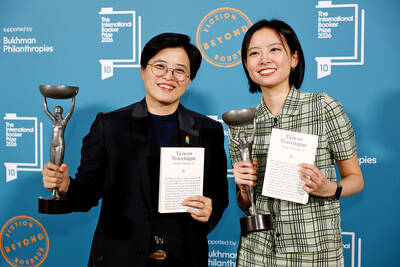
Taiwan Travelogue, the novel by Taiwanese author Yang Shuang-zi and translated into English by Lin King, won the prestigious International Booker Prize in London on May 19. It marks the first time a Taiwanese literary work has received the International Booker Prize, setting a historic milestone both for Taiwanese literature and for the award itself. Prior to this achievement, Taiwan had only once appeared on the Booker radar, when Taiwanese author Wu Ming-yi was longlisted for the Booker Prize in 2018 with The Stolen Bicycle. The International Booker Prize honors works of fiction translated into English and published in the UK or Ireland.

A: Time magazine recently released its list of “The 100 Most Influential People of 2026.” It’s categorized into six groups: Artists, Pioneers, Titans, Icons, Leaders and Innovators. B: TSMC chairman C.C. Wei made the list this year. Which category is he in? A: Wei is actually among the Pioneers, with figures including Disney CEO Josh D’Amaro and MrBeast — the first YouTuber ever to surpass 400 million subscribers. B: Led by Wei, Taiwan’s “silicon shield” TSMC is the sixth-largest company in the world. A: As Nvidia founder Jensen Huang wrote in his introduction, “C.C. Wei is truly one of the

The animal kingdom is full of surprises that challenge our understanding of biology. From remarkable feeding mechanisms to extreme defense strategies, some creatures possess traits so unusual that they seem like pure fiction. Here are four fascinating examples that show nature’s endless creativity. The humble snail may appear simple, but its mouth tells a different story. Snails possess a ribbon-like tongue called a radula, densely covered with anywhere from 1,000 to 12,000 tiny teeth. This structure works like a cheese grater, allowing them to scrape and grind food with surprising efficiency. Far from being passive creatures, snails are actually
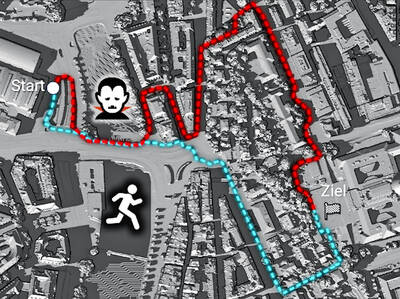
As climate change and urbanization push city temperatures higher, walking outdoors is becoming increasingly uncomfortable in many parts of the world, especially when prolonged time spent in sunlight is involved. As a result, outdoor lovers are now seeking cooler, shaded walking routes. However, most mainstream map apps still do not __1__ shaded footpaths. Enter routing.osm.ch — a Swiss web-based route planner that introduces a novel solution to this problem. Its “Vampire mode,” named after the legendary creatures’ fear of being __2__ natural light, was developed by a Swiss research team led by Professor Stefan Keller. The platform combines open data from


 RSS
RSS