


President Tsai Ing-wen (蔡英文) yesterday urged voters to re-elect her, saying that the Jan. 11 elections are pivotal, because “the whole world is watching Taiwan” due to the protests in Hong Kong.
Tsai visited Penghu’s Magong City (馬公) in the morning, attended rallies in central Taiwan afterward, and stumped for Democratic Progressive Party (DPP) legislative candidates and those from smaller pan-green camp parties.
“The world wants to see what Taiwanese will decide. [The international community is] concerned that what has been taking place in Hong Kong might happen in Taiwan as well,” she told the crowds.
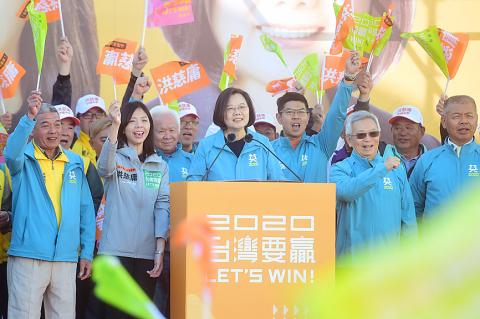
Photo: Liao Yao-tung, Taipei Times
Speaking about China’s “one country, two systems” formula, Tsai said: “This is not an option for Taiwanese.”
“Hong Kongers have taken to the streets because they have to fight for their freedom and democracy. In Taiwan, we have our freedom and democracy, that is because we have sovereignty, which is held by all 23 million of Taiwan’s population,” she said.
“Therefore we must safeguard our sovereignty, because if we no longer have it, Taiwanese will have to take to the streets to wrestle it away from China,” Tsai said.
She urged everyone to vote, saying: “The bigger the turnout, the louder our voice and our decision can be heard by the world... When our citizens cast their votes, we can safeguard Taiwan’s sovereignty, freedom and democracy, by which we can ensure to continue have these for our future generations.”
Meanwhile, Vice President Chen Chien-jen (陳建仁) focused on the nation’s multicultural society, saying that government policies in the past few years have allowed foreigners to settle down and enjoy Taiwan’s freedom and democracy.
Speaking at a gathering of new immigrant women in Taichung, Chen said the government’s New Southbound Policy is an important direction for the nation, as are its improved policies for “new residents” — foreigners who have acquired Republic of China citizenship.
DPP officials at the gathering said they met many new residents who have lived and worked in Taiwan for more than 20 years after marrying Taiwanese men, and that the best two words they had for the nation are “freedom” and “democracy.”
Many of them said they are happy to live here, because they can vote, participate in public affairs and fulfill their dreams, the officials said.
“Taiwan is a multicultural society and a vibrant place composed of many ethnic groups that welcomes people from other countries. Some have been here since historic times, and others arrived only recently, but everyone in Taiwan can pursue happiness and a better life. So we must cherish the freedom and democracy that we have,” Chen said.
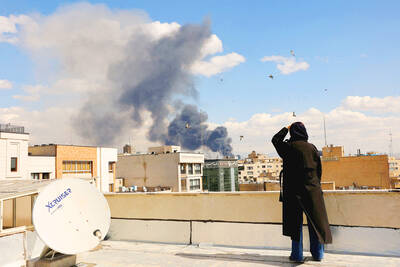
CHAOS: Iranians took to the streets playing celebratory music after reports of Khamenei’s death on Saturday, while mourners also gathered in Tehran yesterday Iranian Supreme Leader Ayatollah Ali Khamenei was killed in a major attack on Iran launched by Israel and the US, throwing the future of the Islamic republic into doubt and raising the risk of regional instability. Iranian state television and the state-run IRNA news agency announced the 86-year-old’s death early yesterday. US President Donald Trump said it gave Iranians their “greatest chance” to “take back” their country. The announcements came after a joint US and Israeli aerial bombardment that targeted Iranian military and governmental sites. Trump said the “heavy and pinpoint bombing” would continue through the week or as long

An Emirates flight from Dubai arrived at Taiwan Taoyuan International Airport yesterday afternoon, the first service of the airline since the US and Israel launched strikes against Iran on Saturday. Flight EK366 took off from the United Arab Emirates (UAE) at 3:51am yesterday and landed at 4:02pm before taxiing to the airport’s D6 gate at Terminal 2 at 4:08pm, data from the airport and FlightAware, a global flight tracking site, showed. Of the 501 passengers on the flight, 275 were Taiwanese, including 96 group tour travelers, the data showed. Tourism Administration Deputy Director-General Huang He-ting (黃荷婷) greeted Taiwanese passengers at the airport and
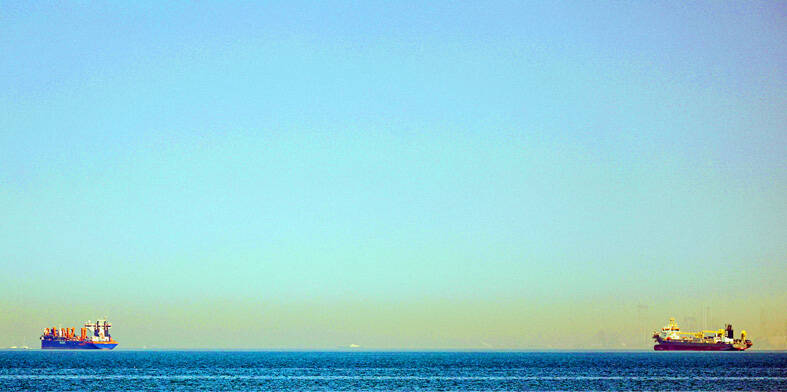
State-run CPC Corp, Taiwan (CPC, 台灣中油) yesterday said that it had confirmed on Saturday night with its liquefied natural gas (LNG) and crude oil suppliers that shipments are proceeding as scheduled and that domestic supplies remain unaffected. The CPC yesterday announced the gasoline and diesel prices will rise by NT$0.2 and NT$0.4 per liter, respectively, starting Monday, citing Middle East tensions and blizzards in the eastern United States. CPC also iterated it has been reducing the proportion of crude oil imports from the Middle East and diversifying its supply sources in the past few years in response to geopolitical risks, expanding
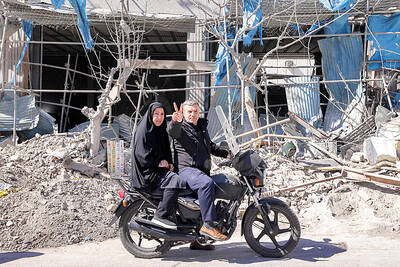
STRAIT OF HORMUZ: In the case of a prolonged blockade by Iran, Taiwan would look to sources of LNG outside the Middle East, including Australia and the US Taiwan would not have to ration power due to a shortage of natural gas, Minister of Economic Affairs Kung Ming-hsin (龔明鑫) said yesterday, after reports that the Strait of Hormuz was closed amid the conflict in the Middle East. The government has secured liquefied natural gas (LNG) supplies for this month and contingency measures are in place if the conflict extends into next month, Kung told lawmakers. Saying that 25 percent of Taiwan’s natural gas supplies are from Qatar, Chinese Nationalist Party (KMT) caucus secretary-general Lin Pei-hsiang (林沛祥) asked about the situation in light of the conflict. There would be “no problems” with


 RSS
RSS