


After the general budget cleared the legislative floor, Premier William Lai (賴清德) yesterday evening announced that the Cabinet is to resign en masse today.
Lai made the announcement at the Legislative Yuan in Taipei while thanking legislators for passing this year’s budget.
“The general budget has been passed. The time has come,” Lai said.
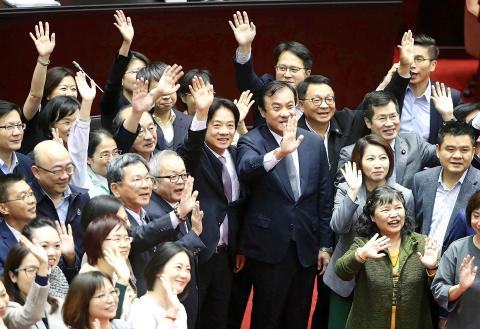
Photo: CNA
“I will hold an extraordinary Executive Yuan meeting tomorrow [Friday] to proceed with the Cabinet’s mass resignation and patiently wait for the president to announce a new premier,” he told reporters.
He expressed gratitude to Taiwanese for the support they have shown during his time as premier.
Prior to the announcement, Lai was warmly received by Democratic Progressive Party (DPP) lawmakers, many of whom hugged him. They later took a photograph together.
“I love you, premier,” several DPP lawmakers shouted.
Earlier, several rounds of votes were held for motions on which consensuses had not been reached during cross-caucus negotiations.
Motions tendered by the Chinese Nationalist Party (KMT) to freeze the budget of the Transitional Justice Commission, halve the budget of the Ill-gotten Party Assets Settlement Committee and deny stipends for the Central Election Commission chairman and vice chairman were struck down by the DPP caucus, which has the legislative majority, in votes that stayed close to party lines.
Non-partisan Solidarity Union Legislator May Chin (高金素梅), speaking on behalf of the People First Party, cited the Transitional Justice Commission’s “deviation from its course” as a reason to freeze its budget.
The commission should expedite efforts to exonerate people who had been unfairly or unjustly tried during the authoritarian era, but it has so far only acquitted 2,775 out of an estimated 13,400 such people, she said.
By putting forth proposals to replace currency bearing Chiang Kai-shek’s (蔣介石) image, the commission has gotten its priorities wrong, she said.
The only motion to suspend stipends that passed was a proposal targeting the Railway Bureau director-general over the Puyuma Express derailment in October last year proposed by the New Power Party (NPP) caucus.
The motion was carried by all four caucuses during negotiations and was passed yesterday without a vote.
NPP Executive Chairman Huang Kuo-chang (黃國昌) in a speech criticized the bureau and the Taiwan Railways Administration, saying they repeatedly lied to lawmakers about what technical issues might have caused the derailment.
The families of the victims are still waiting for the truth, he added.
The general budget for fiscal year 2019 is now NT$1.99 trillion (US$64.65 billion) after NT$24 billion, or 1.19 percent, was trimmed.

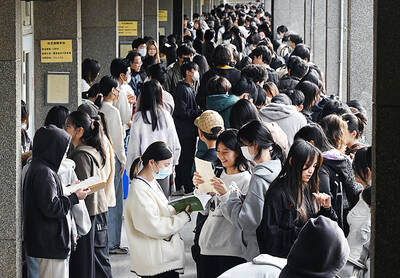
A global survey showed that 60 percent of Taiwanese had attained higher education, second only to Canada, the Ministry of the Interior said. Taiwan easily surpassed the global average of 43 percent and ranked ahead of major economies, including Japan, South Korea and the US, data from the Organisation for Economic Co-operation and Development (OECD) for 2024 showed. Taiwan has a high literacy rate, data released by the ministry showed. As of the end of last year, Taiwan had 20.617 million people aged 15 or older, accounting for 88.5 percent of the total population, with a literacy rate of 99.4 percent, the data

NEW LOW: The council in 2024 based predictions on a pessimistic estimate for the nation’s total fertility rate of 0.84, but last year that rate was 0.69, 17 percent lower An expected National Development Council (NDC) report expects the nation’s population to drop below 12 million by 2065, with the old-age dependency ratio to top 100 percent sooner than 2070, sources said yesterday. The council is slated to release its latest population projections in August, using an ultra-low fertility model, the sources said. The previous report projected that Taiwan’s population would fall to 14.37 million by 2070, but based on a new estimate of the total fertility rate (TFR) — the average number of children born to a woman over her lifetime — the population is expected to reach 12 million by
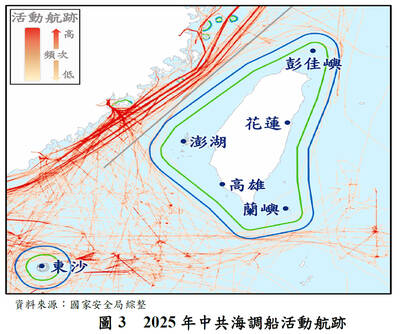
INTENSIFYING THREATS: Beijing’s tactics include massive attacks on the government service network, aircraft and naval vessel incursions and damaging undersea cables China is prepared to interfere in November’s nine-in-one local elections by launching massive attacks on the Taiwanese government’s service network (GSN), a report published by the National Security Bureau showed. The report was submitted to the Legislative Yuan ahead of the bureau’s scheduled briefing at the Foreign Affairs and National Defense Committee tomorrow. The national security team has identified about 13,000 suspicious Internet accounts and 860,000 disputed messages, the bureau said of China’s cognitive warfare against Taiwan. The disputed messages focus on major foreign affairs, national defense and economic issues, which were produced using generative artificial intelligence (AI) and distributed through Chinese

COUNTERING HOSTILITY: The draft bill would require the US to increase diplomatic pressure on China and would impose sanctions on those who sabotage undersea cable networks US lawmakers on Thursday introduced a bipartisan bill to bolster the resilience of Taiwan’s submarine cables to counter China’s hostile activities. The proposal, titled the critical undersea infrastructure resilience initiative act, was cosponsored by Republican representatives Mike Lawler and Greg Stanton, and Democratic Representative Dave Min. US Senators John Curtis and Jacky Rosen also introduced a companion bill in the US Senate, which has passed markup at the chamber’s Committee on Foreign Relations. The House’s version of the bill would prioritize the deployment of sensors to detect disruptions or potential sabotage in real-time and enhance early warning capabilities through global intelligence sharing frameworks,


 RSS
RSS