


The US’ decision to summon its envoys to the Dominican Republic, El Salvador and Panama should tell Beijing that it cannot pressure nations to break diplomatic relations with Taiwan without consequences, American Institute in Taiwan (AIT) Chairman James Moriarty said on Wednesday.
Moriarty described China’s actions of the past few years, which ended a diplomatic truce with Taiwan, as “troubling,” adding that Beijing’s efforts to unilaterally alter the “status quo” across the Taiwan Strait are harmful and do not contribute to regional stability.
“We will tell the Chinese that picking off diplomatic partners of Taiwan is a source of great concern to the United States,” he said at an annual symposium organized by the Washington-based Global Taiwan Institute. “We’ve been telling China as clearly as possible that these are not consequence-free actions.”
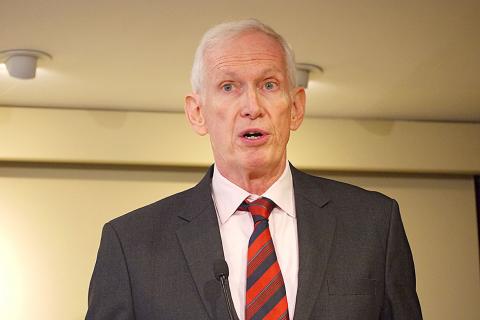
Photo: CNA
Taiwan has lost five diplomatic allies to China since President Tsai Ing-wen (蔡英文) took office in May 2016, including Panama in June last year, the Dominican Republic in May and El Salvador last month, reducing the number of nations that recognize it to 17.
On Friday last week, the US Department of State said it had summoned US Ambassador to the Dominican Republic Robin Bernstein, US Ambassador to El Salvador Jean Manes and US Charge d’Affaires in Panama Roxanne Cabral for “consultations related to recent decisions to no longer recognize Taiwan.”
Observers in the US, both outside and inside government, and including a broad spectrum of members of the US Congress, are deeply troubled that China has escalated its pressure on Taiwan, including increased People’s Liberation Army activity in the air and seas around Taiwan, Moriarty said.
Recent congressional action on Taiwan, including the unanimous passage of the Taiwan Travel Act, reflects those concerns, he said.
Consistent with the Taiwan Relations Act, the US considers any effort to determine the future of Taiwan by other than peaceful means, including by boycotts or embargoes, of grave concern to the US, Moriarty said.
“We encourage both sides of the Taiwan Strait to demonstrate patience, flexibility and creativity in resolving differences,” he said.
When asked by a reporter why the US did not recall its ambassador to China if it wants to send a message to Beijing, Moriarty said there are many issues that the US and China need to tackle and that Taiwan is an important one.
The US has to make Washington’s stance clear to China, he said, adding that the US government’s move had drawn Beijing’s attention.
The US hopes the two sides of the Taiwan Strait would resume constructive dialogue, he said.
Moriarty said he did not know whether talks between Taiwan and the US under the bilateral Trade and Investment Framework Agreement would be held this year.
Taiwan-US trade discussions have been conducted regularly to seek common ground to address certain bothersome issues, he said.
It would take some time for Taiwan and the US to sign a free-trade agreement, Moriarty said, adding that more formal talks would be held only if progress is made on pending issues.

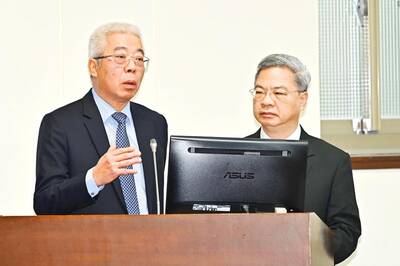
Taiwan has arranged for about 8 million barrels of crude oil, or about one-third of its monthly needs, to be shipped from the Red Sea this month to bypass the Strait of Hormuz and ease domestic supply pressures, CPC Corp, Taiwan (CPC, 台灣中油) said yesterday. The state-run oil company has worked with Middle Eastern suppliers to secure routes other than the Strait of Hormuz, through which about 20 percent of the world’s oil and liquefied natural gas typically passes, CPC chairman Fang Jeng-zen (方振仁) said at a meeting of the legislature’s Economics Committee in Taipei. Suppliers in Saudi Arabia have indicated they
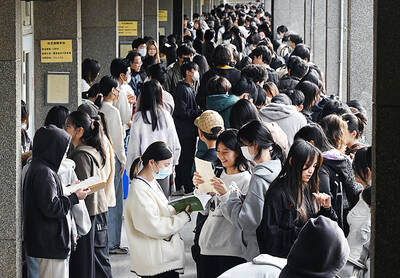
A global survey showed that 60 percent of Taiwanese had attained higher education, second only to Canada, the Ministry of the Interior said. Taiwan easily surpassed the global average of 43 percent and ranked ahead of major economies, including Japan, South Korea and the US, data from the Organisation for Economic Co-operation and Development (OECD) for 2024 showed. Taiwan has a high literacy rate, data released by the ministry showed. As of the end of last year, Taiwan had 20.617 million people aged 15 or older, accounting for 88.5 percent of the total population, with a literacy rate of 99.4 percent, the data
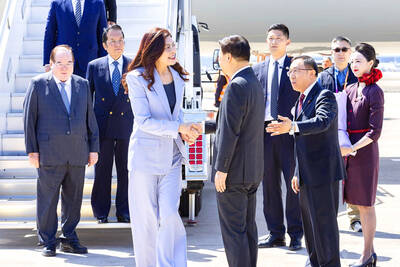
CCP ‘PAWN’? Beijing could use the KMT chairwoman’s visit to signal to the world that many people in Taiwan support the ‘one China’ principle, an academic said Chinese Nationalist Party (KMT) Chairwoman Cheng Li-wun (鄭麗文) yesterday arrived in China for a “peace” mission and potential meeting with Chinese President Xi Jinping (習近平), while a Taiwanese minister detailed the number of Chinese warships currently deployed around the nation. Cheng is visiting at a time of increased Chinese military pressure on Taiwan, as the opposition-dominated Legislative Yuan stalls a government plan for US$40 billion in extra defense spending. Speaking to reporters before going to the airport, Cheng said she was going on a “historic journey for peace,” but added that some people felt uneasy about her trip. “If you truly love Taiwan,

NEW LOW: The council in 2024 based predictions on a pessimistic estimate for the nation’s total fertility rate of 0.84, but last year that rate was 0.69, 17 percent lower An expected National Development Council (NDC) report expects the nation’s population to drop below 12 million by 2065, with the old-age dependency ratio to top 100 percent sooner than 2070, sources said yesterday. The council is slated to release its latest population projections in August, using an ultra-low fertility model, the sources said. The previous report projected that Taiwan’s population would fall to 14.37 million by 2070, but based on a new estimate of the total fertility rate (TFR) — the average number of children born to a woman over her lifetime — the population is expected to reach 12 million by


 RSS
RSS