


One of Hong Kong’s best-known democracy activists was yesterday banned from running in upcoming elections, the latest blow to freedoms in the territory as Beijing tightens its grip.
Agnes Chow (周庭), 21, a former leader of the 2014 “Umbrella movement” protests that called for political reform, had her nomination rejected because she supports self-determination for the semi-autonomous territory, the government said.
The move came as fears grow that political debate is being shut down under pressure from an assertive Beijing, with the jailing of democracy activists fueling concern.
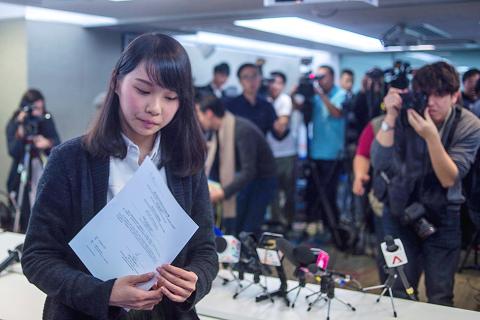
Photo: AFP
The emergence of campaigners calling for independence for Hong Kong since the failure of the “Umbrella movement” to win reform has incensed Beijing, and Chinese President Xi Jinping (習近平) has made it clear that he will not tolerate any challenge to Chinese sovereignty.
The pro-Beijing Hong Kong government has previously barred independence activists from standing for office, but Chow’s ban is the first against a more moderate campaigner.
She had been hoping to stand in by-elections in March, which were triggered by the disqualification from the Hong Kong Legislative Council of six lawmakers who protested while taking their oaths of office in 2016.
“Self-determination or changing the Hong Kong Special Administrative Region [HKSAR] system by referendum, which includes the choice of independence, is inconsistent with the constitutional and legal status of [the] HKSAR,” the government said.
It added that someone who “advocates or promotes” self-determination or independence cannot uphold the Basic Law, the territory’s mini-constitution.
Chow is a member of Demosisto, a political party cofounded by leading democracy campaigner Joshua Wong (黃之鋒), who is currently on bail after being jailed for his role in the 2014 rallies.
Demosisto does not campaign for independence, but advocates self-determination and a referendum for Hong Kong people to decide how they want to be governed.
The ban on Chow has wide-scale implications for other similar activists who want to stand for office, including Wong.
Demosisto said it condemned what it called a political decision and a “purge” by the Chinese Communist Party.
“The government’s motivation is to eliminate the hopes of an entire generation of young people,” it said in a statement.
Chow said that Demosisto as a party does not advocate independence.
“But we believe Hong Kong people have the right to decide on our future and our lifestyle,” she told reporters.
The ban is also another setback for the pan-democratic camp, which is trying to win back the six seats it lost due to the disqualifications.
Losing those seats robbed it of the one-third minority vote needed to block important bills in the pro-Beijing legislature.
Rights group Human Rights Watch accused Beijing and Hong Kong authorities of “redoubling” efforts to undermine the already limited electoral rights of citizens.
“This is another act in Beijing’s play to chip away Hong Kong’s autonomy,” group senior researcher on China Maya Wang (王松蓮) said.

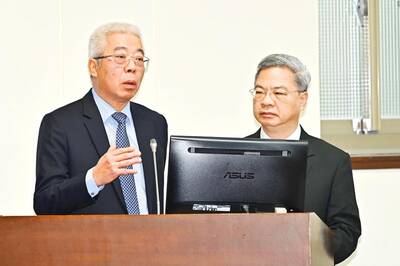
Taiwan has arranged for about 8 million barrels of crude oil, or about one-third of its monthly needs, to be shipped from the Red Sea this month to bypass the Strait of Hormuz and ease domestic supply pressures, CPC Corp, Taiwan (CPC, 台灣中油) said yesterday. The state-run oil company has worked with Middle Eastern suppliers to secure routes other than the Strait of Hormuz, through which about 20 percent of the world’s oil and liquefied natural gas typically passes, CPC chairman Fang Jeng-zen (方振仁) said at a meeting of the legislature’s Economics Committee in Taipei. Suppliers in Saudi Arabia have indicated they
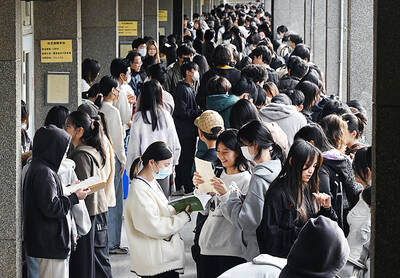
A global survey showed that 60 percent of Taiwanese had attained higher education, second only to Canada, the Ministry of the Interior said. Taiwan easily surpassed the global average of 43 percent and ranked ahead of major economies, including Japan, South Korea and the US, data from the Organisation for Economic Co-operation and Development (OECD) for 2024 showed. Taiwan has a high literacy rate, data released by the ministry showed. As of the end of last year, Taiwan had 20.617 million people aged 15 or older, accounting for 88.5 percent of the total population, with a literacy rate of 99.4 percent, the data

CCP ‘PAWN’? Beijing could use the KMT chairwoman’s visit to signal to the world that many people in Taiwan support the ‘one China’ principle, an academic said Chinese Nationalist Party (KMT) Chairwoman Cheng Li-wun (鄭麗文) yesterday arrived in China for a “peace” mission and potential meeting with Chinese President Xi Jinping (習近平), while a Taiwanese minister detailed the number of Chinese warships currently deployed around the nation. Cheng is visiting at a time of increased Chinese military pressure on Taiwan, as the opposition-dominated Legislative Yuan stalls a government plan for US$40 billion in extra defense spending. Speaking to reporters before going to the airport, Cheng said she was going on a “historic journey for peace,” but added that some people felt uneasy about her trip. “If you truly love Taiwan,

NEW LOW: The council in 2024 based predictions on a pessimistic estimate for the nation’s total fertility rate of 0.84, but last year that rate was 0.69, 17 percent lower An expected National Development Council (NDC) report expects the nation’s population to drop below 12 million by 2065, with the old-age dependency ratio to top 100 percent sooner than 2070, sources said yesterday. The council is slated to release its latest population projections in August, using an ultra-low fertility model, the sources said. The previous report projected that Taiwan’s population would fall to 14.37 million by 2070, but based on a new estimate of the total fertility rate (TFR) — the average number of children born to a woman over her lifetime — the population is expected to reach 12 million by


 RSS
RSS